 Posted by
The Holy Inquisition went after heretics above all, not just witches, and used torture to obtain confessions. Here are the main instruments and torments attributed to the Middle Ages, grouped by category: water, animals, rope, fire, mutilation, piercing, crushing and deprivation. Be careful, though: many were used by secular courts, and some, like the Iron Maiden, are 19th-century fakes.
When we think of medieval torture, our minds go to the torture of witches. However, the Holy Inquisition did not only focus on witches and warlocks, but also (and above all) on anyone considered a heretic. This often included scholars, writers and scientists in general, guilty of preaching something different from what the Bible said.
“But once these people were arrested, how were they forced to confess to crimes they never committed?”
With the tortures they were subjected to. In this the Holy Inquisition was very well prepared and kept using new and ever more efficient means to get the results it wanted. In this article I will describe all the main medieval torture instruments.
Medieval instruments and tortures
For convenience I will divide the tortures and instruments into several categories:
- with water
- with animals
- with rope
- with fire
- by mutilation
- by piercing
- by crushing
- other
Medieval water tortures

The water torture
Water tortures were relatively simple to carry out. The simplest method of all was to force the victim to drink huge amounts of water. This alone caused severe pain, and on top of that the torturers sometimes tapped on the water-filled abdomen, causing even more pain.
The ducking stool
The ducking stool was not a very cruel torture and was mostly meant to humiliate the victim. Reserved almost exclusively for women, it consisted of dunking a stool, with the victim tied to it, into a river. Sometimes victims were dunked into ponds of foul water instead. Although it was not a very harsh torture, some women, often elderly, died of the shock.
The cold water ordeal
The cold water ordeal was a torture, but also a way to prove a victim’s innocence or guilt. The victim was thrown, tied up, into a river. If they floated, it meant God had rejected them, so they were guilty. If they sank, they were innocent. The accused was usually tied to a rope precisely so they could be pulled out, but those who sank were often not pulled out in time and drowned.
Medieval tortures with animals

The rat torture
Among the animals most used for torture were rats. They could be inserted into the victim’s anus or vagina, and the openings were then sewn shut. The panicking animal bit and gnawed at the victim from the inside.
Other times they were placed on the victim’s belly and enclosed by a bottomless cage. Feeling trapped, the rats tried to escape by eating the victim’s flesh. Other times still, prisoners were put in dark, damp rooms into which hundreds of rats were then released. They ate the victim, horribly mutilating them.
Insect torture
Insects could also be used to torture. The simplest method was to tie the victim up and cover them in honey. Then they were left outdoors, where ants and bees would bite and sting them. Other times wasps or other insects were put in a glass, which was then turned upside down on the victim’s navel so the insects would sting them over and over. A torture based entirely on insects is scaphism.
Animal torture
This torture consisted of putting animals, usually cats or snakes, into a sack. The sack was then put over the victim’s head and closed, letting the beasts disfigure them. A similar punishment, used in Ancient Rome, was the penalty of the sack. It was reserved for parricides: the victim was sewn into a watertight sack together with various animals and then thrown into the river. The animals were so ferocious that the victim often reached the water already dead.
The goat’s tongue
Put like this it does not sound like much of a torture. Instead it could be truly painful. The victim was tied up and their feet locked in stocks. Then the soles of the feet were smeared with lard and salt, and a goat that had been starved for days was released. The goat, an animal that loves salt, began to lick the victim’s feet.
At first it only tickled (which still counts as torture), but then its rough tongue began to remove the layers of skin. Needless to say, this caused extreme pain. It is also said that in some cases the goat could lick all the way down to the muscles and bones.
Medieval rope tortures
Rope was also an easy instrument to find, and many tortures were based on it.
The strappado
This torture was usually the first one used to try to make the accused confess. Their arms were tied behind their back and attached to a rope. The rope ran through a pulley a few metres above the floor, and a torturer, working it, could lift the victim. Lifting them caused severe pain in the shoulders, and letting them fall and then stopping them abruptly could dislocate both shoulders.
The rack
Ropes were also used to stretch the victim’s body while they lay on a board. The board had ropes that were tied to the victim’s wrists and ankles. They were then tightened with winches, stretching the body and dislocating the joints.
Another method was to tie the victim’s wrists with a thin cord and then tighten it more and more. This first caused loss of feeling in the limb, then abrasions, and finally the cord cut into the flesh, causing serious damage.
The Judas cradle and the Spanish donkey
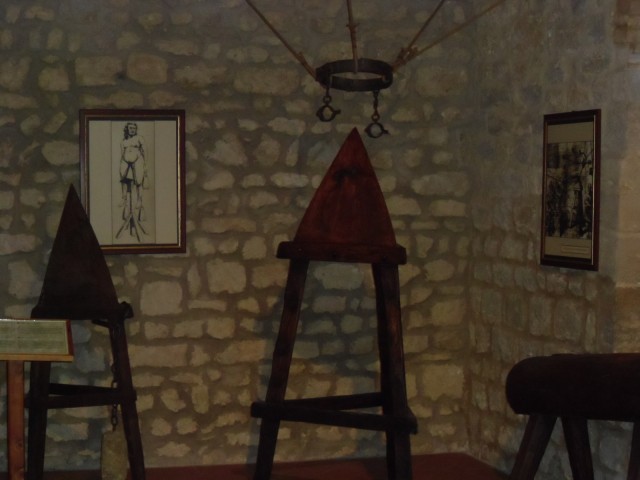
The Judas cradle and the Spanish donkey are very similar. The first is a stool with a pyramid-shaped seat, the second a trestle with a sharp triangular top. The victim was held up in mid-air with ropes, using a system of pulleys. Then they were guided and violently lowered onto the Judas cradle or the donkey. This caused severe pain and tearing in the genital area.
Another variant was to seat the victims on top of the two instruments and tie weights to their feet, so that the points of the devices sank into the flesh.
The witch’s cradle
The witch’s cradle has little to do with the Judas cradle. In this punishment the victim was closed in a sack and then tied to the branch of a tree. They were then swung back and forth for many hours on end. It may seem a mild punishment, but it caused disorientation and pushed the prisoner to confess. Sometimes victims were so disoriented that they had hallucinations.
Medieval fire tortures
The stake
The fire torture par excellence is the stake. Used above all on heretics and witches, this torture and death penalty meant the victim was burned alive. If they were lucky enough, the executioner drugged them before the execution, dulling their senses so they would not feel too much pain. Other times they went to the stake fully conscious.
In a mass execution, with a large fire, there was a good chance they would die of asphyxiation rather than burns. But if the pyre was for one person only, they would suffer a great deal before death came.
The fire ordeal
The fire ordeal, like the water one, was technically a test. If the accused passed it, they were innocent. Unfortunately fire ordeals were impossible tests, such as plunging an arm into a cauldron of boiling water without getting burned, or walking a set distance holding a red-hot iron bar.
The crucible and the witch’s candle
The crucible was a torture in which molten lead was poured into the victim’s orifices. Usually it was poured into the ears and mouth, other times straight into the stomach. This caused severe burns or, in the worst cases, death.
The witch’s candle, instead, was a candle placed upright in the victim’s mouth and then lit. As it melted it caused severe burns to the face, partly because candles back then were made of tallow, that is animal fat, which drips heavily.
Burning the feet
Once again the feet are the protagonists of this torture. In some cases they were coated with flammable substances and set alight, causing severe burns.
Medieval mutilation tortures
Many tortures involved mutilating the victim’s body. To do this the inquisitors used specific tools.
The turcas
These were pincers of various shapes and sizes with two purposes. They could be used to crush the victim’s fingers, deforming them completely, or to tear out the prisoners’ nails. Usually, after the turcas, the torturers tormented the crushed or nailless fingertips with small sticks pushed into the raw flesh.
The breast ripper
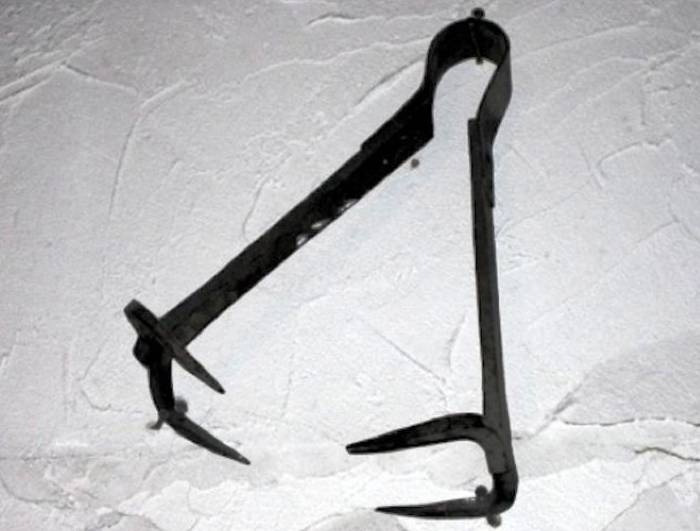
As the name says, this tool was used to tear the flesh from the victims’ breasts. Sometimes the whole breast was torn off. It is also known as the “tarantula” or the “Spanish spider”.
The cat’s paw
The cat’s paw was an iron tool used in a way similar to the breast ripper. It was driven into the victim’s flesh and then pulled to tear away skin and muscle. Used on the abdomen it could kill the victim by disembowelling them.
The pear
The pear is one of the best-known torture instruments of the Inquisition. Closed, it looks like a pear, but it opens by means of an internal screw. The pear was inserted, closed, into the victim’s orifices: mouth, vagina or anus. Then it was opened with the screw, forcing the internal tissues or the mouth until it caused very serious damage.
There is a problem, though: no document from the period describes the use of the pear as a torture instrument. The examples we see in museums almost all date from the 17th century or later, and some historians think they were simple tools (or collectors’ items) that were only later given this function.
The wheel
The wheel was an instrument similar to a cart wheel: round, with spokes inside. The person was tied to the spokes so that the limbs lay across the empty spaces. Then victims were struck with clubs until their limbs broke. Once the torment was over, the victim’s arms and legs were cut off and they were beheaded.
Sometimes the prisoner was tied to the outside of the wheel and struck with a club, or the wheel was rolled, crushing them.
The saw
Rebels, especially soldiers, were sawn alive. At first they were sawn at the waist, but then the method changed. Prisoners were hung upside down and sawn starting from the genitals. This way blood flowed to the head, keeping the brain supplied with oxygen and preventing the victim from fainting or bleeding out too soon.
Hair knotting
Knotting was used mainly on women or on anyone with long hair. The hair was knotted to a stick, which was then twisted to pull it. If the confession was not satisfactory, the executioner could twist so hard that the victim was scalped.
Medieval piercing tortures
The Iron Maiden of Nuremberg
Also known as the Iron Maiden, this device was a kind of cabinet with a vaguely human shape. The door had long iron spikes, and when the victim was shut inside they pierced the body. The spikes were placed strategically so as not to hit vital organs, thus prolonging the agony.
It is said that this instrument was found in the dungeons of the castle of Erzsébet Báthory. In reality the Iron Maiden is almost certainly a fake: there is no evidence it ever existed in the Middle Ages. Its “story” was born at the end of the 18th century with the writer Johann Philipp Siebenkees, and the examples displayed in museums were assembled in the 19th century, often by putting together pieces from different periods. The link to Erzsébet Báthory is also part of the legend.
The witch’s chair
The witch’s chair was a chair covered in spikes over its whole surface. The spikes were not very long, and simply sitting on the chair did not cause pain, because the body’s weight was spread evenly over the short, closely spaced spikes.
It did cause serious damage, however, when the victim was tied to the chair and their wrists and ankles were pressed hard against it. That way the spikes went into the flesh. The metal chair was hollow and a brazier could be placed underneath to heat it, burning the victim and helping the spikes sink further into the body.
Impalement
Impalement too was sometimes used to execute heretics. There were various techniques: longitudinal, transverse, with hooks. To see each technique in detail, read the article on impalement.
The heretic’s fork
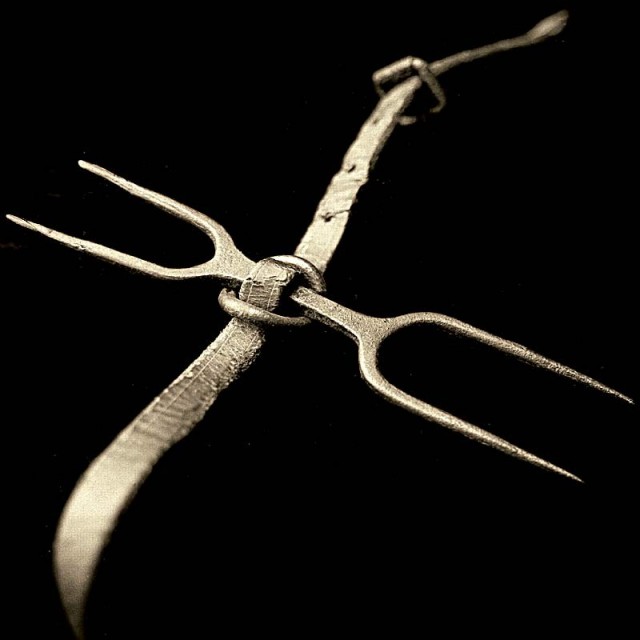
The fork was an instrument that looked like a fork with two prongs at each end. It was placed under the victim’s chin so that one end touched the chin and the other the breastbone. This way prisoners could not rest their head and were forced into a very uncomfortable position. When the muscles gave way, the fork pierced the throat or the chest.
Medieval crushing tortures
Peine forte et dure
Known by its French name “peine forte et dure”, it consisted of crushing the victim. They were tied up and laid on the ground, and a board was placed on their belly. Weights or stones were then piled on the board to slowly crush the victim, who died of suffocation or crushing. Sometimes executioners placed sharp stones under the victim’s back to break it, so that the prisoner would feel less pain.
This technique was also used to make defendants confess. Instead of a deadly weight, they used weights that caused pain but not death, and the treatment was repeated for as many days as it took to get a confession. Peine forte et dure was still in use in the 1700s.
The head crusher
This instrument was a kind of metal helmet attached to two rods at the ends. Under the helmet was a bar on which the victim’s chin rested. The helmet was then put on the head and gradually lowered, shattering the skull.
The skull-splitting rings
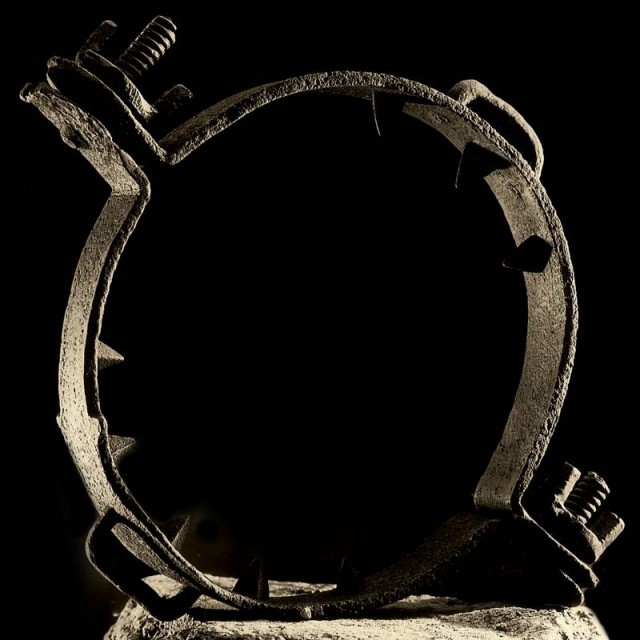
The skull-splitting rings were rings with spikes on the inside that were fitted around the victim’s skull. They were then tightened with a screw, driving the spikes into the skin and bone. The pressure was so strong that the eyes burst out of their sockets and brain matter came out of the nose. Then the top of the skull came away.
The knee splitter
This tool served, as the name suggests, to crush and shatter the victim’s knees. It was a vice with spikes on both inner sides and was applied to both arms and legs, but above all to elbows and knees. The spikes went into the joints, damaging them permanently and causing severe pain.
The thumbscrew
What this instrument did is easy to guess too. It is also a vice, though smaller than the knee splitter, and it was used to crush and shatter thumbs and finger joints.
The iron boot
This was an iron boot wide enough to hold both legs. Wooden wedges were driven between the legs until they pressed against the sides of the boot, sometimes until they broke. An alternative use of the iron boot was to heat it red-hot while the victim’s feet were inside.
Medieval deprivation tortures
Finally, some tortures involved depriving the victim of food, water or sleep.
Deprivation of food and water could be carried out in an ordinary prison cell or inside hanging cages. The victim was put in a hanging cage that was often too small to stand up in and too narrow to sit down. Then they were abandoned there without food or water until they died.
Other times sleep deprivation was used, immobilising the victim’s feet so they had to hold an uncomfortable, painful position, or drenching them often with cold water. This could lead to physical and mental breakdown and even death.
But did the Inquisition really use all these instruments?
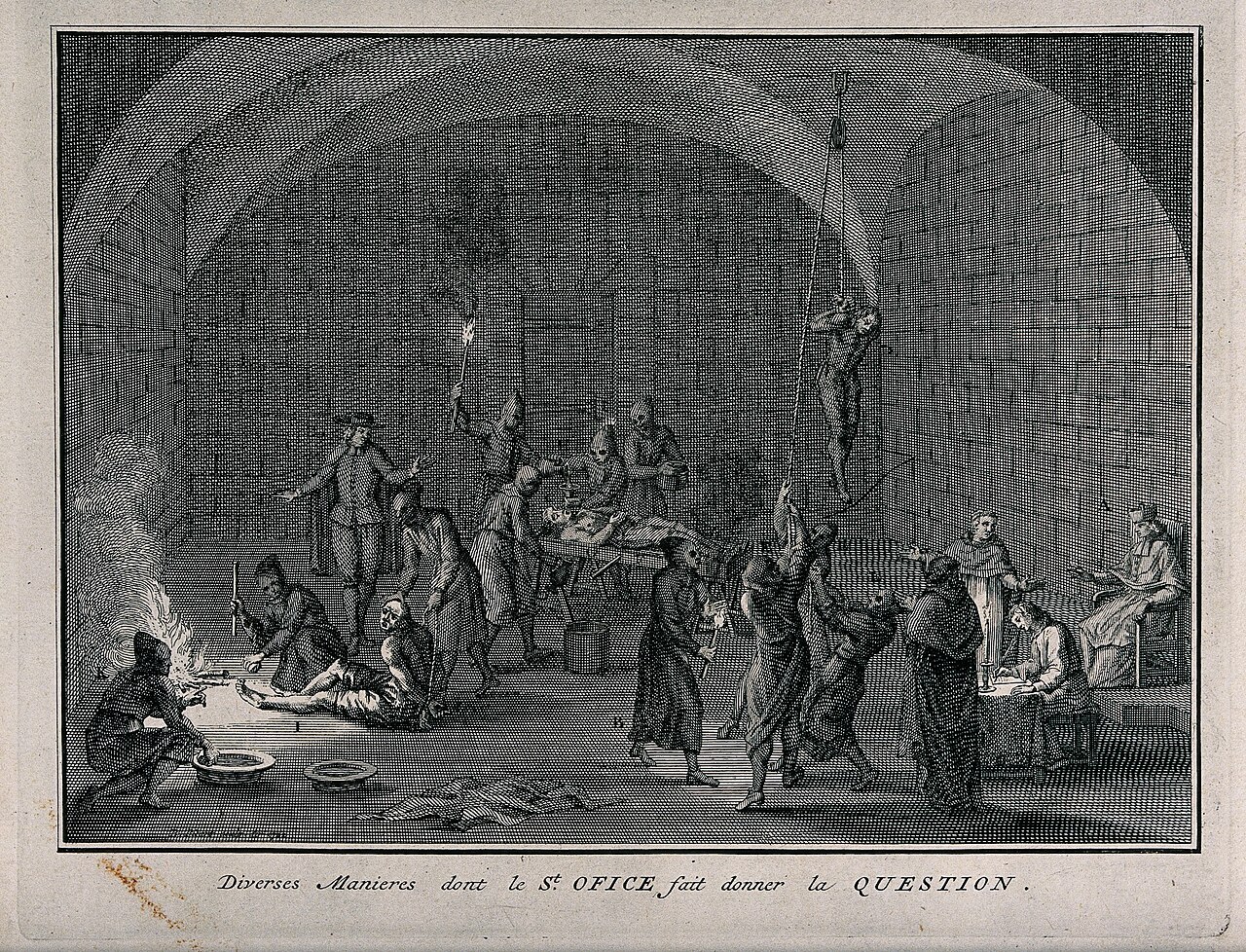
Before saying goodbye there is one thing you need to know. Many of the instruments on this list were used mostly by secular courts, that is ordinary justice, and not by the Inquisition. And some, like the Iron Maiden and perhaps the pear, are more legend than history.
The Inquisition certainly did use torture, but according to precise rules written in its manuals: in theory no blood was to be shed and the life of the accused was not to be put at risk, the session had a limited duration and the confession then had to be confirmed “in cold blood”. The most used methods were three: the rope (strappado), the rack and the water torture.
This obviously does not mean that the rules were always respected, nor that those sessions were any less terrible for the people who suffered them.
I hope you enjoyed this article! If you did, how about leaving a like and sharing it? You would do me a huge favour! To discover tortures even older than the medieval ones, read the dedicated article!
🦋 Emadion lives through its readers. If this story kept you up at night, buy me a coffee: it helps me bring you the next nightmare.
☕ Support Emadion on Ko-fi