 Posted by
Death by burning is a very ancient penalty, already found in the Code of Hammurabi and the Bible. In Rome there was the tunica molesta, and Nero burned Christians as human torches. In the Middle Ages and the early modern period it was used against heretics, witches and converted Jews: among the most famous victims are Jan Hus in 1415, Joan of Arc in 1431 and Giordano Bruno in 1600.
When you think about death by burning, your mind probably goes straight to the witch hunts of the 1500s and 1600s. Am I right? But you should know that death by burning was already in the Code of Hammurabi, the famous Babylonian king, around 1800 BC.
Capital execution of death by burning
There weren’t many variants of burning at the stake. Essentially, the only difference was the intensity of the fire:
- High fire: when many people were condemned at the same time, the fire was bigger and victims more often died of asphyxiation from the smoke, rather than from burns.
- Low fire: when a single person was executed, the fire could be kept low, and dying took much longer. In this case death came from excessive loss of fluids caused by the burns, heart failure from the heat or decomposition of vital organs due to heat.
There is evidence of the use of burning at the stake as capital punishment in Babylon and ancient Egypt as early as 1900 B.C. and 1800 B.C., but also in the Assyrian and Jewish tradition.
The Code of Hammurabi, for example, condemned to the flames anyone caught looting a house that was on fire: the thief was thrown into the same fire. The same fate awaited a priestess who opened a tavern or went into one to drink, and a man who slept with his own mother after his father’s death.
The Bible prescribes burning too. In Leviticus it is the penalty for a man who marries both a woman and her mother, and for a priest’s daughter who becomes a prostitute. In Egypt, an inscription records that Prince Osorkon burned several rebels alive during a civil war in the 9th century BC.
Burning in Ancient Rome
Even in ancient Rome the burning at the stake was used as capital punishment and sometimes the Tunica Molesta was used.
This practice required the condemned man to be tied to a pole wearing a tunic smeared with pitch. Once he was bound, the executioners would pour burning resin or grease on his face, and to make sure that the victim would not lower his head, nails were placed under his chin.
The tunic was then set alight, starting the fire directly on the skin of the condemned.
This method was often used also to execute Christian martyrs.
The most famous episode is recorded by the historian Tacitus. After the Great Fire of Rome in 64 AD, Emperor Nero blamed the Christians and had them executed in horrific ways: some were torn apart by dogs, some crucified, others covered in flammable material and set alight at night in his gardens, to serve as human torches.
The stake and the witches
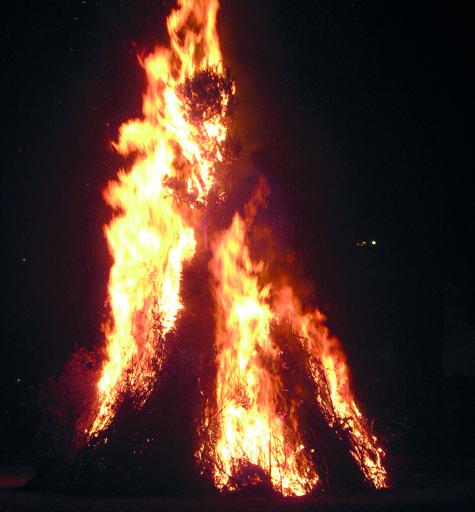
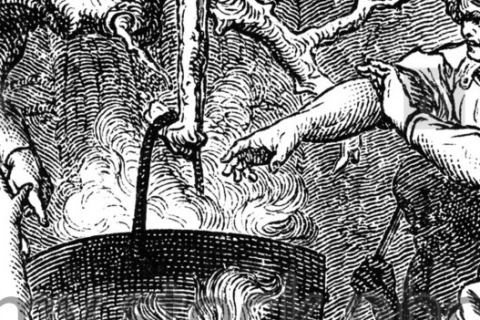
In the Middle Ages, burning at the stake was widely used for witches and heretics.
And not only them: in Spain, Muslims and Jews who refused to convert to Christianity were burned, or those who had done so but did not convince the Inquisition.
The first recorded auto-da-fé was held in Seville in February 1481: six conversos, Jews who had converted and were accused of secretly practising their old faith, were burned alive. In the months that followed, hundreds more went to the stake in the same city.
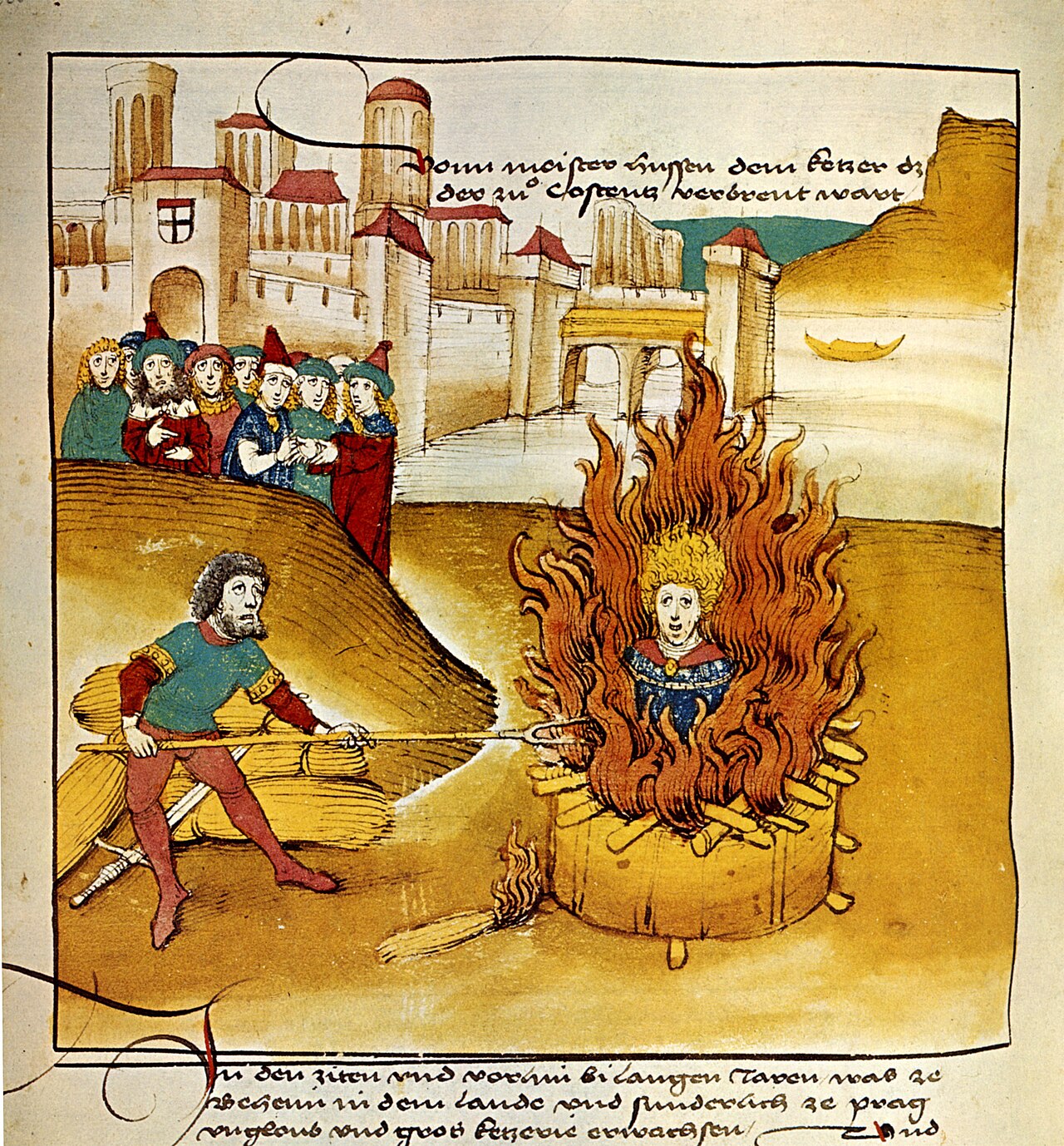
One of the most famous burnings in European history is that of the Czech theologian Jan Hus, burned at Constance on 6 July 1415. He had come to the Council with a safe-conduct from the Emperor, convinced he could defend his ideas. He was arrested, tried for heresy and sent to the stake. His ashes were thrown into the Rhine so his followers could not keep them as relics.
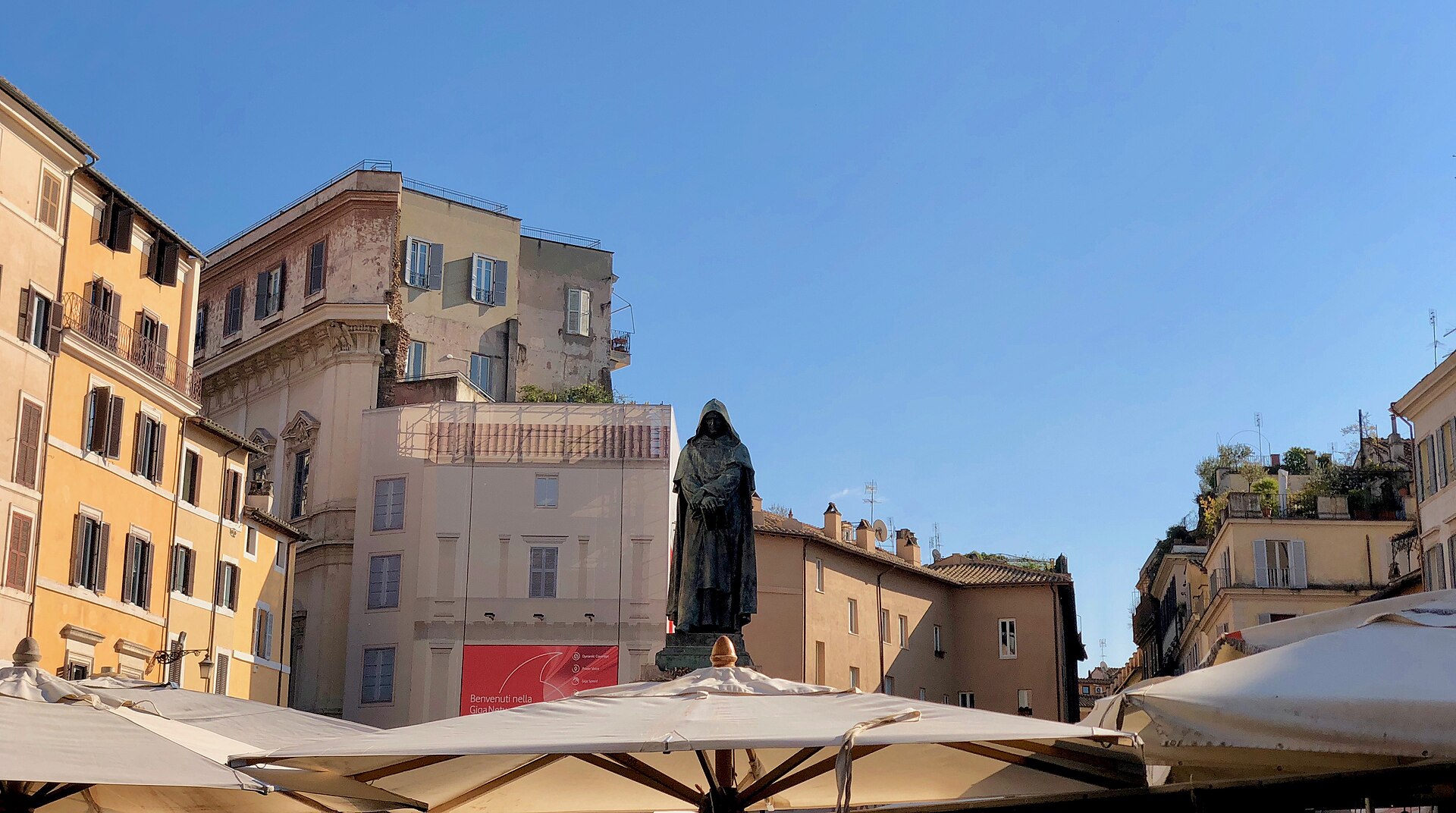
In Italy, on 17 February 1600, the philosopher Giordano Bruno was burned alive in Rome’s Campo de’ Fiori, condemned by the Inquisition after an eight-year trial. According to the chronicles he was led to the stake with his tongue clamped so he could not speak to the crowd. Today his statue stands on the exact spot where he died, hood drawn over his face, turned towards the Vatican.
One of the most famous sentences for heresy is that of Joan of Arc. According to the accounts we have, she was burned alone, and the executioners did not grant her the mercy, as sometimes happened, of making her lose consciousness or strangling her before the fire.
So the Maid of Orléans was burned alive at 19, feeling all the pain of the flames licking her body and screaming in the fire until she died.
It was 30 May 1431, in the Old Market Square in Rouen. According to witnesses, Joan asked for a cross, which an English soldier made for her out of two pieces of wood, and as the flames rose she kept calling on the name of Jesus. After she died, the executioner raked back the embers to show the crowd her charred body, proving she had not escaped. Then he burned her again, and her ashes were thrown into the Seine.
The executioner’s “mercy”
As you’ve seen with Joan of Arc, the condemned were not always burned alive and conscious. In many cases the executioner strangled them with a cord just before lighting the fire, or let them suffocate in the smoke. It was a form of “mercy” that could sometimes be granted, or bought.
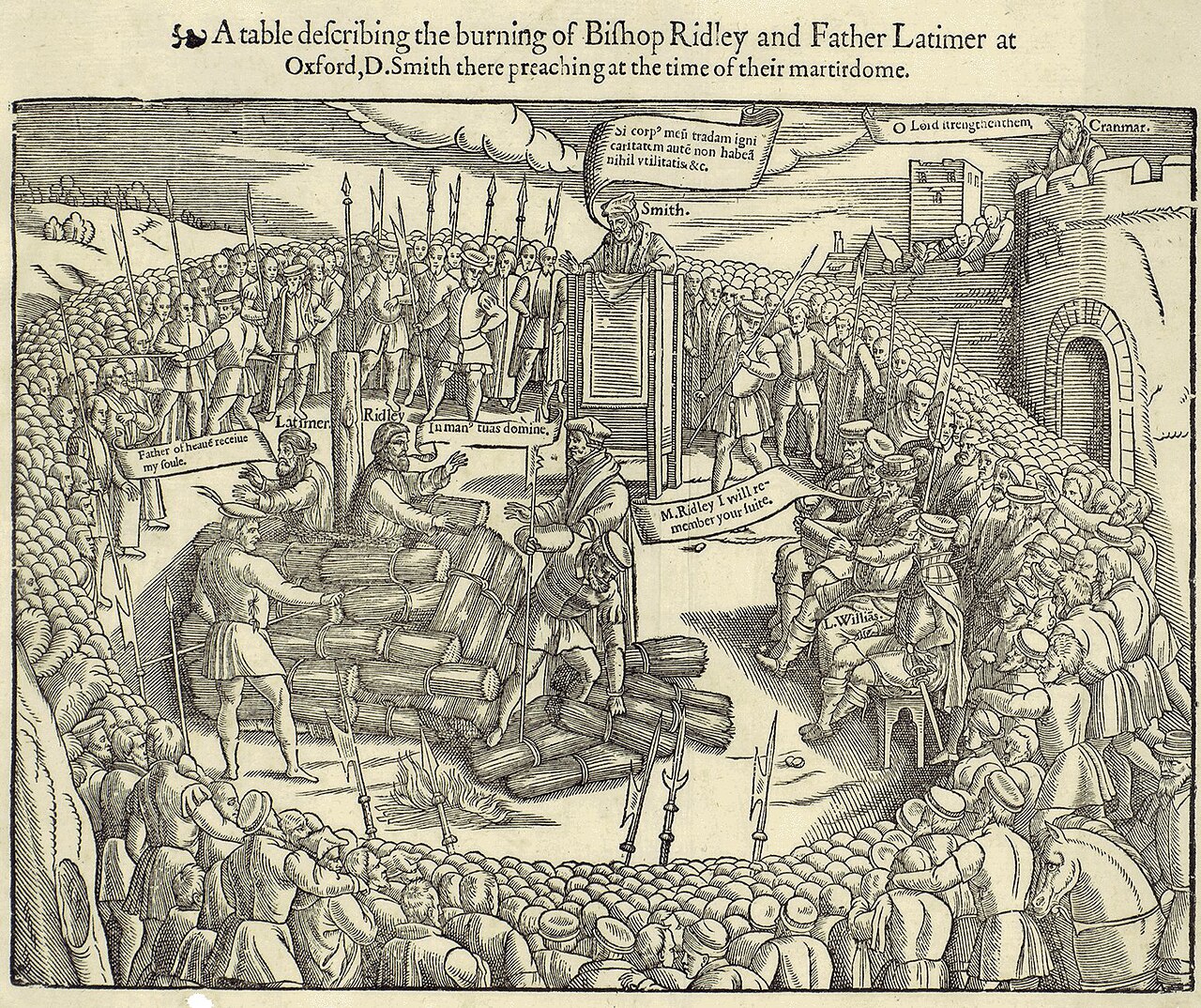
In England another method was used: a bag of gunpowder tied around the prisoner’s neck, which exploded and killed them quickly. The most famous case is that of the Protestant bishops Hugh Latimer and Nicholas Ridley, burned together at Oxford on 16 October 1555 under Queen Mary I, “Bloody Mary”. Latimer died almost at once. Ridley’s fire had been badly built: it burned only from the waist down, and the bishop suffered for a long time, begging the flames to reach him, until the gunpowder finally went off.
Also in England, until the late 18th century, burning was the penalty for women who killed their husbands, a crime treated as a form of treason. They were usually strangled first, but not always: in 1726 Catherine Hayes, convicted of murdering her husband, was burned alive because the flames reached the executioner before he could strangle her.
In Germany, the last sentence of death at the stake was handed down in 1835, but it was probably never carried out. The last person burned alive in Germany was Johannes Thomas, in 1804, convicted of arson.
🦋 Emadion lives through its readers. If this story kept you up at night, buy me a coffee: it helps me bring you the next nightmare.
☕ Support Emadion on Ko-fiSources
- Death by burning, Wikipedia
- Tacitus, Annals, book XV