 Posted by
Crucifixion was used by the Persians, Phoenicians and Carthaginians and became the symbolic punishment of Rome, reserved for slaves, rebels and pirates: in 71 BC Crassus had six thousand of Spartacus’s followers crucified along the Via Appia. Death could take days, from asphyxia or blood loss. It was abolished by Constantine in the 4th century. Archaeological evidence is extremely rare.
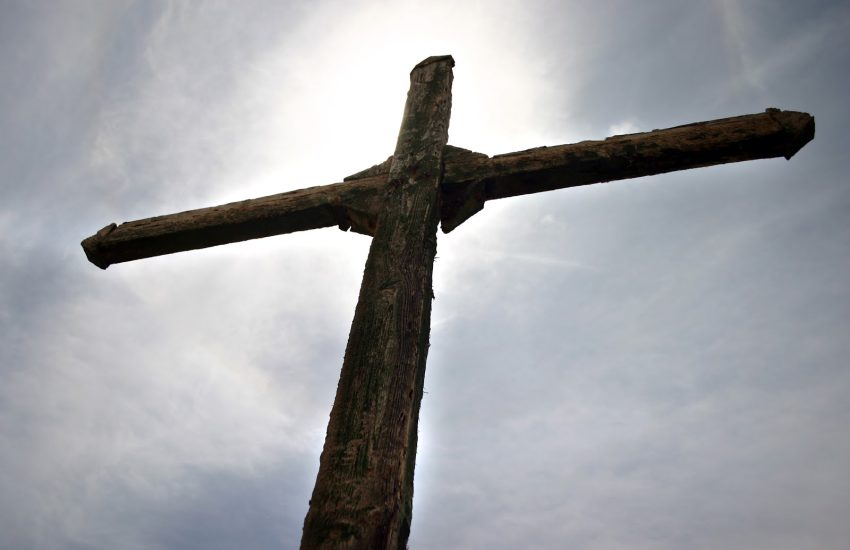
The crucifixion was a widely used method of execution in ancient times, and it is definitely one of the most painful ones especially because death, with this method, can occur even after several days. Crucifixion came in many variations, starting from the shape of the cross.
This method of execution was widely used in antiquity, but unfortunately sometimes it is still used in some countries today.
A bit of history
Crucifixion was already used by the Persians, as the Greek historian Herodotus tells us, and it was also practised by the Phoenicians and Carthaginians. After capturing the city of Tyre in 332 BC, Alexander the Great, according to the historian Curtius Rufus, had two thousand of its inhabitants crucified along the coast.
But it was the Romans who made it the signature punishment of their empire. It was reserved for slaves, rebels, pirates and the worst criminals: as a rule, a Roman citizen could not be crucified. The most terrifying example comes from the revolt of Spartacus. In 71 BC, after the rebel slaves were defeated, the general Crassus had six thousand prisoners crucified along the Appian Way, from Capua all the way to Rome. Anyone travelling that road walked for some two hundred kilometres between crosses.
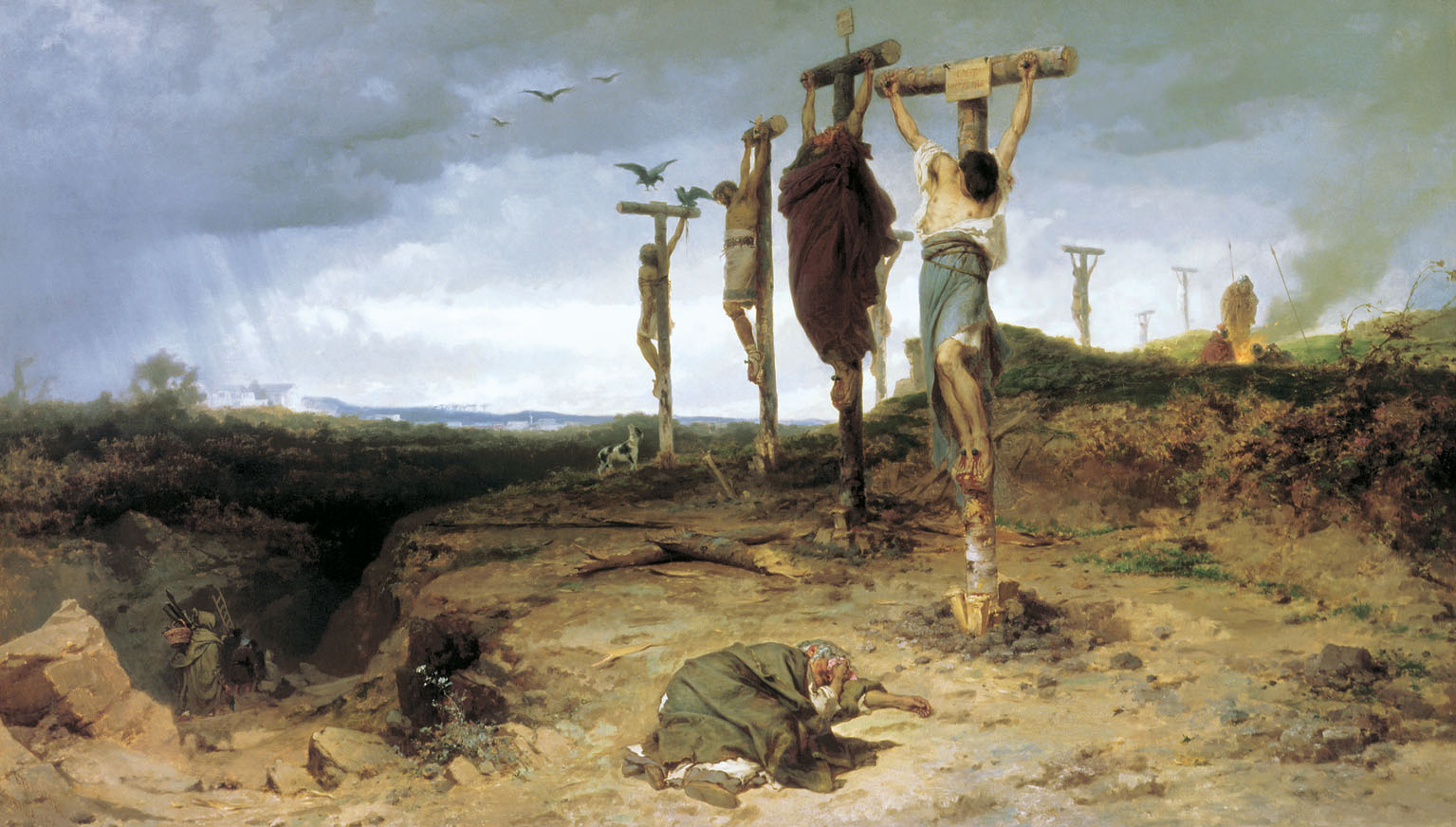
Crucifixion was abolished in the Roman Empire by Constantine, the first Christian emperor, in the 4th century, out of reverence for the death of Jesus.
Methods of execution by crucifixion
Crucifixion is a terrible method of execution. The pain is excruciating, and that was the reason why it was used: as a deterrent.
To see a person on a cross dying of starvation in awful pain that can last for days, it may make viewers think twice before committing a crime themselves.
In addition to being very painful, crucifixion was also humiliating as victims were crucified naked. Although paintings of that period depict victims with their private parts covered, this was not the case in reality.
The types of cross
There are many types of cross:
- The first is simply a pole stuck in the ground on which the condemned man was tied, with arms extended upward.
- Then there was the cross with two poles, one of which supported horizontally immediately above the vertical pole, forming a T cross.
- This horizontal pole could sometimes be placed just below the higher end of the vertical post, forming the cross we all know.
- Then there was the X-Cross
- And finally the Y-Cross
In the case of a cross with two poles, the condemned was often made to carry the shorter pole, the horizontal which could weigh up to 45 kilos (about 100 pounds), up to the place of execution. He was then placed on the smaller pole and only then hoisted on the vertical post.
Tortures on the cross
Once the condemned was put on the cross, with his hands and feet tied by a rope or nailed, he could be subjected to further torments.
One of the most common was to be impaled in the groin area. Others could simply include torments with spears and body cuts.
The Roman philosopher Seneca, in the 1st century, wrote that he had seen crosses of every kind: some victims hung head down, some pierced through their private parts, others with their arms stretched out on the crossbeam.
And the nails? For centuries people argued over whether they were really used or whether ropes were enough. Archaeology provides an answer: in 1968, in a 1st-century tomb in Jerusalem, archaeologists found the heel bone of a crucified man, Yehohanan, still pierced by an iron nail about eleven centimetres long. The nail had bent against a knot in the wood and could not be pulled out. In 2017 a similar find was made in England, at Fenstanton in Cambridgeshire: another heel bone with a nail driven through it, one of the very few physical traces of crucifixion ever found. Many scholars also believe the nails for the hands actually went through the wrists, because the palm alone could not have held the weight of the body.
How death by crucifixion came
As I mentioned before, a prisoner could survive for several days on the cross, before dying.
The survival could depend on several factors:
- The crucifixion method
- The prisoner’s health
- The environment (temperature)
Eventual death was caused by asphyxiation, hypovolemia (low blood volume) or pulmonary embolism.
When executioners wanted to prolong the pain, they made sure to put a support under the victim’s feet, to give him a foothold. In this way the body avoided to slide downwards, leading to asphyxiation and therefore to a “fast” death.
Then, when the executioners decided that the prisoner could die, they would shatter his leg bones with clubs to make the body fall, causing the asphyxiation. Other times instead his heart was pierced with a spear, or sometimes they lit a fire at the base of the cross and let him choke with smoke.
After death the body was left on the cross, so that the people would see him for a few days.
However, the crucifixion was not only in use in ancient Rome, but also in the Far East, such as Japan and the Middle East.
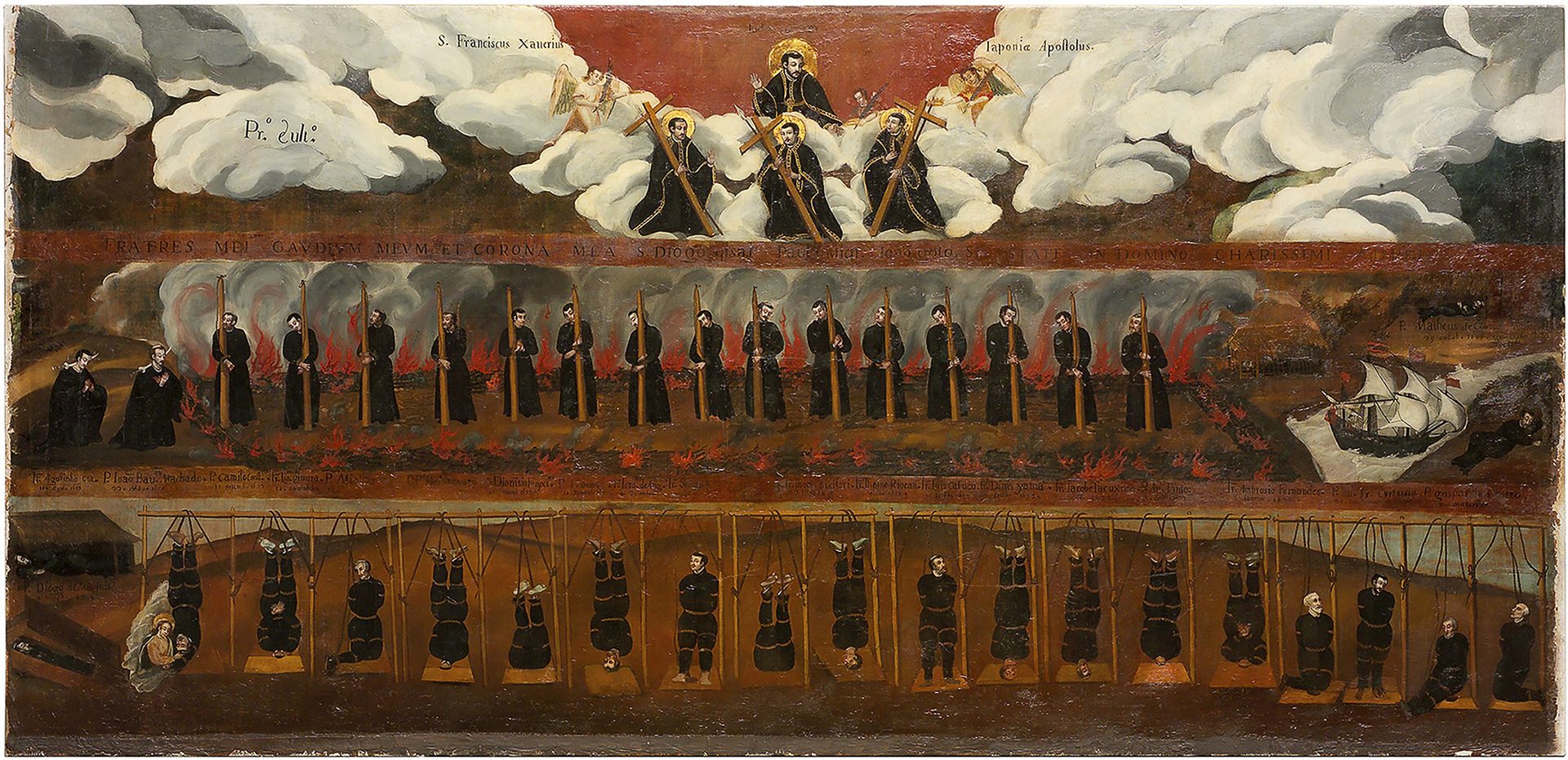
In Japan crucifixion, called haritsuke, was used mainly between the 16th and 19th centuries. The condemned was tied to a cross and then speared to death. The best-known episode is that of the 26 Martyrs of Nagasaki: on 5 February 1597, twenty-six Christians, including European missionaries and Japanese boys, were crucified on a hill above the city on the orders of Toyotomi Hideyoshi.
The crucifixion today
Unfortunately the crucifixion is still considered in some countries as a death penalty, though not used, and used in others. Some examples of countries where the crucifixion was used in the 2000s are:
- Myanmar
- Iraq
- Saudi Arabia
- Syria
- Ukraine (but beware: the story of a child crucified in Sloviansk, broadcast in 2014 by a Russian TV channel, later turned out to be false)
It is also legal in the United Arab Emirates, Iran and Sudan.
In Saudi Arabia, “crucifixion” almost always means publicly displaying the body of the condemned after beheading. In Syria and Iraq, between 2014 and 2017, Islamic State militants crucified a number of people, sometimes leaving the bodies on display for days in the squares of Raqqa.
🦋 Emadion lives through its readers. If this story kept you up at night, buy me a coffee: it helps me bring you the next nightmare.
☕ Support Emadion on Ko-fiSources
- Crucifixion, Wikipedia
- Seneca, Consolation to Marcia
- Appian, The Civil Wars, book I