 Posted by
China is famous for its tortures. The lingchi isn’t one of the most famous methods of execution, but it surely is one of the most terrible. The prisoner would be tied to a wooden post and cut in various parts of the body, which were then removed.
History of the death by a thousand cuts
Lingchi is better known as “death by a thousand cuts” and, as the name suggests, it was a method of torture and execution, used in China from around 900 AD, which involved making many cuts and removing flesh from the victim.
The term literally means “slow process” and it derives from an expression that indicates climbing a mountain slowly.
This torture method was used for those guilty of serious crimes such as treason, massacres and the killing of parents.
It could be inflicted on people who were alive, as a form of torture and capital punishment, but also on corpses as a sign of humiliation, and in both cases this occurred in public places.
Execution
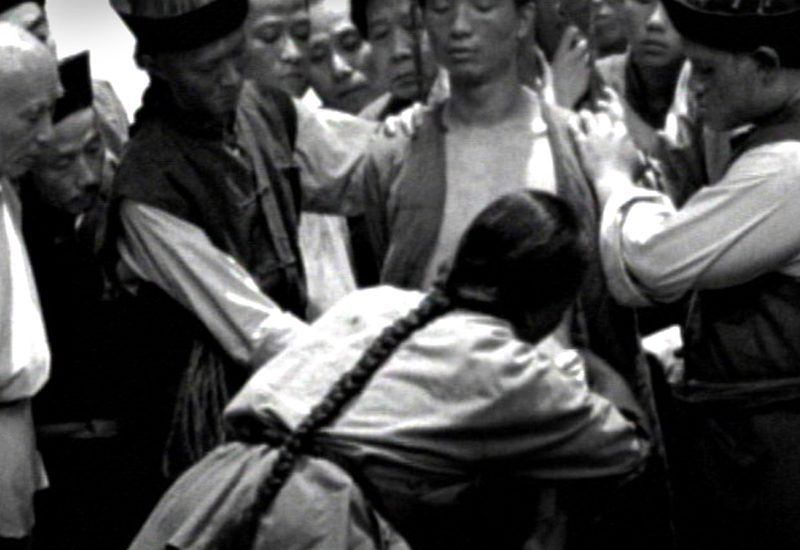
The victim was tied to a pole and the executioner proceeded inflicting numerous cuts and removing portions of flesh.
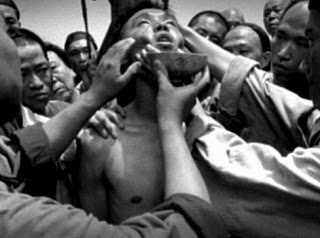
Sometimes the victim was given opium as an act of piety, to put them into a state of unconsciousness state.
Despite the name is “death by a thousand cuts” scholars believe that the cuts inflicted before the victim reached their death would have been far fewer, about a few dozen. This is because after this amount of wounds a victim would die.
From the literature we have regarding this topic, such torture did not last more than 15 or 20 minutes.
Lingchi, between legend and truth
 Lingchi is very often associated with China, but it has often been mythologized and described as worse than it actually was.
The common belief is that the victims, after being tied to a wooden pole, first had their eyes plucked out, then they had the nose, ears, fingers and genitals mutilated.
Subsequently large portions of flesh from the shoulders and thighs were removed.
The truth is that, according to what we have been told by travellers in China such as the Australian G. E. Morrison, this torture was inflicted post-mortem or, otherwise, after the victim had been drugged with a lot of opium.
Chinese chronicles, however, also record some terrifying exceptions. In 1510 the eunuch Liu Jin, the most powerful man at the Ming court, was accused of plotting against the emperor and sentenced to lingchi. According to accounts of the time the execution lasted three days, with more than three thousand cuts. In 1630 it was the turn of General Yuan Chonghuan, a military hero wrongly accused of treason: the Beijing crowd, convinced of his guilt, reportedly even bought pieces of his body. Only decades later was his innocence recognised, and today he is remembered in China as a patriot.
Abolished in 1905, it oddly became famous in the West only from 1910 onwards as a symbol of the death penalty in China.
Abolition came on 24 April 1905, thanks to a reform of the penal code pushed by the jurist Shen Jiaben, who considered lingchi a barbaric punishment unworthy of a modern state. A few days earlier, in Beijing, a man named Fou Tchou-li, convicted of murdering a Mongol prince, had been executed this way. Some French soldiers who were present took photographs, which in the following years circulated in Europe as postcards and helped make lingchi the symbol of “Chinese cruelty”. Decades later the French writer Georges Bataille published them in his book The Tears of Eros, making them even more notorious.
🦋 Emadion lives through its readers. If this story kept you up at night, buy me a coffee: it helps me bring you the next nightmare.
☕ Support Emadion on Ko-fiSources
- Lingchi, Wikipedia
- Timothy Brook, Jérôme Bourgon, Gregory Blue, Death by a Thousand Cuts, Harvard University Press, 2008