 Posted by
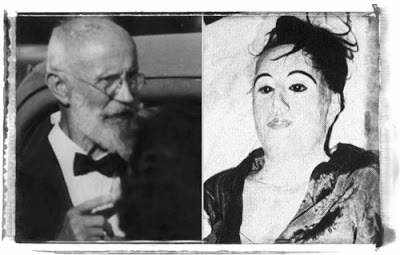
- Who: Carl Tanzler, or “Count Carl von Cosel” (Dresden, 1877 – Florida, 1952).
- Her: Elena “Helen” Milagro de Hoyos (1909-1931), a young Cuban-American woman who died of tuberculosis.
- What he did: in 1933 he stole her body from the Key West cemetery and lived with it for seven years.
- Aftermath: discovered in 1940, he was never convicted because the statute of limitations had expired.
Carl Tanzler was a German-born radiology technician, later a naturalised American, who fell in love with one of his patients affected by TB. After the girl’s death, Carl’s feelings for her did not change at all.
Biography
Carl Tanzler was born on 8 February 1877 in Dresden, Germany. As a child he said to have had a recurrent vision of his supposed ancestress, Countess Anna Constantia von Cosel, who showed him the face of his true love: an exotic, dark-haired woman.
As a young man he traveled first to India and then in Australia, where he was caught by the outbreak of the First World War.
In Australia British soldiers put him, along with other Germans, in a concentration camp. After the end of the war the prisoners were not allowed to return to their homes, instead they were sent to Holland where they would be released. There, Tänzler was freed and was reunited with his mother, with whom he lived for three years. In Australia, meanwhile, he had tried to escape from Trial Bay prison by secretly building a sailing boat.
Around 1920 he married Doris Schäfer and had two daughters, and in 1926, following his mother’s advice, he moved to the US, where his sister had already emigrated, travelling via Cuba. In America he called himself “Count Carl von Cosel”, like his supposed ancestor.
He settled with his family in Zephyrhills, Florida, and in 1927 he moved alone to Key West to work in a Navy hospital.
Maria Elena Milagro de Hoyos
On 22 April 1930, while working at the hospital in Key West, he met Maria Elena Milagro de Hoyos, known as Helen, a 20-year-old daughter of a local cigar maker, who was there with her mother to go through some examinations.
Helen, of Cuban origin, was recognized by Tänzler as the girl in the vision he had as a child and fell in love with her.
From the tests it turned out to be suffering from tuberculosis and Tänzler did his best to treat it.
During her hospital stay he also filled her with gifts, clothes and jewelry, but all its thoughtful care wasn’t enough and Helen died on 25 October 1931, aged just 22.
Tänzler paid the funeral and, after asking permission to the family, he built a mausoleum in Key West cemetery, where he began to go to visit his beloved one every night. Later he said that during those nights he saw the spirit of Helen who asked him to take her away from the grave.
So one night in April 1933, mad with love, he stole the body from the mausoleum and took it to his house.
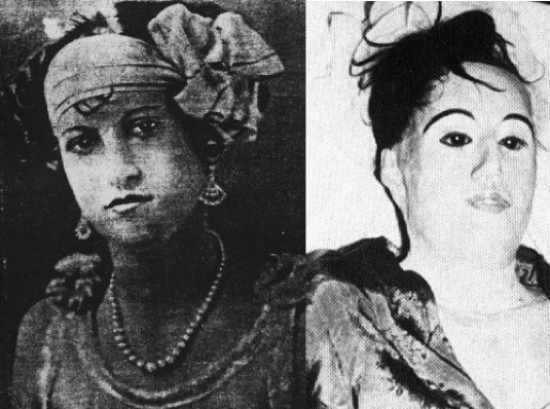
There, he cleaned it and disinfected it, joined the bones with piano wire and put glass eyes in the sockets. Since the body was already decomposing he replaced the skin with silk soaked in wax and plaster. He also built a mask with Helen’s features and painted it.
Then he made a wig using Helen’s hair that he had been given by her mother after her death and he placed it on the skull, thus completing his beloved one.
The discovery of the corpse
 The body remained with him for seven years until, in October 1940, one of Helen’s sisters, Florinda, began to hear voices claiming that Tänzler was living with her sister’s body.
When she went to his house to talk to him, she discovered the embalmed body of Helen and called the police.
Tänzler was arrested and was subjected to a psychiatric examination that proved him capable of discernment.
He was then put on trial for destroying a grave and taking away a dead body without permission. However, he was released because the offense had lapsed.
Immediately after the discovery, the body was examined by forensic doctors and then put on public display at a local funeral home, where some 6,800 people viewed it. Strangely, the public largely sided with Tanzler, seen as an eccentric “romantic”. It was later given back to the family that buried it in an unmarked grave, in order to avoid any more attention.
Allegations of Necrophilia
The case sparked a huge interest from the public and the press, and many details were disclosed.
Nevertheless one of these emerged only in 1972 when two doctors who had attended the 1940 autopsy claimed that there was a tube made of cardboard that would allow Tänzler to have sexual relations with Helen’s body.
These claims may now no longer be verified and it is unclear whether or not Tänzler was guilty of necrophilia.
What is certain is that after being separated from the body of his beloved one, Tänzler used a death mask to reproduce Helen’s face and he created an effigy.
The radiologist died on 3 July 1952, aged 75, and his body was found on the floor, behind one of his organs, only three weeks after his death.
Some insinuated that the effigy was actually the real body of Helen, which Tänzler had managed to get back again, but these claims have never been confirmed.
🦋 Emadion lives through its readers. If this story kept you up at night, buy me a coffee: it helps me bring you the next nightmare.
☕ Support Emadion on Ko-fi