 Posted by
Hanged, drawn and quartered describes a method of execution in force from 1351 to 1870 in England as a punishment for high treason, even though quartering was often practiced post-mortem as early as in the Middle Ages.
“Hanged, drawn and quartered” torture method
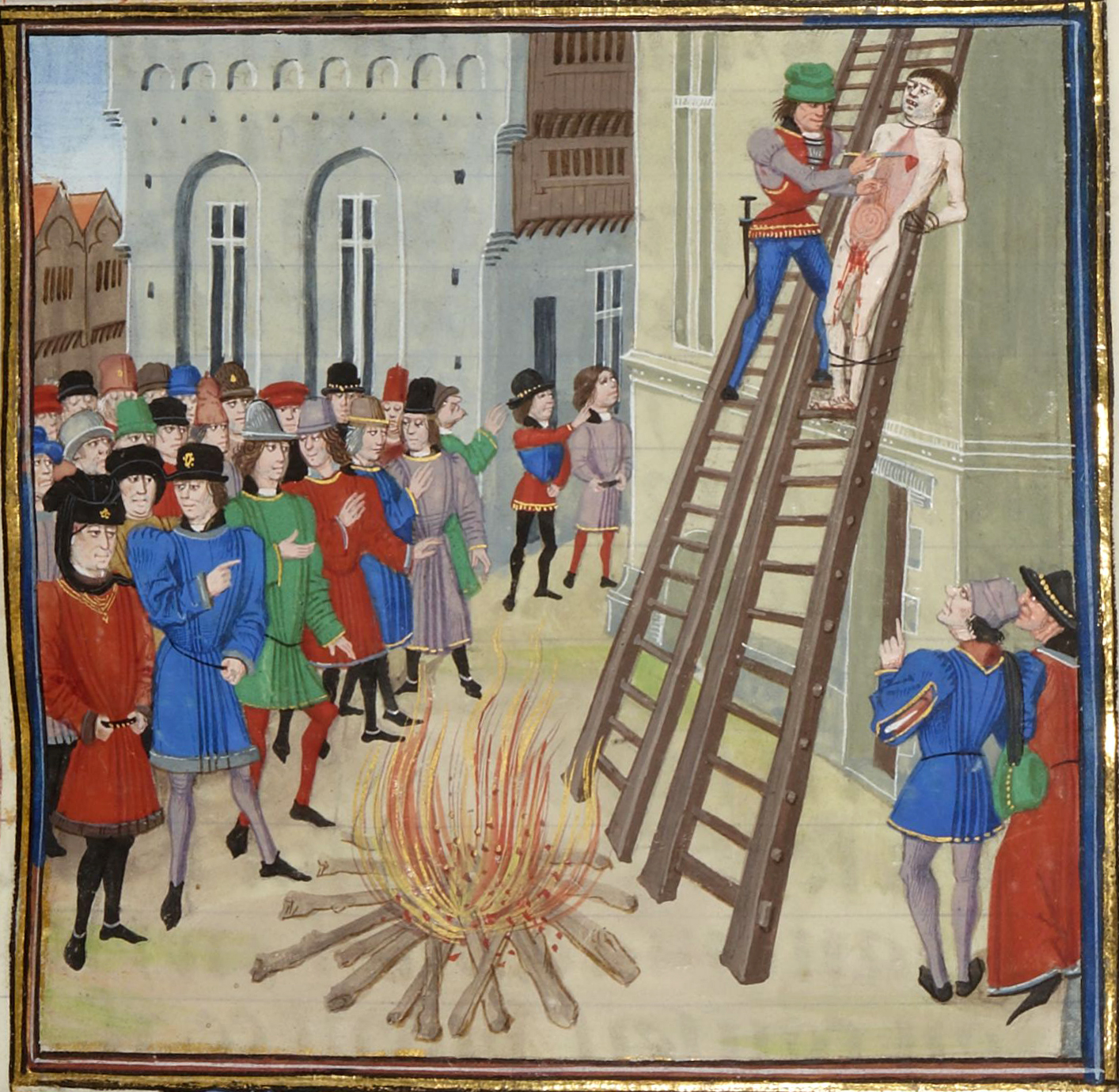
The prisoners were led to the gallows where they were stripped and hanged.
The executioner, however, made sure that the neck would not break and released the prisoner before death.
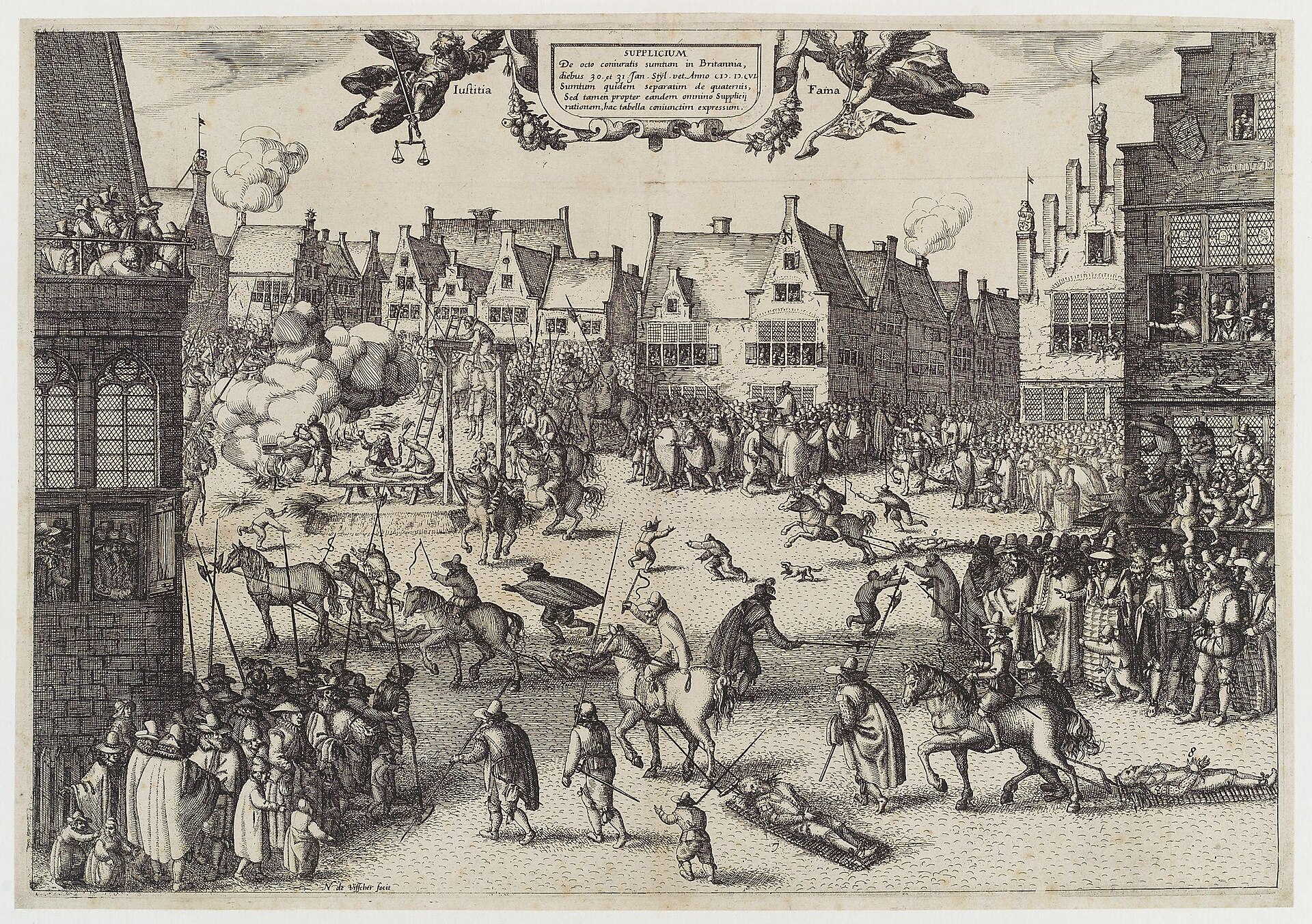
Initially they were brought to the gallows pulled by horses, but this greatly reduced the life of the victim and therefore it was decided to opt for another solution: the prisoners were tied to wooden carts attached to a horse, which dragged them to the gallows.
After being hanged, the victim was placed on a wooden table, with his hands tied behind his back, and emasculated.
The penis and testicles were cut off neatly, and while the person was still conscious, their belly was cut open and the intestines were extracted, which were then burnt together with the genitals right in front of the convicted.
At this point the prisoner was beheaded and his body was cut first into two and then into four parts. Each of the four parts was then exposed at the four corners of the city, as a deterrent, and the head was displayed on a spike, often on the gate of London Bridge.
But of course women could not be treated in the same way:
It would have been unseemly to show a naked woman in public! To solve this problem they would burn them alive on a stake.
This method of execution was aimed not only to cause immense pain, but also to denigrate the victim by depriving them of their dignity, by exposing them naked and by cutting off their genitals, but also to take away the status of “person” from them, as they got a worse treatment than that granted to animals that, usually, were killed before being quartered.
This technique of execution and torture was soon exported to the rest of Europe, but was never widely used.
The most famous victims
As early as 1283 the Welsh prince Dafydd ap Gruffydd suffered this fate. But the most famous early victim is the Scottish patriot William Wallace, executed in London in 1305: his head was displayed on London Bridge and the four parts of his body sent to different towns in the north as a warning. A few years later, in 1326, it was the turn of Hugh Despenser the Younger, the powerful favourite of King Edward II, executed in Hereford on an extremely high scaffold so that everyone could see.
In 1606 it was the turn of the Gunpowder Plot conspirators, who had tried to blow up Parliament. Guy Fawkes, by then broken by torture, at least managed to escape the worst part: according to the chronicles, on the scaffold he jumped or fell from the ladder and broke his neck, dying before he could be quartered.
Over time the sentence was carried out less and less literally. In 1820 the members of the Cato Street Conspiracy, who had planned to assassinate the entire British cabinet, were sentenced to be hanged, drawn and quartered, but the sentence was reduced to hanging and beheading after death. In 1870 the punishment was abolished for good.
History
The history of dismemberment however goes back to even before 1300.
In Asia it was already carried out several centuries earlier, using trained elephants. Blades were tied under the feet of the elephant and, when the trainer would give the order, the elephants walked on top of the victim and cut them into pieces.
Even during the Holy Roman Empire this method was used to punish treason crimes, and Charles V, in his Constitutio Criminalis Carolina, described how quartering was to be carried out: the body had to be divided into 4 parts and the four parts would then be hung from stakes in four parts of the city. This is how Wilhelm von Grumbach died in 1567, convicted of high treason. He was gutted and brought alive to the scaffold where he was strapped to a table and his heart was torn out of his body before he was quartered.
An eyewitness says that von Grumbach screamed for several minutes after his heart was snatched from his body.
Although it was usually used for high treason, sometimes this method could be used for other very serious crimes.
This was the case of Bastian Karnhars who, in 1600, was accused of 52 murders, including 8 women, first raped and then killed, and a child. Karnhars had first three strips of skin removed from his back using skinning method, then was tortured with burning tongs, his fingers were cut off one by one, his limbs were broken on a wheel and then quartered while still alive.
Quartering done with animals
Another method of quartering involved tying the four limbs of the victim to 4 horses which were then driven in different directions. Subsequently an executioner would cut the body suspended in mid-air in two. This was the fate in France of François Ravaillac, the assassin of King Henry IV, in 1610, and of Robert-François Damiens, who in 1757 had wounded King Louis XV with a penknife. Damiens’s execution in Paris lasted hours: the horses could not tear his limbs off, and in the end the executioner had to cut his tendons so that the quartering could be completed. The philosopher Michel Foucault opened his famous book Discipline and Punish with the account of that day.
Or the prisoner’s feet were tied to a large rock and the head to another. The body was tied at the top of a wall and the stones were thrown down. In this way the body was sliced sharply.
It has been used as a form of death penalty in Korea and China, but is now no longer in use in any country.
🦋 Emadion lives through its readers. If this story kept you up at night, buy me a coffee: it helps me bring you the next nightmare.
☕ Support Emadion on Ko-fiSources
- Hanged, drawn and quartered, Wikipedia
- Michel Foucault, Discipline and Punish, 1975