 Posted by
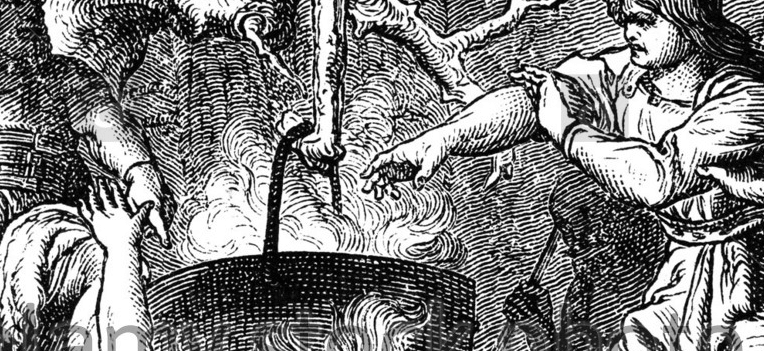
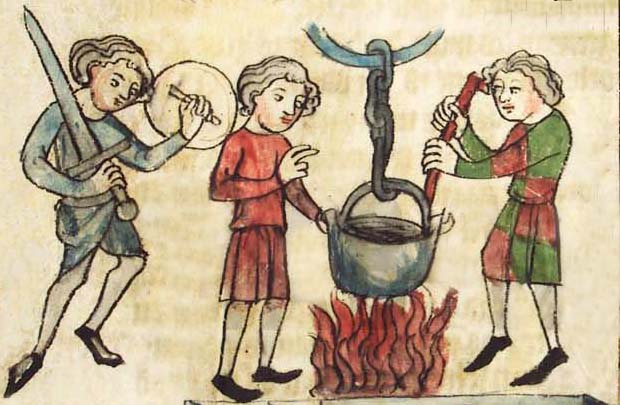
In the hot water ordeal the accused had to fish a ring or a coin out of the bottom of a cauldron: if after three days the wound was infected, they were guilty. Already found in the 6th-century Lex Salica, the test lost its value after 1215, when the Fourth Lateran Council banned priests from blessing it. According to a study of Hungarian records, about two defendants out of three passed it.
Ordeals – ‘the judgments of God’ – are usually related to the Inquisition and to the tortures inflicted on those accused of heresy and witchcraft. However, trials by ordeal (and hot water ordeal) were used both before and after the Inquisition and not only in Europe.
Ordeals are actually much older than the Inquisition. The cauldron ordeal already appears in the Lex Salica, the law of the Franks written in the early 6th century, and it was used mostly in ordinary cases: theft, murder, adultery, disputes over land and inheritance. In fact, by the time the Inquisition was born, ordeals were already in decline: in 1215 the Fourth Lateran Council, called by Pope Innocent III, banned priests from blessing them, and without the priest the test lost its religious force. Within a few decades they had vanished almost everywhere in Europe.
The hot water ordeal
The accused was required to dip his hands, sometimes up to his wrists or elbows, in a cauldron of boiling water and retrieve a ring or a coin sitting on the bottom of the cauldron.
This ordeal would take place in a church, by a priest. Before starting, both the accused and the cauldron were sprinkled with holy water.
Subsequently, all the attendees prayed to God, and the accused had to dip his arm in boiling water or, sometimes, boiling oil.
Afterwards, the wounds were bound and examined after three days. If the wounds showed ‘putrid blood’ or a blister ‘slightly bigger than a walnut’, then the accused was clearly guilty.
Hot water was also used as a mean of torture and as a means of execution, such as death by boiling, which was in effect until the Modern Age.
In fact, France abolished the death by boiling only in 1791.
In England, too, boiling was for a while a legal punishment. In 1531 King Henry VIII made it the penalty for poisoners, after a cook, Richard Roose, was accused of poisoning the food served in the household of the Bishop of Rochester. Roose was boiled alive in London in 1532. The law was repealed a few years later, in 1547.
This method did not belong only to the Inquisition, the Christian or the Western world. There is evidence that the trial by ordeal with hot water was also used in other parts of the world.
The Ordeal of Hot Water in India
In India, a man could ask his wife or his servants to undergo the ordeal of water in order to verify his doubts about their loyalty.
Furthermore, there is an evidence in 1867 in the “Bombay Gazette” that a man underwent the ordeal with hot oil because he was accused of theft.
How to Survive the Hot Water Ordeal
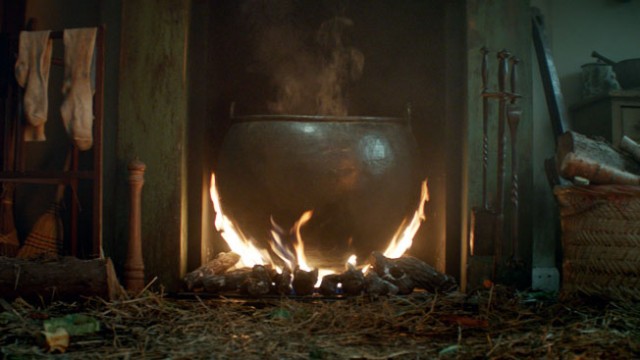
How was it possible to go through the hot water ordeal unharmed? This ‘God’s judgment’ was often used also because a number of people managed to survive the ordeal with no harm.
If everyone was found to be guilty, then no one would have wanted to undergo this trial by ordeal.
Voltaire thought that, before the ordeal, some accused could rub over their skin a mix of oil of vitriol, alum, and onion juice.
More recent studies, however, proved that such a mixture would not have prevented the skin from scalding.
How was it possible, then, that some people did not get any wounds from this ordeal? The most reasonable answer could be that a priest, moved to pity or more likely bribed, tampered with the equipment used for the ordeal.
An interesting clue comes from the records of the time. The Regestrum Varadinense, the register of the cathedral of Várad in Hungary, lists more than two hundred ordeals held in the early 13th century. According to an analysis by the economist Peter Leeson, about two out of three defendants passed the test. That’s a remarkably high rate, if the iron and the water had really been scalding. Leeson suggests that priests, convinced that anyone willing to face the test was probably innocent, made sure the water wasn’t quite so hot. Those who knew they were guilty, meanwhile, often preferred to confess rather than face the cauldron.
The accused of heresy could undergo not only the hot water ordeal, but also the cold water ordeal.
🦋 Emadion lives through its readers. If this story kept you up at night, buy me a coffee: it helps me bring you the next nightmare.
☕ Support Emadion on Ko-fiSources
- Trial by ordeal, Wikipedia
- Peter T. Leeson, Ordeals, Journal of Law and Economics, 2012