
 Posted by
Lawrenceville, Georgia. Good Friday, 1982. In the driveway of a suburban house, a high school kid is lying under his car, an old 1964 Chevrolet Impala, working on the rear suspension. Suddenly the jack slips. The back of the car comes down and pins him against the wheel. He blacks out.
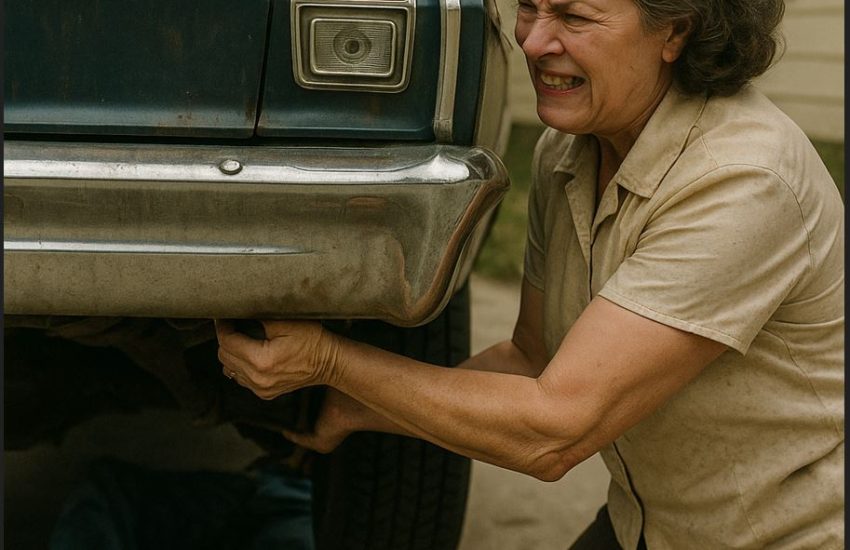
Moments later his mother, a woman in her late fifties, runs out of the house, grabs the bodywork and lifts. And she keeps holding it up until two neighbours put the jack back and drag her son out.
Her name was Angela Cavallo, and she has since become the most quoted example in the world of “hysterical strength”, the extraordinary strength some people show when a life is at stake. But what really happened that day? How heavy was the car, how high did she lift it, and for how long? And above all, is it even possible? I went back to the 1982 news reports, to what mother and son said years later, and to what the science actually says.
Lawrenceville, April 1982
Lawrenceville is the county seat of Gwinnett County, about 30 miles northeast of Atlanta. Today it is part of the sprawling metro area, but in the early 1980s it was still a small Southern town built around its red-brick courthouse of 1885.

This is where Angela Cavallo lived with her son Tony, full name Anthony Vincent Cavallo II, then a high school junior. Like plenty of boys his age, Tony had an old car to fix up: a 1964 Chevrolet Impala, the quintessential American family sedan of the decade. More than 17 feet long, it weighed somewhere between 3,300 and 3,700 pounds depending on the body and engine.

The accident
On the afternoon of 9 April 1982, Good Friday, Tony had jacked up the back of the Impala in the driveway and slid underneath to work on the rear suspension. According to the Associated Press, he was trying to hammer something loose when the jack slipped out. It was a bumper jack, the column-style jack that came in the trunk of almost every American car back then. It had a terrible reputation: one knock or sideways shove and it could let go.
The rear of the car dropped onto Tony and pinned him in the rear wheel well. All anyone could see was his body from the waist down. He was unconscious, but he had not been fully crushed.
The first to notice was a boy, Johnny Edwards, 11, who was visiting his grandparents next door. Johnny ran to tell Angela, then went to round up help from the neighbours.
Five minutes
Angela Cavallo ran outside, grabbed the car, lifted it and screamed for help. According to the AP story, she raised it about four inches. While she held it, she tried to wake her son with her feet. “I was kicking him, saying ‘Get out, get out,'” she told reporters.
Tony didn’t come round. Angela kept holding the car until two men from the neighbourhood arrived, slid the jack back under it and pulled the boy out. She later estimated she had held it for about five minutes; some later articles say “more than five minutes”. None of the sources I found names the two neighbours. The name “Rex Merideth”, which pops up online now and then, appears neither in the 1982 coverage nor in anything Angela or Tony said later.
What happened to Tony
Tony was taken to a local hospital and then to a neurologist in Decatur, on the edge of Atlanta, to rule out brain damage. The tests were clear. He had only scrapes and bruises, and after a couple of nights in hospital he was home by Easter Monday.
Angela, a Catholic, also credited the prayers of the people at her parish, St. Lawrence Catholic Church in Lawrenceville, who had been praying for Tony.
From a local story to papers across America
The AP picked up the story and it ran on 14 April 1982 in newspapers across the country. The Springfield Union in Massachusetts carried it on page 25 under the headline “She Lifted a Car to Save Her Son”. It was the kind of story that gets clipped and retold for decades.
And it was. Repeated in books of anecdotes, in sermons and later online, the account lost its details and grew: the car became “a one-and-a-half-ton car”, lifted “off the ground”. Plenty of people ended up filing it under urban legends.
The check: Angela on the phone, 24 years later
In January 2006 a reader asked Cecil Adams, the writer behind the long-running myth-busting column The Straight Dope, whether a mother could really lift a car to save her child. With help from a journalist who dug up the original 1982 AP story, Adams tracked down Angela Cavallo and interviewed her by phone.
Angela, by then elderly, confirmed the story but toned it down herself. She described herself as about 5 feet 8, large-framed and strong. She doubted she had lifted the car a full four inches, but said she raised it enough to take the weight off her son. She guessed she held it for about five minutes, put it down to adrenaline, and said she doubted she could have done it under normal circumstances.
A doctor friend of Adams raised an interesting objection: an adrenaline rush is unlikely to last five minutes. In his view, this was less about superhuman strength than about an extraordinary ability to endure pain and fatigue.
Tony’s version
A month later, in February 2006, Adams received a letter signed Anthony Vincent Cavallo II. It was Tony, now a grown man, writing to say that yes, his mother had saved his life. He also corrected two details the press had got wrong. The rear wheel had not been taken off: the suspension spring had. And he wasn’t under the car as such, but caught between the top of the rear wheel and the fender.
Tony, too, thought his mother probably hadn’t lifted the car four inches, but she had held it up long enough for the neighbours to reset the jack and pull him free. At the time of the letter he was running five Goodyear tire stores. Adams concluded that the feat was probably less dramatic than the legend, but real.
Where the versions differ
Put the sources side by side and some details hold up while others don’t.
- The date: Adams’s column, based on the AP story, gives Friday 9 April 1982, Good Friday. Some later accounts say “Friday, 11 April”, but 11 April 1982 was Easter Sunday, so that is almost certainly a mistake.
- The car’s weight: figures range from about 3,000 pounds (Live Science) to 1,692 kg, roughly 3,730 pounds (English Wikipedia). The real figure depended on body style and engine, and in any case Angela never lifted the whole car.
- The height: the AP said four inches. In 2006 both Angela and Tony thought it was less.
- How it happened: the press said a wheel had been removed; Tony says it was the spring, and that he was trapped between the wheel and the fender.
- How long: “about five minutes” is Angela’s estimate. Nobody was timing it.
None of this disproves the story. It cuts it down to size, and if anything makes it more believable.
What is “hysterical strength”?
Hysterical strength is the term for the unusual strength some people show when their own life, or someone else’s, is in danger. It is extremely hard to study. No ethics board would approve an experiment where a child is pinned under a car to measure the mother’s reaction, and real cases are rare, unpredictable and backed only by eyewitness accounts.
Adrenaline
Faced with danger, the sympathetic nervous system triggers the “fight or flight” response that physiologist Walter Cannon described a century ago. The inner part of the adrenal glands, the medulla, floods the blood with adrenaline and noradrenaline. The heart speeds up, blood pressure rises, the airways open, blood is diverted to the muscles and the liver releases sugar. At the same time the body produces endorphins and other substances that dull pain.

But adrenaline doesn’t turn ordinary muscle into a champion’s. Australian physiologist Gordon Lynch says it can boost muscle force and may recruit more motor units than usual. Kinesiologist Robert Girandola of the University of Southern California admitted that the adrenaline rush is something “nobody has ever quantified”.
Maximal strength vs absolute strength
The most convincing explanation comes from biomechanist Vladimir Zatsiorsky, long a professor at Penn State, who separates two things:
- absolute strength: what your muscles could produce in theory, if every fibre fired at once;
- maximal strength: what you can actually produce by conscious effort, even when you try your hardest.
According to Zatsiorsky, an ordinary person in training taps about 65% of their absolute strength; a well-trained lifter can get past 80%. The excitement of competition adds roughly another 12%. The rest is a reserve the nervous system keeps locked away to protect muscles, tendons and bones. South African scientist Tim Noakes calls this mechanism the “central governor”: a brake the brain puts on the body.
In extreme danger that brake can ease off. But as science writer Jeff Wise put it, summing up Zatsiorsky’s work, fear brings you closer to your absolute strength; it doesn’t take you beyond it. A woman who can normally lift 100 pounds might manage 135 in a panic, not 3,000.
The power of the mind: a 1961 experiment
In 1961 two physiologists, Michio Ikai of Japan and Arthur Steinhaus of the United States, measured volunteers’ arm strength under different conditions. When a pistol was fired unexpectedly behind them, their strength went up by roughly 7 to 10%; shouting during the effort added more. The biggest gain came under hypnosis: around 26 to 30%. Amphetamines also helped, while an adrenaline injection on its own made no significant difference. Their conclusion was that our everyday limits are largely psychological.
The physics: how much did she really lift?
There is one point most retellings skip. Angela didn’t lift a one-and-a-half-ton car. She lifted one rear corner of a car whose other wheels were still firmly on the ground.

On big 1960s American sedans, with a heavy V8 up front, most of the weight sits on the front axle. The rear of a 1964 Impala carries roughly 1,400 to 1,600 pounds, and a single rear corner about half that. When you lift one corner, the car pivots on its other wheels like a lever, and the force you need is roughly the load on that corner: several hundred pounds, not three thousand. Girandola reckons that in a crisis adrenaline might take someone from a few dozen pounds to a few hundred, not to thousands.
A few hundred pounds is still a huge amount for an untrained woman approaching sixty: that is competition-lifting territory. But she didn’t have to lift all of it. She only had to ease the pressure on Tony enough for him to breathe, and hold it there until help came. If he was wedged between wheel and fender, even an inch or two made all the difference.
Then there is the time. Five minutes is a long while for a maximal effort, and this is where the doctor’s comment makes sense. Angela probably didn’t hold the car at the same height the whole time. She held on, bearing part of the weight, while fear and endorphins masked the pain. That is extraordinary endurance more than superhuman strength.
Other documented cases
Over the past few decades the news has recorded quite a few similar cases, almost always with the same pattern: a jack gives way, a car comes up a few inches, and someone can’t explain how they did it.
Tom Boyle, Tucson, 2006
One evening in late July 2006 in Tucson, Arizona, Tom Boyle and his wife watched a Chevrolet Camaro hit an 18-year-old cyclist, Kyle Holtrust, and drag him along the road. The teenager was trapped under the car, alive and screaming. Boyle, who stood 6 feet 4 and weighed about 300 pounds, ran over and lifted the front of the car long enough for the driver to pull the boy out. “All I could think is, what if that was my son,” he told the Arizona Daily Star. Holtrust survived with head and leg injuries. Boyle found out afterwards that he had shattered eight teeth from clenching his jaw.
Lauren Kornacki, Virginia, 2012
In July 2012 Lauren Kornacki, 22 and a recent graduate, found her father Alec, 52, pinned under his BMW 525i in Glen Allen, Virginia. The jack had slipped while he was fixing a tyre. Lauren lifted the car enough to free him and, when she saw he wasn’t breathing, started CPR. A few compressions in, he began to breathe again. Alec survived with five broken ribs and a fractured sternum. “I just literally lifted up the car,” she told ABC News.
The others
- Lydia Angiyou, Ivujivik (Quebec), 2006: faced down a polar bear threatening her son and other children with her bare hands, holding it off until a hunter arrived.
- Nick Harris, Ottawa (Kansas), December 2009: lifted a Mercury sedan that had backed over a six-year-old girl. There were no witnesses, but police said they had nothing to dispute his account; the girl got away with a concussion.
- Hannah and Haylee Smith, Oregon, 2013: two teenage sisters lifted a tractor of about 3,000 pounds off their father.
- Charlotte Heffelmire, Virginia, 2016: lifted a burning pickup off her father, then drove it out of the garage and helped her family out of the house as it caught fire.
Online you will also find a “Hannah Kornacki”. She doesn’t exist: she is a mash-up of Lauren Kornacki and Hannah Smith.
From the Incredible Hulk to Warehouse 13
Jack Kirby, who created the Incredible Hulk with Stan Lee in 1962, said in a 1990 interview that the character was inspired by a woman who lifted a car to free her baby. That can’t have been Angela Cavallo, since the Hulk came twenty years earlier, and comics historian Mark Evanier has cast doubt on the anecdote. More recently the TV series Warehouse 13 added “Angela Cavallo’s car fender” to its collection of objects with supernatural powers: touch it and you get superhuman strength.
I also looked for TV coverage from the time. You will read online that Angela appeared on shows like That’s Incredible! or Ripley’s Believe It or Not!, but I found no source that confirms it.
A mother, a car, a son
Angela Cavallo’s story has survived more than forty years of retelling precisely because it is true, even if it is smaller than the legend. She didn’t lift a whole car, and maybe not even four inches. She lifted one corner, enough to take the weight off her son’s chest, and held it until the neighbours came. Twenty-four years later she talked about adrenaline, and he talked about a mother who saved his life. The rest, what the body can do when the mind takes the brake off, is still largely a mystery that no lab can reproduce.
🦋 Emadion lives through its readers. If this story kept you up at night, buy me a coffee: it helps me bring you the next nightmare.
☕ Support Emadion on Ko-fiSources
- Cecil Adams, SuperMom: Could a mother actually lift a car to save her child? – The Straight Dope, 20 January 2006
- Cecil Adams, Everybody’s getting into the act: more tales of supernatural strength (with Anthony Vincent Cavallo II’s letter) – The Straight Dope, 17 February 2006
- Thomas Jay Kemp, Angela Cavallo Saves Her Son’s Life with Her Supermom Strength (Springfield Union, 14 April 1982) – GenealogyBank, 2013
- Steve Reece, Superhuman strength comes in all sizes – The Reporter
- 10 People Who Saved a Life with Inconceivable Strength – Listverse, 2022
- Ian Douglass, Can Adrenaline Give Me Hulk-Like Strength? – MEL Magazine
- Natalie Wolchover, How Powerful Is Willpower? – Live Science, 2011
- Jeff Wise, Superhuman? No, Just Very Frightened (Zatsiorsky, Nick Harris) – 2009
- Jeff Wise, Yes, You Really Can Lift a Car Off a Trapped Child (Tom Boyle) – Psychology Today, 2010
- Scott Eden, Unlocking the mystery of superhuman strength (Ikai and Steinhaus, Zatsiorsky) – ESPN, 2019
- Fuerza histérica: cómo se explica que una persona pueda levantar un auto – T13, 2016 (Spanish)
- How do people find the superhuman strength to lift cars? – NBC News
- Alexis Huicochea, Man lifts car off pinned cyclist – Arizona Daily Star, 28 July 2006
- Alyssa Newcomb, Superhero Woman Lifts Car Off Dad – ABC News, 2012
- Hysterical strength – Wikipedia
- Gwinnett County Courthouse – Wikipedia
