 Posted by
In November 1565, in Vervins, Picardy, Nicole Obry, or Aubry, a girl of 15 or 16, began to fall ill and to say she was possessed. For the priests it was Beelzebub, the “Prince of the Huguenots”. Exorcised every day before huge crowds in Laon cathedral, she was declared free on 8 February 1566. In the middle of the Wars of Religion, the “Miracle of Laon” became a weapon of Catholic propaganda against the Protestants.
Sudden convulsions, superhuman strength, a voice that didn’t seem to be hers and a fierce hatred of everything sacred. For 16th-century France there was no doubt: this wasn’t illness, it was demonic possession. So began the story of Nicole Obry, often called Aubry, a French girl of just fifteen or sixteen who, between 1565 and 1566, became the protagonist of one of the most spectacular and disturbing exorcisms in European history, the so-called “Miracle of Laon”.
France in the Wars of Religion
The 16th century in France was a turbulent time. The Wars of Religion between Catholics and Protestants, the Huguenots, were tearing the country apart, and even after the Peace of Amboise in 1563 tension remained extremely high. Laon lay in the domain of the Prince of Condé, one of the Protestant leaders. In that climate fear of the devil was palpable, and possessions were seen as tangible proof of the presence of evil, but also as a chance to show which was the true faith.
The story of Nicole Obry
Nicole lived in Vervins, a small town in Picardy. She was the daughter of a butcher and, despite her young age, was already married to a tailor. On the afternoon of 3 November 1565, according to accounts of the time, a spirit appeared to her that looked like her recently deceased grandfather. The spirit asked her to have masses said and to make a pilgrimage to Santiago de Compostela to free his soul from Purgatory. Nicole felt so ill that her life was feared for, then she recovered and told her parents everything.
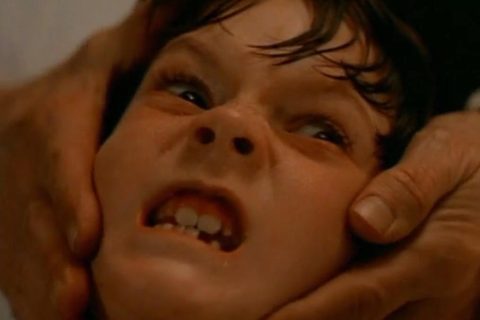
The family did as asked, but the symptoms came back, worse than before. The girl could no longer eat, was shaken by convulsions, seemed to have extraordinary strength and spoke in a hoarse voice that was not her own. The family called a Dominican friar, Pierre de la Motte, who after examining her decided that this was not her grandfather at all but an evil angel, a devil. During the exorcisms, forced to reveal its name, the demon said it was Beelzebub. At times there were said to be as many as thirty devils inside her.
The Prince of the Huguenots
Beelzebub, however, was no ordinary demon. He presented himself as “the Prince of the Huguenots” and declared that the Protestant ministers were his servants. Above all, he said he would not leave for anyone less than the Bishop of Laon. On 4 January 1566 Bishop Jean de Bours arrived in Vervins, but he too failed to drive him out. The local Huguenots, publicly accused by the “devil” of being in league with Satan, cried fraud and tried to stop the exorcisms. Partly for her own protection, on 24 January Nicole was taken to Laon.
The public exorcism
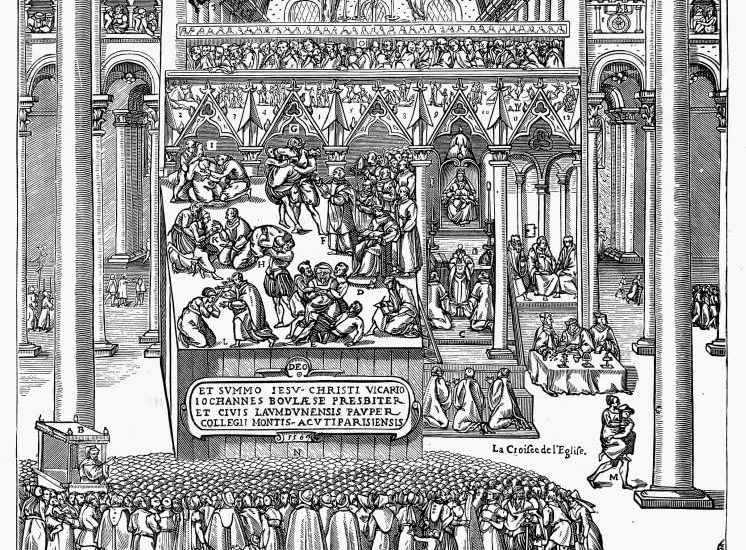
In Laon the exorcism was not an intimate, quiet ritual but a real religious spectacle. Every day Nicole was carried in procession from the convent where she was staying to the great cathedral of Notre-Dame, where she climbed onto a specially built stage in front of thousands of people. The exorcist ordered “Prince Beelzebub” to speak, and the girl, writhing and screaming, delivered real sermons against the Protestants. The demon claimed that local Huguenots had stolen a consecrated host, cut it up and burned it, and boasted that he and his obstinate Huguenots would do more harm to Christ than the Jews had.
The exorcists’ main weapon was the Eucharist. This was no accident: by showing that the devil fled before the consecrated host, the Catholics wanted to prove in front of everyone the real presence of Christ, the very dogma the Protestants rejected. The public dialogues with Beelzebub also vindicated holy water, relics and the sign of the cross, all practices the Huguenots considered superstitions.
The deliverance
After about two months of almost daily exorcisms, on 8 February 1566 the bishop raised the host before Nicole and drove out the last demons. The convulsions stopped, her voice returned to normal and her body grew calm. Catholic chronicles even speak of thunder and a thick fog wrapping the cathedral’s bell towers. For the crowd and the Church it was the victory of faith over evil, and that day was celebrated every year in Laon cathedral until the French Revolution.
For the Protestants, though, it was all staged. The Prince of Condé even had Nicole imprisoned, and an order from King Charles IX was needed to free her. Practically nothing is known of what happened to her afterwards.
A forgotten case
Nicole Obry’s case is little known today, overshadowed by more recent and famous stories like that of Anneliese Michel in Germany. Yet in the 16th century it caused a sensation all over Europe. Within a few months several eyewitness accounts had been published, and Hebrew professor Jean Boulaese collected the testimonies of the dean of the cathedral, a canon and the city’s royal notary in a book that became very famous. The “Miracle of Laon” also inspired other “possessions” in France and is considered one of the precedents of the famous Loudun possessions.
Modern historians are much more cautious. Some, like historian D. P. Walker, have dismissed Nicole as a fraud, while others see her as a fragile, perhaps ill girl caught in the middle of a political and religious struggle far bigger than her. Even her story changed over time: at first she spoke of her grandfather’s spirit, and only after the visits of so many priests did Beelzebub appear.
Was it really possession, or rather a disorder that the medicine of the time couldn’t understand? We will never know. What we do know is that a sixteen-year-old girl became the unwilling protagonist of one of the most spectacular battles between the Church and the devil, and that behind every story of possession there always remains the shadow of doubt.
🦋 Emadion lives through its readers. If this story kept you up at night, buy me a coffee: it helps me bring you the next nightmare.
☕ Support Emadion on Ko-fiSources
- Nicole Aubrey, Wikipedia
- Essays in History, the Laon case in Boulaese’s account
- Gizmodo, The 16th century exorcism that became political propaganda
- G. Dall’Olio, Beyond Simulation. An Enquiry Concerning Demonic Possession, Palgrave Macmillan, 2015