 Posted by
Between 1632 and 1634, in Loudun, in Poitou, the Ursuline nuns led by Mother Superior Jeanne des Anges claimed to be possessed by demons and accused the parish priest Urbain Grandier of summoning them. After public exorcisms and a trial pushed by Cardinal Richelieu, Grandier was tortured and burned alive on 18 August 1634. The “possessions” went on until 1637.
In the heart of 17th-century France, between 1632 and 1634, the small town of Loudun became the stage for one of the most dramatic and controversial episodes of witchcraft persecution in European history, the case of the “Devils of Loudun”. A tangle of faith, politics, sexuality, power and local rivalries turned an alleged demonic possession into a real spectacle of exorcisms, trials and death sentences. Even today, almost four centuries later, the story keeps inspiring books, films and plays.
But what really happened in Loudun? Who were the protagonists, and what dynamics fuelled what is often called a “witch hunt” of almost theatrical proportions? In this article we look at the historical facts, the testimonies of the time and the modern interpretations of one of the most enigmatic chapters in the history of witchcraft.
The historical context
The France of Louis XIII was going through a time of great tension. The monarchy, led by Cardinal Richelieu, was trying to strengthen central power, and the wounds of the Wars of Religion between Catholics and Protestants were still open. The Counter-Reformation pushed towards greater orthodoxy and stricter morals.
The town of Loudun
Loudun, in Poitou, now in the Nouvelle-Aquitaine region, was a town divided between Catholics and Huguenots. To weaken the Protestant strongholds, the Crown had ordered the town’s walls and castle to be pulled down, and the townspeople were split: the Huguenots wanted to keep them, while most Catholics supported the king. On top of that, in May 1632 an outbreak of plague claimed many lives. The Ursuline convent, opened in 1626, housed seventeen nuns with an average age of twenty-five, led by the prioress Jeanne des Anges.
Urbain Grandier, the awkward priest
Urbain Grandier had come to Loudun in 1617 as parish priest of Saint-Pierre-du-Marché and canon of the church of Sainte-Croix. He was handsome, cultured, well-off and a brilliant preacher, and for that very reason many envied him. It was said he had fathered a child with Philippa Trincant, daughter of the king’s prosecutor Louis Trincant, who was his friend, and that he had dishonoured several important families with his affairs. He had even written a book against clerical celibacy.
Around 1629 a certain Jacques de Thibault beat him with a cane outside the church of Sainte-Croix over his conduct with women, and the resulting trial brought Grandier before the church court. The Bishop of Poitiers banned him from serving for five years in the diocese and forever in Loudun, but Grandier appealed, several witnesses retracted and the case was dismissed. Above all, Grandier had publicly opposed the demolition of the walls ordered by Richelieu, and a scathing satire of the cardinal attributed to him was circulating.
The outbreak of the crisis
The first “possessions” began in the autumn of 1632, about five months after the plague arrived, as the epidemic was dying down. A young nun said she had had a vision of her confessor, Father Moussant, who had recently died, and soon other sisters reported similar visions. Canon Jean Mignon, the convent chaplain and Trincant’s nephew, and therefore Grandier’s enemy, decided to proceed with exorcisms.
The nuns said the demon Asmodeus had been sent to commit wicked and lewd acts with them. At first they gave different answers about who had sent it, but on 11 October 1632 Grandier’s name came up, even though none of them had ever met him. The Mother Superior, Jeanne des Anges, was said to be possessed by Astaroth, who had entered her, they said, the day Grandier sent her a bunch of roses, and with him other demons, including Leviathan. Witnesses claimed the priest appeared in the convent at all hours, without anyone knowing how he got in.
According to Aldous Huxley, it all started when Grandier refused to become the convent’s spiritual director. Jeanne des Anges, who had seen him from afar and heard of his adventures, had become obsessed with him and, rejected, called in Canon Mignon instead. A counsellor of the time, on the other hand, claimed that Grandier applied for the post and that it went to Mignon. Either way, many in town were already speaking of imposture. Grandier asked for the nuns to be isolated, and the Archbishop of Bordeaux ordered them separated: for a while the “possessions” seemed to calm down.
The accusations
But the nuns’ behaviour grew ever more extreme. They screamed, swore, barked and drew crowds of onlookers. At that point Richelieu stepped in. Jean de Laubardemont, the man sent to demolish Loudun’s tower, had been stopped by the town militia and, back in Paris, had also reported what was happening among the Ursulines. In November 1633 he was commissioned to investigate, and Grandier was arrested and locked up in the prison of Angers.
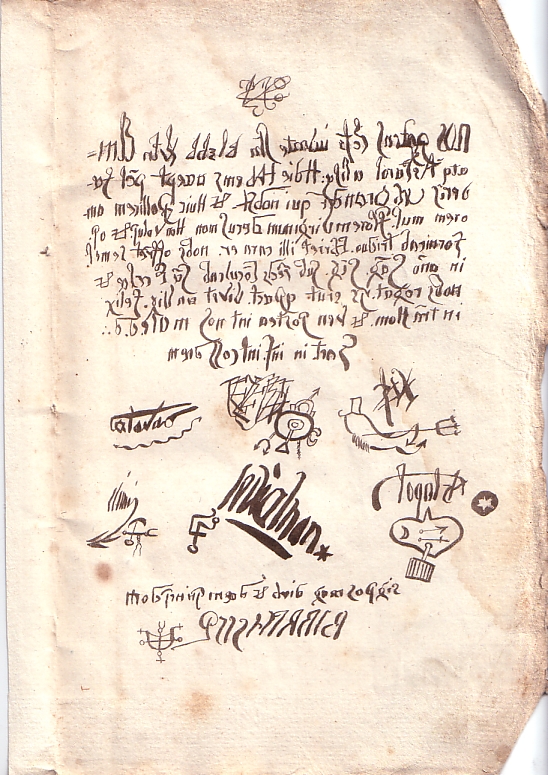
The nuns accused him of having signed a pact with the devil and of bewitching them to lead them into temptation. During the trial a “pactum diaboli” was even produced, a Latin document supposedly signed by Grandier and several demons. Letters from the bailiff of Loudun, his chief supporter, calling the possessions an imposture, were intercepted.
The public exorcism
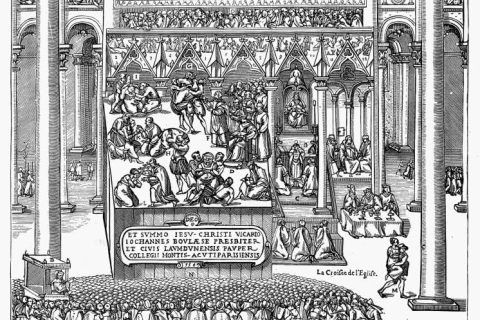
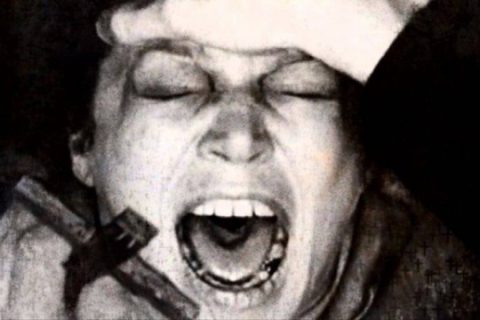
On 31 May 1634 Laubardemont returned to Loudun with a decree of the King’s Council confirming all his powers and forbidding the Parlement and any other judge from interfering. For two and a half months the Bishop of Poitiers and several clerics, including the Capuchin Father Tranquille and the Franciscan Father Lactance, exorcised the nuns before huge audiences. The “possessed” screamed, writhed and took on unnatural postures, in a spectacle that fuelled panic and religious fervour throughout the region.
On 23 June 1634 Grandier was brought to the church of Sainte-Croix, his own church, to attend the exorcisms. Since he and his supporters spoke of imposture, he was ordered to act as exorcist himself. He could not refuse. The nuns attacked him, and the scene was taken as further proof of his guilt.
The trial and the stake
In August 1634 the case came before the judges. Grandier was accused of making a pact with the devil and of inviting someone to a sabbath, and on 18 August he was found guilty of magic, maleficia and causing the possession of the Ursulines. The sentence required him to beg forgiveness publicly, with a rope round his neck and a lit candle in his hand, before the churches of Saint-Pierre-du-Marché and the Ursulines, and then to be burned alive in the square of Sainte-Croix, his ashes scattered to the wind. Before that, he was to be tortured to make him reveal his accomplices. Among other tortures he suffered “the boot”, which crushed his legs. He named no one.
He had been promised that he could speak to the crowd and that he would be strangled before the flames reached him, an act of “mercy”. But when he tried to speak from the scaffold, the monks threw so much holy water in his face that no one could hear his last words. Then, according to historian Robert Rapley, it was Father Lactance, enraged by taunts from the crowd, who lit the pyre before the executioner could strangle him. The flames rose so violently that they burned the rope, and Grandier fell alive into the burning wood.
After the sentence
Grandier’s death did not stop the possessions, and the public exorcisms continued. Among the exorcists who arrived after his death was the Jesuit Jean-Joseph Surin, who devoted himself above all to Jeanne des Anges. The displays went on until 1637, when, according to the accounts, the last demons left the Mother Superior’s body, making the names Joseph and Mary appear on her left arm. Jeanne made a pilgrimage to the tomb of Saint Francis de Sales in Annecy, and in 1638 she was received by Richelieu and Louis XIII.
A witch hunt typical of its time
The Loudun case has much in common with other trials of the period, such as the Aix-en-Provence possessions of 1611: testimonies of possession, relentless targeting of a prominent man, political use of the affair. As early as 1679 the English philosopher John Locke wrote that the story of the possessed nuns of Loudun was nothing but a contrivance of Richelieu to destroy Grandier, managed by the Capuchins and well acted by the nuns, but that it was all a cheat.
Modern interpretations
Some think the first “manifestations” were just pranks by the boarding pupils to frighten the nuns, and that it was then Canon Mignon who suggested Grandier’s name to highly suggestible nuns. Historian Michel de Certeau read the nuns’ symptoms as a psychological disorder, a form of hysteria, and possession as a way of expressing, through someone else’s voice, ideas, fears and desires they could not say openly, in a closed convent, in a town devastated by plague.
The role of sexuality
The sexual nature of the accusations has led many historians to read the case as a reflection of the tensions of the time. The Counter-Reformation Church imposed an ideal of absolute chastity, and young women shut away in convents, often not by choice, could give shape to their inner conflicts precisely through “possession”.
In popular culture
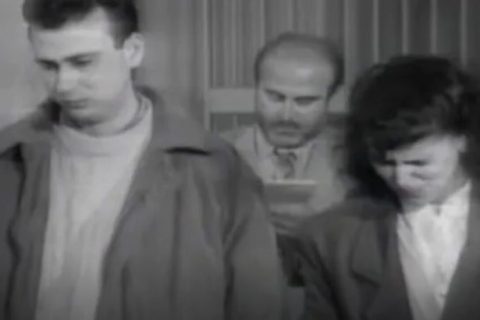
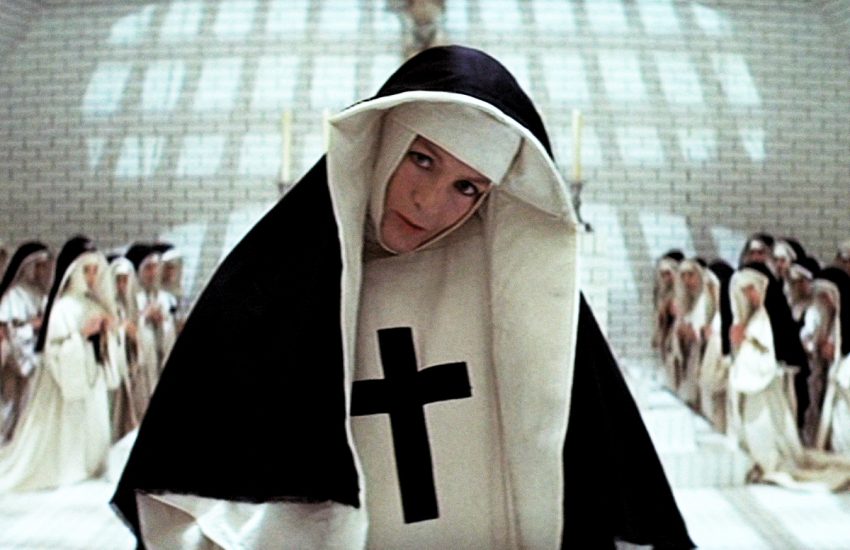
In 1952 Aldous Huxley published “The Devils of Loudun”, which blends historical reconstruction and psychological interpretation. The book inspired John Whiting’s play “The Devils”, staged by the Royal Shakespeare Company. In 1961 the Polish film “Mother Joan of the Angels”, based on a novella by Jarosław Iwaszkiewicz, was loosely inspired by the events, and in 1969 Krzysztof Penderecki drew from it the opera “The Devils of Loudun”, which premiered at the Hamburg State Opera. Finally, in 1971 came Ken Russell’s “The Devils”, based on Huxley and Whiting, which became a cult film for its raw depiction of religion and power.
What can we learn from the Devils of Loudun?
The case of the Devils of Loudun shows how collective fear, politics and religion can intertwine until they generate a whirlwind of accusations and violence. First of all, it reminds us how dangerous accusations without evidence can be, replaced by emotional testimony and social pressure. Then, it shows the danger of power that exploits justice for its own ends. And finally it tells us how important it is to look at these phenomena through the eyes of psychology too. Almost four centuries later, Loudun remains a symbol of intolerance, but also of a dark fascination that never stops questioning us.
🦋 Emadion lives through its readers. If this story kept you up at night, buy me a coffee: it helps me bring you the next nightmare.
☕ Support Emadion on Ko-fiSources
- Loudun possessions, Wikipedia
- Aldous Huxley, The Devils of Loudun, 1952
- Michel de Certeau, The Possession at Loudun