 Posted by
In 1949 a 14-year-old boy from Maryland, known by the pseudonym Roland Doe, underwent a series of exorcisms by Jesuit priests in Washington and St. Louis. The case inspired William Peter Blatty’s novel The Exorcist (1971) and the 1973 film. Several researchers believe he was a disturbed boy or was seeking attention. He died in 2020.
Roland Doe (sometimes called Robbie Mannheim) is the name that was given to a 14-year-old boy who underwent a series of exorcisms in the US in the late 1940s, in 1949.
Despite his name being kept secret, his story has become very popular and probably you too know it. Why?
Because the exorcism of Roland Doe first inspired the book and then movie “The Exorcist”
Roland Doe
Not much is known about Roland before the exorcism. We know that he was born in 1935 into a Lutheran family of German origin and that in the 1940s he lived in Cottage City, Maryland.
Being an only child the only people with whom he interacted and played were adults, especially Aunt Harriet, a spiritualist who also taught him how to use the Ouija board.
After the death of Harriet, the family began to notice unusual facts.
- He heard strange noises
- Furniture pieces changed position by themselves
- Some objects started to levitate when Roland was around
The family, of Lutheran faith, then turns to the Lutheran pastor Luther Miles Schulze and asked him for advice.
Schulze, apart from being a pastor, was also interested in parapsychology and invited Roland to his house to see if what his family was saying true.
The pastor too claimed to have seen objects move by themselves with his own eyes, although parapsychologist Joseph Banks Rhine suspected he had unconsciously exaggerated the facts, and he recommended the Roland family to consult a Catholic priest.
The first exorcism

The family accepted the advice and Roland underwent various exorcisms, one of them led by the priest Edward Hughes at Georgetown University Hospital, a Jesuit institution.
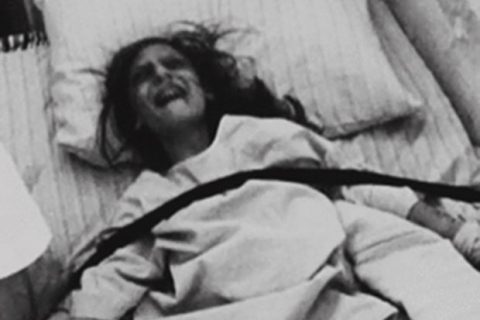
During this exorcism Roland was tied to the bed, but we don’t know how, he managed to free one arm and get a mattress’ spring.
With this spring he hurt Hughes’ arm and the exorcism was cancelled.
After the failed exorcisms, unexplained scratches appear on the boy’s body. His mother, a native of St. Louis, Missouri, wants a change of scene, and when the word “LOUIS” appears among the scratches on her son’s ribs, the family decides to leave. In St. Louis, a cousin of Roland’s, a student at Saint Louis University, contacts one of his professors, the Jesuit priest Raymond Bishop.
Bishop, together with his colleague William S. Bowdern, visited Roland and what he saw pushed him to apply for permission to perform an exorcism.
Bishop too saw objects fly around the room, but not only that. The bed Roland is tied to trembled and the boy’s voice became guttural while pronouncing sentences in Latin.
Also, just as in the case of Anneliese Michel, Roland seemed to feel an aversion to all that is sacred.
The exorcism
The archbishop authorised the exorcism, which took place at the Alexian Brothers Hospital in south St. Louis. According to one account, 48 people witnessed it, nine of them Jesuits. One of these is Walter H. Halloran, a Catholic priest who was working in the psychiatric ward of a hospital.
During the exorcism, Halloran would later say, marks and words appeared on the boy’s body, such as
“Evil” and
“Hell”
During the rite, in a violent attack, Roland would break Halloran’s nose.
After the exorcism
After the exorcism Roland is reported to have actually been freed from the demons that had taken possession of his body and that he lived a quiet life thereafter.
Raymond Bishop kept a detailed diary of the exorcism, and as early as 1949 some newspapers published anonymous articles about the case. This story inspired the writer William Peter Blatty for his novel The Exorcist, published in 1971, which two years later was made into the famous film.
There are those who claim that poor Roland was suffering from some mental illness and was not really possessed, or those who say that the whole affair has been hugely inflated to create a money-making story.
A writer, Mark Opsasnick, claimed to have found Roland’s family and talked to relatives and friends of the boy.
From these conversations he revealed that the boy often played pranks on friends and acquaintances, and the author has therefore come to the conclusion that even the possession had been another orchestrated prank to get attention. According to Opsasnick, Halloran himself never heard the boy’s voice change and thought he was simply repeating Latin words he had heard from the priests. Before his death, Halloran said he did not feel able to state with certainty that the boy had been possessed. As early as 1993 the writer Thomas B. Allen, in his book Possessed, had concluded that he was simply a deeply disturbed boy.
In December 2021 the magazine Skeptical Inquirer revealed Roland Doe’s real identity: a man born in 1935 who died on 10 May 2020 and who, after those events, had lived, as Halloran put it, “a rather ordinary life”.
The truth, however, will forever remain a mystery to everyone except to those present at the ritual.
🦋 Emadion lives through its readers. If this story kept you up at night, buy me a coffee: it helps me bring you the next nightmare.
☕ Support Emadion on Ko-fi