 Posted by
The “flying carpet” (bisat al-rih) is a torture used in Syrian prisons under Bashar al-Assad: the prisoner is tied to a folding wooden board that bends him into a V, causing serious back injuries, while he is beaten and tortured with electricity. Testimonies collected by Amnesty and Human Rights Watch and the “Caesar” photos documented it; after Assad’s fall in December 2024, prisons such as Sednaya were opened.
When you hear or read the word flying carpet you probably think of tales from the East, like Aladdin in “The Arabian nights”. Other people less fortunate than you and me however will forever associate these words with terrible memories.
The flying carpet is in fact also the name of a modern torture, used mainly in Syrian’s detention centers during the government of Bashar al-Assad
How the flying carpet works
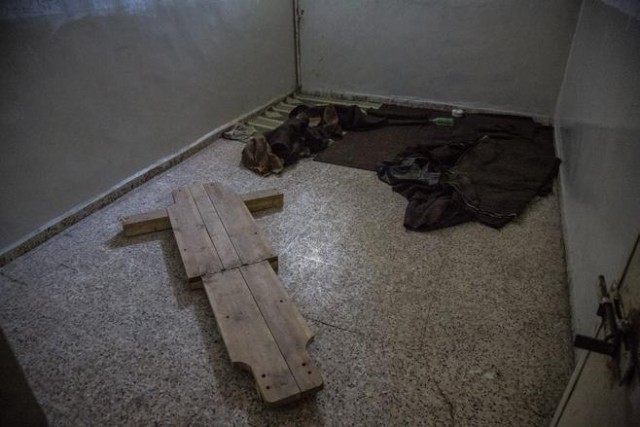
The flying carpet is a simple wooden board to which the prisoner is tied lying on his back. In this position, completely immobile and helpless, the victim is beaten by his captors and tortured with electric shocks, mainly applied in the most sensitive points:
- Genital areas
- Head
The flying carpet is not fixed, but mobile and can be folded in half, bringing the two ends to join each other. When a prisoner is tied to the Bisat al-rih, often the two halves of the wooden board are folded inwards, bending the body of the victim in a V shape bringing the feet and head close together. This causes severe pain and serious injury, sometimes permanent, to the spine. Once in this position, the victims are beaten and tortured with electricity.
Here are some accounts from prisoners subjected to the flying carpet.
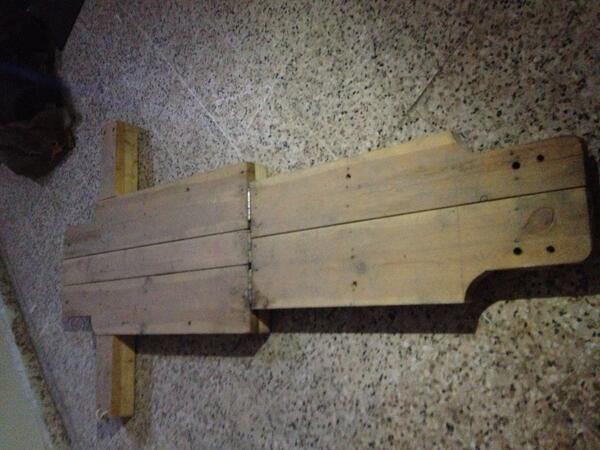
A 23-year-old man tells how he was tortured with Bisat al-rih. He was tied to a wooden board, in the supine position and completely naked.
Then electrodes were applied to his penis and he was subjected to electric shocks so painful that they made him pass out.
When he came round, he remembers how his body was completely blue due to the amount of bruising present on every inch of his skin.
Another man tells of his experience with the flying carpet. He, too, was tied, naked and on his back, to a wooden board.
Then the board’s mechanism was released and the two halves began to fold, leaving the body of the prisoner in a “V” form.
This caused him severe pain in the lower back, and while he was in this position he was beaten for hours by his captors.
He remembers that there were three men taking turns to beat him. When the turn of a torturer was finished, he sat down at a table smoking and drinking tea until it was his turn again.
The evidence
For years the Syrian regime denied everything. But the evidence piled up. In 2012 an Amnesty International report gathered the testimony of dozens of former detainees and listed more than thirty torture methods used in Syrian prisons, including the flying carpet. In 2013, when the city of Raqqa temporarily fell to the rebels, Human Rights Watch researchers found one of these devices in the offices of the security services: a cross-shaped wooden frame that, according to former prisoners, was used to immobilise victims and violently bend or stretch their limbs.
In 2014 a former military police photographer, known by the code name “Caesar”, fled Syria with tens of thousands of photographs of detainees who had died in custody, many showing clear signs of torture. And in 2017 Amnesty called Saydnaya military prison, near Damascus, a “human slaughterhouse”, estimating that thousands of people had been secretly hanged there.
Then, on 8 December 2024, Bashar al-Assad’s regime collapsed and the president fled to Russia. In the days that followed, rebels opened the gates of Saydnaya and other prisons. Thousands of people poured into the corridors looking for relatives who had been missing for years. Prisoners were freed who could no longer remember their own names, and nooses, underground cells and torture devices were found. Former detainees once again spoke of the flying carpet.
🦋 Emadion lives through its readers. If this story kept you up at night, buy me a coffee: it helps me bring you the next nightmare.
☕ Support Emadion on Ko-fiSources
- Amnesty International, “I wanted to die”: Syria’s torture survivors speak out, 2012
- Amnesty International, Human Slaughterhouse: Mass hangings and extermination at Saydnaya Prison, 2017
- Saydnaya Prison, Wikipedia