 Posted by
You are walking along a mountain path in the depths of winter. A sudden gust makes you stagger; perhaps you fall. You get up, brush off the snow and carry on. Only later do you notice a clean, deep cut on your leg or face, as if made by a blade. It doesn’t hurt and barely bleeds. In Japan, for centuries, a wound like that had only one culprit: the kamaitachi, the “sickle weasel”.
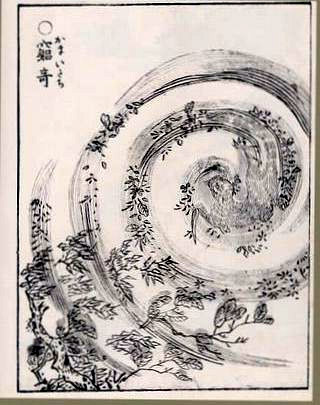
The kamaitachi is a Japanese yōkai that looks like a weasel with claws as sharp as sickles. It travels in whirlwinds and slices the skin of passers-by, leaving wounds that at first feel painless. It is found mainly in the snowy, mountainous regions of Honshū, such as Kōshin’etsu.
A name made of sickle and weasel
The name is written 鎌鼬: kama means sickle, itachi weasel. It was the painter Toriyama Sekien, in the eighteenth century, who first portrayed it as a weasel armed with blades. According to some scholars, however, the name hides a pun: originally people would have spoken of kamae-tachi, a “sword at the ready”, an incorporeal presence tied to the wind that only later took the animal’s form.

Hardly anyone actually sees the creature itself. The kamaitachi travels inside whirlwinds and dust devils, so fast that people debate whether it is invisible or merely incredibly quick. All that remains of its presence is the proof: the cut.
Three brothers and a wound
The legend changes from region to region. In one of the best-known versions, from Gifu prefecture, the kamaitachi are three gods working together: the first knocks the victim down, the second wounds them with the blade, the third applies a miraculous salve to the wound. That is why the cut neither hurts nor bleeds, deep as it is. Another tradition says instead that the kamaitachi drinks the blood from the wound it has just opened.
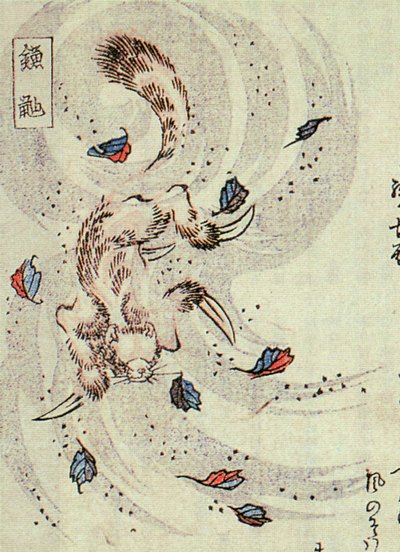
In western Japan the same spirit is called kazakama, “wind sickle”, and is said to slice off people’s skin: at the moment of the strike nothing is felt, but soon afterwards the pain and blood arrive. In Kōchi prefecture it is called nogama, and elsewhere kamakaze, “sickle wind”.
The wind that cuts
Where does such a specific legend come from? For a long time it was thought the cuts were caused by the vacuum at the centre of whirlwinds. Today the most accepted hypothesis is different: intense cold and dry winter wind make the skin fragile, and a knock or a small piece of debris carried by the gust is enough to split it. That is exactly why the legend is rooted mainly in snowy areas. Medicine has paid tribute to the yōkai too: rare cases of spontaneous, unexplained wounds are sometimes called “kamaitachi disease”.
Featured image: undefined, Alpsdake, CC BY-SA 3.0, via Wikimedia Commons.
The kamaitachi has never vanished from the Japanese imagination: anime, manga and video games have turned it into a wind warrior, often as an armed weasel. Yet its power comes from a common, real experience: looking at a wound and being unable to remember how you got it. When the explanation is missing, in Japan someone still smiles and says the sickle weasel has passed by.
🦋 Emadion lives through its readers. If this story kept you up at night, buy me a coffee: it helps me bring you the next nightmare.
☕ Support Emadion on Ko-fi