 Posted by
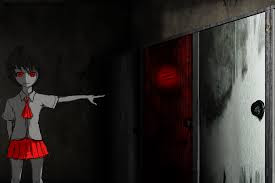
Kuchisake-onna is a woman in a surgical mask who stops passers-by at dusk and asks: “Am I pretty?” Under the mask, her mouth is slit from ear to ear. Tales of slit-mouthed women go back to the Edo period, but the modern legend exploded in Japan in 1979. In a few months it spread from Gifu Prefecture across the whole country. Schools sent children home in groups and police patrolled the streets. There are strict rules for surviving her: never say no, tell her she’s “average”, throw her some sweets.
In June 1979, in the city of Himeji, police arrested a 25-year-old woman walking the streets with a kitchen knife. Her face was covered by a mask, and she had made herself up to look like someone else. She wasn’t after anyone in particular. She was playing a character that, that year, every child in Japan knew by heart.
Elsewhere things were no better. In Koriyama, in Fukushima Prefecture, and in Hiratsuka, near Tokyo, police cars patrolled outside schools at closing time. In Kushiro, Hokkaido, and in Niiza, near Saitama, children were walked home in groups by parents and teachers.
All because of a woman who, in all likelihood, never existed.
“Am I pretty?”
The scene never changes, and that’s where its power lies. You’re walking home at dusk, maybe from evening classes. On a poorly lit street, a tall woman comes towards you. She has long black hair, a long coat, and a surgical mask over her face. Her eyes are beautiful.
She asks: “Watashi, kirei?” Am I pretty?
Say no, and she pulls out a pair of scissors, or a knife, or a sickle, and kills you. Say yes, and she pulls down the mask. Her mouth is slit from ear to ear, her teeth bared. Then comes the second question: “Kore demo?” Even like this?
If you say no now, or scream, it’s over. If you say yes, in many versions she cuts your mouth the same way, so you’ll match. In others she lets you go, then follows you home and comes back in the night.
Running is pointless. One detail Japanese children repeated endlessly was her speed: she could run a hundred metres in three seconds, six in the more generous versions. Wherever you go, she’s already ahead of you.
How to survive
Like every legend born in the playground, Kuchisake-onna comes with rules. And the children of 1979 knew all of them.
The most famous is the in-between answer. Not yes, not no: “Mā mā desu”, you’re so-so, you’re average. Faced with an answer she doesn’t expect, she’s confused long enough for you to slip away. Some suggest asking her the same question back: “And me, am I pretty?”
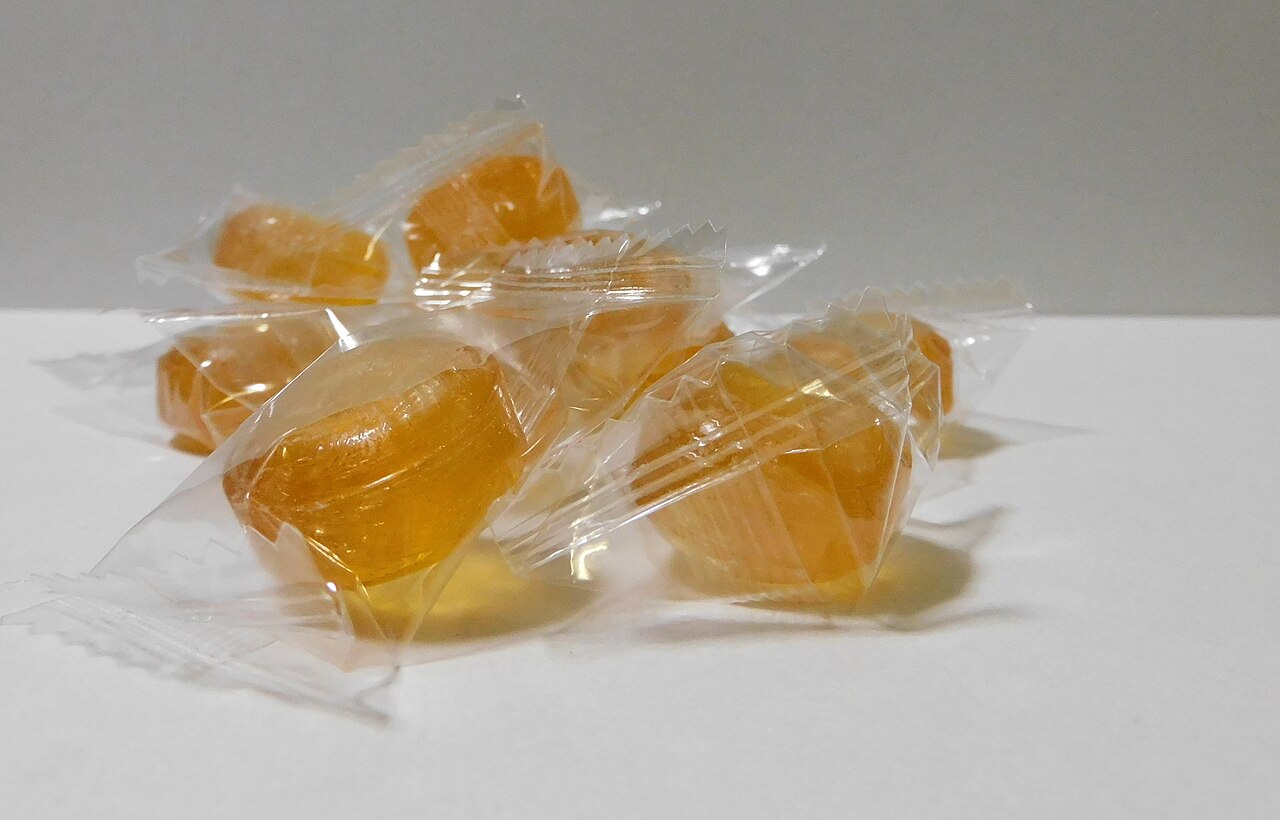
Then there are the sweets. Kuchisake-onna is said to love bekko ame, amber candies made from cooked sugar. Throw some at her and she’ll stop to pick them up one by one, giving you time to vanish. Coins supposedly work too.
Others swore you could just tell her you were late, that you had an appointment, and walk off. And then there’s the strangest rule of all: say “pomade” three times, as in hair pomade. She can’t stand it. The reason came later, as it always does: the surgeon who botched her face was said to wear pomade, and she couldn’t bear the smell.
The variants multiplied. Write “pomade” on your palm. Draw the Japanese character for “dog” on your hand. Run up to the second floor of a building, because she can only chase you on the street. The further the story travelled, the more it grew.
Where the slit mouth comes from
There are many stories about her origin, and almost none can be checked. The most romantic sets it in the distant past, in the Heian or Edo period. A beautiful, vain woman, the wife of a samurai, is unfaithful. He finds out and slashes her mouth with his sword, asking who will think she’s beautiful now. She dies and returns as an onryō, a vengeful spirit.
Modern versions talk instead about cosmetic surgery gone wrong, a woman who escaped from a psychiatric hospital and painted her mouth with lipstick, even medical experiments. In the 1970s cosmetic surgery was becoming common in Japan’s big cities, and a woman whose face was hidden by a mask could easily become, in the imagination, a woman with a scar to hide.
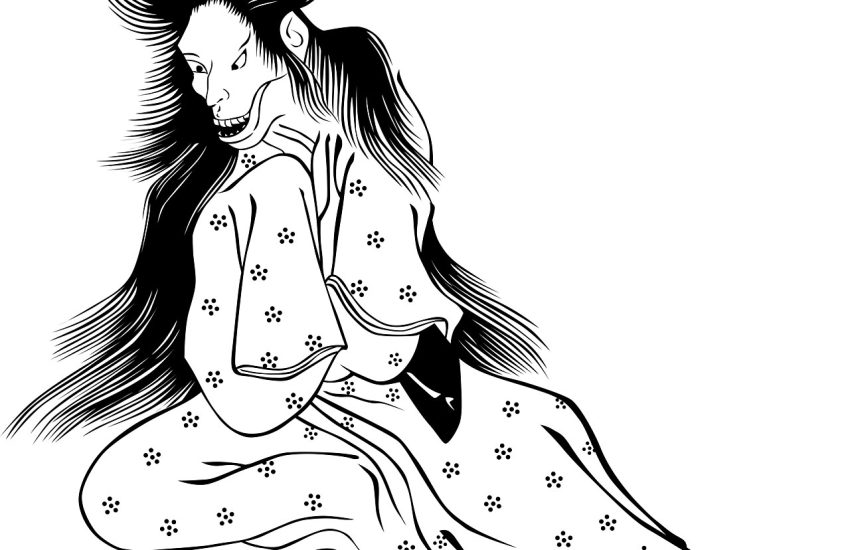
Slit-mouthed women do appear in some Edo-period tales. But in many of them the culprit wasn’t a ghost at all. It was a fox, a kitsune, taking human form to frighten travellers and have a laugh. One such figure appears in the Ehon Sayoshigure, an illustrated book from 1801.
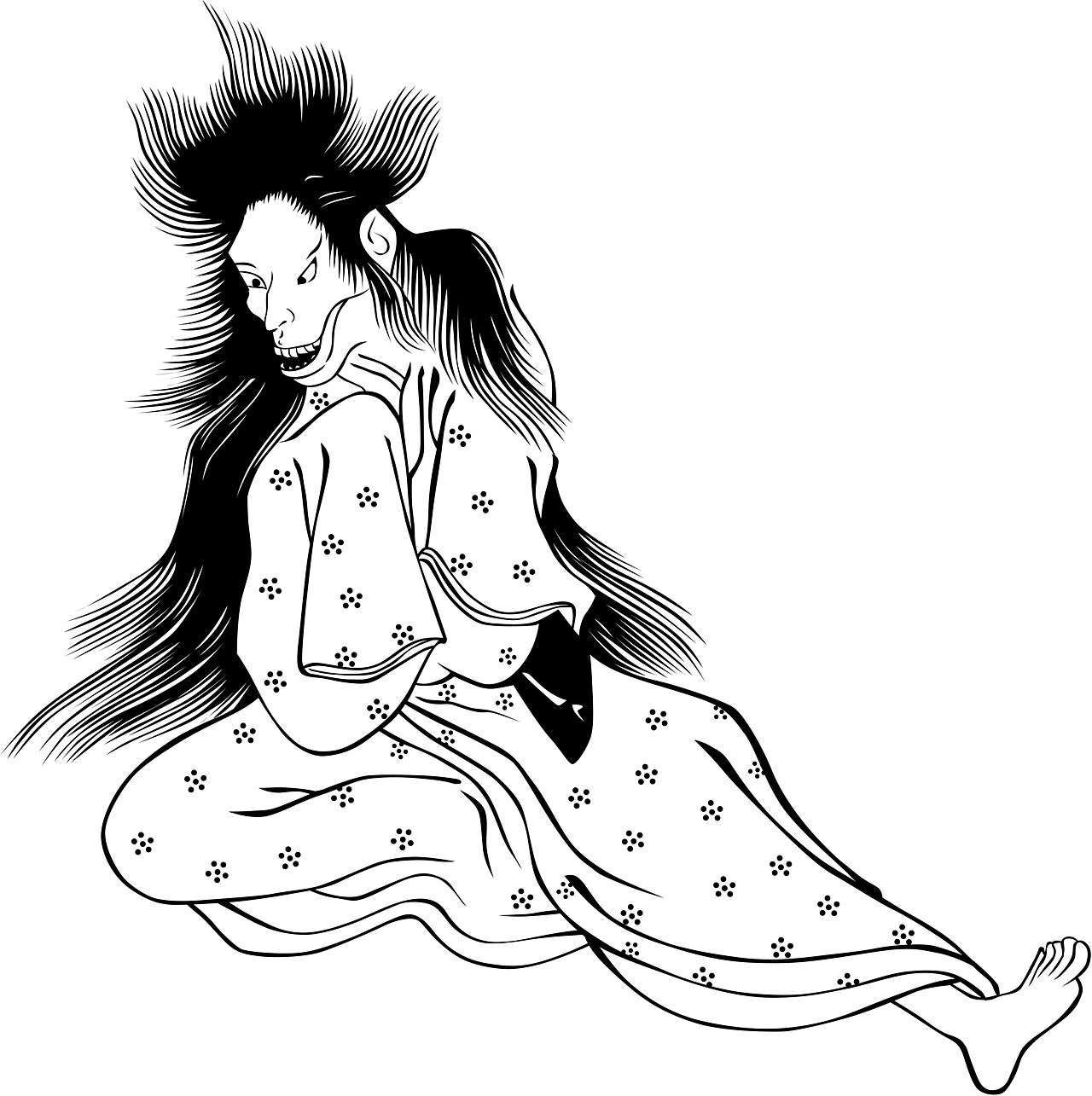
Japanese scholars, however, tend to keep the two apart. The Kuchisake-onna we know today, with the mask, the question and the scissors, doesn’t come straight from old folklore. She’s a modern monster, a child of the late 1970s.
Six months that scared a nation
Her story can be traced almost day by day. In December 1978, in a village in Gifu Prefecture, a rumour spread that an elderly farmer had seen a slit-mouthed woman near the outdoor toilet of her house and fainted from fright. On 26 January 1979 a local paper, the Gifu Nichinichi Shimbun, mentioned in a column a strange rumour going around among children.
In March the national weekly Shukan Asahi picked it up, followed by other magazines. Every article multiplied the sightings, and every sighting added a detail. By June the story had reached from the far north of Japan to the far south. On 29 June Shukan Asahi ran a long feature on it. A week earlier, in Himeji, the woman with the knife had been arrested.
Then, in August, it all stopped. Schools closed for the summer and the legend deflated almost overnight. According to the scholar Yoshiyuki Iikura, the reason is simple: what had spread it were the juku, the evening cram schools. Children from different neighbourhoods and schools met there and carried the rumours home. Once the juku closed, the chain was broken.
More recent research, such as that of the writer Yoshida Yūki, shows that rumours about a “slit-mouthed woman” were already around a few years before 1979. In one of the oldest versions to reach the papers there was nothing supernatural at all: people were warned to watch out for a woman who made up her mouth to look slashed in order to scare passers-by. 1979 turned a person into a monster.
What it’s really about
Those who study the legend see in it many of the fears of the time. Children walking home alone, late, after cram school. Families in which both parents worked. Pressure around female beauty and the spread of cosmetic surgery. And the oldest fear of all: the stranger who stops you in the street.
There’s a more mischievous theory, too, told in Japan: that the rumour was spread by families who couldn’t afford cram school, to frighten the children of their better-off neighbours and keep them home at night. There’s no evidence for it, but it says a lot about how sensitive the subject was.
And then there’s the mask. Even then, wearing one for a cold or hay fever was common in Japan. That’s exactly why a masked woman didn’t stand out. She was just anyone, until she took it off.
A legend that won’t die
Kuchisake-onna never really went away. The folklorist Tōru Tsunemitsu put her at the centre of his studies of school ghost stories, which became a publishing phenomenon in the 1990s. She has returned in films, manga and video games.
And even now, they say, people still meet her. At dusk, on a narrow street, a tall woman in a mask looks you in the eye and waits for an answer. If it happens to you, remember: she’s neither pretty nor ugly. She’s average.
If you enjoyed this, read our other Japanese legends: Toire no Hanako and Hitori Kakurenbo, the hide-and-seek ritual you play alone.
🦋 Emadion lives through its readers. If this story kept you up at night, buy me a coffee: it helps me bring you the next nightmare.
☕ Support Emadion on Ko-fiSources
- Yokai.jp, Kuchisake-onna in 1979: timeline and Japanese sources
- Bunshun Online, excerpt from Yoshida Yūki, Gendai kaidan kō (in Japanese)
- Tokyo Weekender, Kuchisake-onna
- Uncanny Japan, Kuchisake-onna
- Mynavi News, variants of the legend and the “pomade” (in Japanese)
- Wikipedia, Kuchisake-onna
Featured image: a slit-mouthed woman in the Ehon Sayoshigure (1801), photo by Tanapat, Wikimedia Commons, CC BY-SA 4.0.