 Posted by
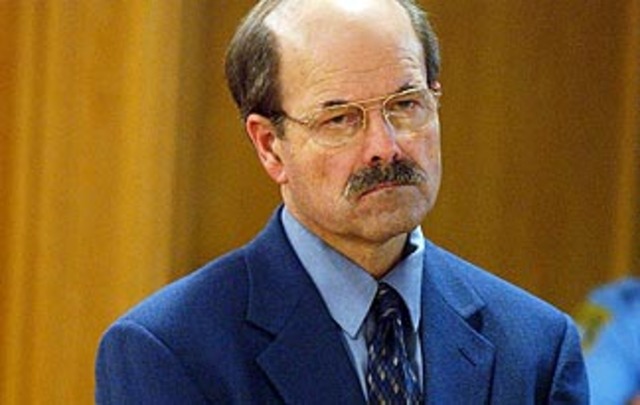
Dennis Rader, born in 1945, killed at least ten people between 1974 and 1991 in Wichita and Park City, Kansas. He signed himself BTK, “Bind, Torture, Kill”, and wrote letters to police and newspapers. By day he was a husband, a father and president of his Lutheran church council. He was betrayed in 2005 by a floppy disk he himself had mailed, and is serving ten consecutive life sentences.
Dennis Rader is an American serial killer, imprisoned for the murder of 10 people. His nickname, BTK, stands for Bind, Torture, Kill. His victims were in fact bound and tortured before being killed.
Biography
Dennis Lynn Rader was born on March 9, 1945 in Pittsburg, Kansas, the eldest of four brothers, and grew up in Wichita, the same city where he would later commit his murders.
As a boy, like many serial killers, he tortured animals and had a fetish for women’s underwear.
As an adult he stole underwear and other personal items from his victims, such as driver’s licenses, and kept them as trophies. On the surface, though, his life was quiet: in 1966 he joined the US Air Force, also serving in Turkey, Greece and South Korea, then graduated and on May 22, 1971 married Paula Dietz at Christ Lutheran Church in Wichita. They had two children, Kerri and Brian.
From 1974 to 1988 he worked at the Wichita office of ADT, a security company, installing alarms. And, ironically, many people worried that the BTK killer might break into their homes called his very company to have an alarm installed. He later became a dogcatcher and compliance officer in Park City, where neighbors remember him as a fussy, extremely strict man. He was also a Cub Scout leader and president of his church council.
The BTK killer’s victims

He has ten confirmed victims, four of them from a single family: father, mother and two children aged 11 and 9.
- January 15, 1974: Joseph Otero, his wife Julie and two of their five children, Josephine and Joseph II;
- April 4, 1974: Kathryn Bright, 21 (her brother Kevin was wounded but survived);
- March 17, 1977: Shirley Vian Relford, 26;
- December 8, 1977: Nancy Fox, 25;
- April 27, 1985: Marine Hedge, 53, one of his neighbors;
- September 16, 1986: Vicki Wegerle, 28;
- January 18, 1991: Dolores Davis, 62.
His modus operandi was more or less always the same: he broke into his victims’ homes, tied them up, often with objects found there, and then suffocated them with a plastic bag or strangled them.
He liked to torture his victims by bringing them close to unconsciousness and then bringing them back, before killing them. This gave him sexual pleasure. He even gave code names to his “projects”: Nancy Fox was “Project Foxhunt”, Vicki Wegerle “Project Piano”, Marine Hedge “Project Cookie”.
The killing of the Otero family
During his trial he described how he killed the members of the Otero family. He thought only the wife and two children would be home, but the husband was there too. He waited at the back and, when they opened the door to let the dog out, he went in.
He said he was a wanted man, pulled out a gun and demanded the car keys and food. Then he tied up the whole family hand and foot. It was at that moment he realized his face was uncovered and his victims could recognize him, and he decided to kill them.
He put a plastic bag over Joseph’s head and strangled Julie. Joseph managed to chew a hole in the bag and he put another one over it. Then he also killed the two children. Mrs. Otero, before dying, begged him to spare her son.
His later victims were mostly women living alone. Rader also confessed that one of his potential victims survived only because she came home late: in 1979 he had broken into the home of Anna Williams, 63, and waited for her, but after a few hours he gave up and left in a rage.
Letters to the press
Rader soon began writing letters to newspapers. In one he complained that no one was talking about him: “How many do I have to kill before I get a name in the paper or some national attention?”. He said he was driven to kill by a “factor X”, something supernatural that he believed had also driven Jack the Ripper and the Son of Sam.
At the end of the letter he even suggested some nicknames for himself, including “BTK”, the Wichita Strangler, the Poetic Strangler, the Bondage Strangler and the Garrote Phantom.
In January 1988 Mary Fager, whose husband and two daughters had been murdered shortly before, received a poem signed BTK. Rader, however, denied being responsible for that crime and, after his arrest, it was confirmed he was not.
The return of BTK

His last murder was in 1991 and by then the case had become one of America’s most famous cold cases. In 2004, however, after thirteen years of silence, Rader started writing again to newspapers, TV stations and police, sending eleven communications in all.
In one of them he claimed the murder of Vicki Wegerle on September 16, 1986, which until then had not been linked to BTK, enclosing some crime scene photos and a photocopy of the victim’s driver’s license, stolen during the murder and never found by police.
Throughout 2004 he kept sending letters and packages with all kinds of objects to newspapers, TV stations and police.
The capture
In one of these letters the BTK killer asked police whether it was safe to send his messages on a floppy disk without being traced. Police replied with a classified ad in the paper: “Rex, it will be ok.”
On February 16, 2005 Rader sent a floppy disk to Wichita TV station KSAS. In the metadata of a deleted Word file police found two pieces of information: “Christ Lutheran Church” and the last user who had modified it, “Dennis”. A quick search revealed that Dennis Rader was president of that church’s council. When investigators drove past his house, they saw a black Jeep Cherokee parked outside, like the one caught on a surveillance camera as BTK dropped off one of his packages.
But they needed conclusive evidence. So they used the DNA of his daughter, Kerri, obtained with a warrant from a pap smear kept at the Kansas State University clinic, and compared it with DNA found under Vicki Wegerle’s fingernails. It was a familial match: the decisive proof.
Dennis Rader was arrested on February 25, 2005 while driving near his home. When an officer asked if he knew why he was going downtown, he replied: “Oh, I have suspicions why.” On June 27, 2005 he pleaded guilty. He was sentenced to 10 consecutive life terms, which he is serving at El Dorado Correctional Facility in Kansas.
BTK today
In July 2005 his wife Paula was granted an emergency divorce. Neither she nor the children had ever suspected anything. His daughter Kerri Rawson has spoken in books and interviews about how hard it is to reconcile her “normal” childhood with having been raised by BTK, and in 2025 Netflix devoted the documentary My Father, the BTK Killer to her.
In 2023 Rader was named the prime suspect in the disappearance of Cynthia Kinney, a 16-year-old girl who vanished in 1976 in Pawhuska, Oklahoma, after words such as “Kinney”, “laundry mat” and “Pawhuska” were found in his writings. He was also suspected in the 1990 murder of Shawna Garber, but investigators later concluded a different killer was responsible.
If you want to know more about Dennis Rader, read Bind, Torture, Kill: The Inside Story of BTK, the Serial Killer Next Door and My Boss was the BTK Killer… I was the Next Victim.
🦋 Emadion lives through its readers. If this story kept you up at night, buy me a coffee: it helps me bring you the next nightmare.
☕ Support Emadion on Ko-fi