 Posted by
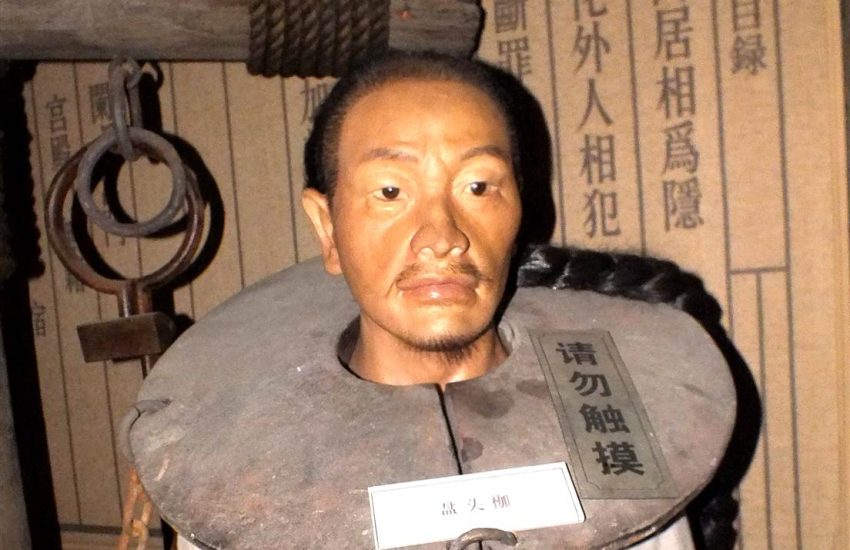
Ancient China had some of the cruellest tortures and punishments: lingchi (death by a thousand cuts), being cut in two at the waist or torn apart by horses, flaying, boiling and the scraping of skin, as well as the mutilations of the “Five Punishments” (tattooing, cutting off the nose, amputation, castration, death). The mutilating punishments were abolished in 167 BC by Emperor Wen of Han.
Ancient Chinese tortures
Chinese tortures are often considered the most atrocious, and this article will show you why: I am about to describe the most terrible Chinese tortures used in ancient times.
“But Lilith, why the ancient ones?” Well, simply because in China torture is still in use (though not officially), and I decided to write a separate article devoted entirely to modern Chinese tortures.
Lingchi, or death by a thousand cuts

This torture, as the name suggests, consisted of making many cuts on the body of the prisoner, who was tied to a post. Death came from blood loss and shock, but sometimes they went beyond simple cuts: whole pieces of flesh were removed, usually from the chest, arms, buttocks and thighs. I have devoted a whole article to this torture, which you can find by clicking here.
Quartering
Although I have already written an article devoted to quartering, the methods of execution in China were different from Western ones.
The first method consisted of cutting the victim in two at the waist. This meant the poor wretch did not bleed to death at once, but stayed alive for a few endless minutes. During the Tang dynasty (618-907) this fate befell Bianji, a Buddhist monk. His crime was having fallen in love with Princess Gaoyang, daughter of Emperor Taizong.
The second method involved horses. The victim’s head and each limb were tied to different horses, which were then whipped and spurred into a gallop. In this way the prisoner’s body was, in the worst case, torn apart; otherwise it was violently stretched, causing pain, dislocated joints and torn tendons. If the strength of the horses was not enough to tear him apart, the executioners stepped in and cut off the limbs and head.
Flaying (or skinning)
Here too there is already an article on flaying, but once again Chinese methods differed from Western ones. In China flaying could be carried out in two ways: with knives or with mercury.
Flaying with knives
In this case two incisions were made along the spine of the living victim, one immediately to the right and one immediately to the left. Then the skin was peeled away all the way to the extremities. Once removed, the skin was spread open like a pair of wings. According to the accounts that have reached us, the victim could survive like this for a whole day.
Flaying with mercury
This technique consisted of burying the person upright, leaving only the head above ground. Then two X-shaped incisions were made on the scalp and the scalp was removed. The executioner then poured mercury into the wounds, which, because of its weight, seeped under the skin and detached it. The victim was held still by the earth but suffered atrocious pain, being flayed from the inside. Then the victim was pulled out of the ground once the skin had completely come away from the body.
Be careful, though: this mercury variant is found mainly in modern stories and legends, and there are no reliable historical sources proving it was ever really practised.
Some corrupt officials of Emperor Zhu Yuanzhang (Ming dynasty, 14th century), on the other hand, were certainly flayed. Their skins were stuffed with straw and displayed in the city as a warning. Centuries earlier, rulers such as Sun Hao (kingdom of Wu), Fu Sheng (Former Qin) and Gao Heng (Northern Qi) were known for having the faces of the condemned flayed.
Boiling to death
As you can easily guess, people subjected to this torture were put in a large cauldron of boiling water. Sometimes this torture was used for interrogation, and so only some limbs were plunged into the boiling water. To read the details of boiling to death, visit the dedicated article.

Scraping of the skin
Boiling water is also the protagonist of this torture, and its inventor was Zhu Yuanzhang, the first emperor of the Ming dynasty. The victim was first stripped naked and made to lie on a metal board, then boiling water was poured over them. The water scalded the victim’s body, and the executioner used a toothed metal tool, like a comb, to scrape away the skin and flesh down to the bone. Given the atrocity of the torture, the victim usually died before it was over.
Amputation
Amputation was meant to cause pain and irreparably damage the victim’s body without killing them. It was one of the “Five Punishments”, and usually the nose, feet or legs were amputated, while in some cases the kneecaps were removed. This torture not only caused pain, but also prevented the victim from working and so from supporting themselves, as well as, obviously, from committing any further crimes.
Castration
Castration was also one of the “Five Punishments” and was originally a purely male penalty. Men had their penis and testicles cut off with a knife. Then the area was covered with an ointment to stop the bleeding, and a goose quill was inserted into the urethra to stop it closing up as the wound healed. For women, instead of castration, solitary confinement was imposed, to prevent any contact with the opposite sex.
This changed under the Ming dynasty, however, and women too began to be subjected to castration (although, despite the name, it was not a real removal of the ovaries). Female castration was carried out by savagely beating the woman’s abdomen until it caused damage similar to a uterine prolapse.
Some even went as far as self-castration as a sign of loyalty to their emperor. One example of this enormous sacrifice was Gang Bing.
“Yes Lilith, but what are the Chinese Five Punishments?” I’ll explain right away! 🙂
The Chinese Five Punishments

“Five Punishments” was the name given to a series of physical punishments in force in ancient China. They are divided into:
- the five punishments in ancient China
- the five punishments in dynastic China
- the five punishments for women
The five punishments in ancient China
- Mò or qing: the criminal was given an indelible tattoo on the face or forehead. For the first crime the right forearm was tattooed, for the second the left, and for the third the forehead and/or face.
- Yì: the criminal’s nose was cut off, without any anaesthetic.
- Yué or bin: the amputation of one or both feet, of the legs, or the removal of the kneecaps.
- Gong, yinxing, fuxing or canshi xing: the removal of the penis and testicles. This penalty was imposed for adultery or promiscuity.
- Dà pì: finally, the death penalty, which could include quartering, beheading and strangling.
The five punishments in imperial China
The earlier mutilating punishments were abolished during the Han dynasty by Emperor Wen (in 167 BC, after the plea of a girl, Chunyu Tiying, who offered herself as a slave to save her father from mutilation), and after various changes, under the Sui and Tang dynasties (581-907), they became these:
- Chi: criminals were beaten on the buttocks with a bamboo cane. This penalty had five degrees: 10 strokes (or a payment of 600 wén), 20 strokes (or 1 guàn and 200 wén), 30 strokes (or 1 guàn and 800 wén), 40 strokes (or 2 guàn and 400 wén), 50 strokes (or 3 guàn).
- Zhàng: criminals were beaten with a stick on the back, buttocks or legs. This penalty also had five degrees: 60 strokes (or 3 guàn and 600 wén), 70 strokes (or 4 guàn and 200 wén), 80 strokes (or 4 guàn and 800 wén), 90 strokes (or 5 guàn and 400 wén), 100 strokes (or 6 guàn).
- Tú: imprisonment, in 5 degrees: 1 year in prison plus 60 strokes (or 12 guàn), 1 and a half years plus 70 strokes (or 15 guàn), 2 years plus 80 strokes (or 18 guàn), 2 and a half years plus 90 strokes (or 21 guàn), 3 years plus 100 strokes (or 24 guàn).
- Liú: exile to a distant place, without permission to return to one’s birthplace. This penalty had three degrees: 1,000 kilometres plus 100 strokes of the stick (or 30 guàn), 1,250 kilometres plus 100 strokes (or 33 guàn), 1,500 kilometres plus 100 strokes (or 36 guàn).
- Sǐ: the death penalty by strangling or beheading. From the Song dynasty onwards lingchi was also used. The death penalty could be avoided by paying 45 guàn.
Bear in mind that 1 guàn was worth 1,000 wén.
The five punishments for women

These punishments were used on women instead of the traditional ones:
- Xingchong: the criminal was forced to grind grain.
- Zanxing: the criminal’s fingers were squeezed with sticks between them, causing great pain.
- Zhangxing: the criminals were beaten with sticks.
- Cisi: forced suicide.
- Gongxing: confinement in a room. This was the penalty for adultery or promiscuity.
It is not clear why women were given different punishments, but one hypothesis is that women were considered inferior beings, so much so that they were not held fully responsible for a crime. It was the husband or father who had to watch over what a woman did, as if she were an animal to be kept in check.
The water torture
“Lilith, why didn’t you write about the famous Chinese water torture?” You’re right, the water torture is perhaps the most famous of all Chinese tortures. But there is a reason why I did not include it here. To find out, read the article 😉
🦋 Emadion lives through its readers. If this story kept you up at night, buy me a coffee: it helps me bring you the next nightmare.
☕ Support Emadion on Ko-fi