 Posted by
During works on junction 10 of the M5 motorway near Cheltenham (Gloucestershire, England), archaeologists from Archaeological Research Services have uncovered a Roman-era cemetery with more than 100 burials. More than 50 are “non-normative”: some of the dead were decapitated, others buried crouched. Such graves are usually very few in a Roman cemetery: here they are more than half. Why is still a mystery.
It was supposed to be one of the many preventive digs that come before a road project. A field near Cheltenham, in the heart of the English countryside, to be cleared before widening a junction of the M5 motorway. Instead, just beneath the surface, archaeologists found row upon row of graves. And the more they dug, the more they realised something was off in that cemetery.
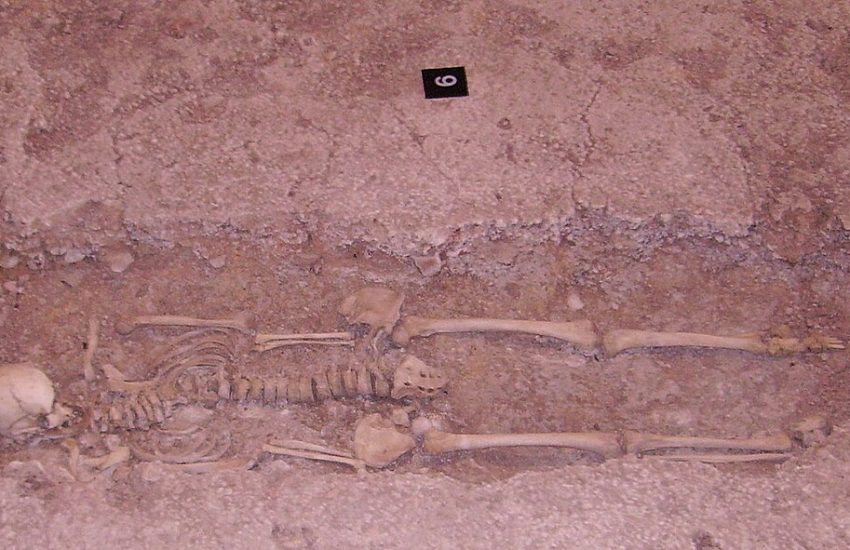
Many of the dead had not been buried the way the Roman world usually did, lying on their backs. Some were curled up on their side. Others no longer had their heads in place.
The discovery under the motorway
Excavations began in early 2026 and are being carried out by Archaeological Research Services (ARS) for Gloucestershire County Council, as part of the M5 Junction 10 improvement scheme, a project of around £407 million due to be completed in 2029. Traces from very different periods have emerged in the area, from the Palaeolithic to the Anglo-Saxon period, but the heart of the discovery is a Roman-era cemetery.
More than 100 burials have been recorded so far. Alongside the human remains, well-preserved brooches, bracelets, pottery, bricks and roof tiles have come to light, as well as animal bones and coins. All the material will now go to specialists, who will have to pin down the dating of the graves and work out who the people buried there were.
More than half the graves “break the rules”
What struck the archaeologists was something else. More than 50 burials have been described as “non-normative”, that is, different from the funeral rite one would expect in a Roman cemetery. Some bodies were decapitated, others laid in a crouched position with their knees bent.
According to project manager Ada Torka-Lis, in a Roman cemetery these burials usually make up only a small percentage of the total. Here they are more than half. That, she told the BBC, is what makes the site unique, so much so that it could be of national importance. The archaeologists, however, prefer to wait for the analyses before saying so with certainty.
A very British mystery
Burials of decapitated people are not entirely new to English archaeology. Quite the opposite: they are one of the great puzzles of Roman Britain. Between the 3rd and 4th centuries AD, bodies buried with their heads removed, often placed between the legs or near the feet, appear in several cemeteries on the island. It is a phenomenon almost unknown in the rest of the Empire, to the point that several scholars consider it an almost exclusively British peculiarity.
One of the best-studied cases is Knobb’s Farm, in Cambridgeshire. There, out of 52 Roman-era burials, 17 were of decapitated people, adult men and women. In 2021 a study published in the journal Britannia suggested they were people sentenced to death: at that time Roman law prescribed capital punishment for a growing number of crimes. Not all experts agreed, however. Some pointed out that those villages were far from the towns where justice was administered, and that similar graves are almost never found elsewhere in the Empire.
In York, in a Roman cemetery excavated at Driffield Terrace, dozens of skeletons of young men have emerged, many of them decapitated. Some have suggested gladiators, others soldiers or executed prisoners: there too, there is no definitive answer.
Punishment, ritual or fear of the dead?
Why would anyone separate a dead person’s head from the body? There are three main theories, and they are not mutually exclusive. The first is the simplest: execution. Beheading was a penalty under Roman law, and some of these people may have been sentenced to death and then buried in the community cemetery.
The second looks at ritual. In many cases bone analysis suggests the head was removed after death, carefully, and then placed in a specific spot in the grave. Not a punishment, then, but a funeral gesture whose meaning escapes us today: perhaps a way of accompanying the dead, perhaps a local custom that survived Romanisation.
The third theory is the one that most fires the imagination: the fear that the dead might come back. In many cultures, separating the head from the body, tying up the corpse or burying it face down served to stop the dead from rising and tormenting the living. These are the same gestures we find centuries later in the so-called “anti-vampire” burials of Eastern Europe. Crouched burials too, a tradition much older than Rome, may reflect beliefs of this kind, or simply the memory of local customs.
What Cheltenham could reveal
The M5 cemetery could help answer these questions precisely because it is so rich in unusual burials. Analysis of the bones will show whether the beheadings happened before or after death, the age and sex of the dead, and the diseases they suffered from. Isotopes and DNA could reveal whether they were locals or outsiders, and whether they were related.
For now, beneath a motorway junction, lies a community of more than a hundred people who two thousand years ago chose to treat half of their dead differently. To punish them, to honour them or to make sure they stayed underground: that is what archaeologists will try to understand in the coming years.
If you are fascinated by places where the living treated the bones of the dead in unusual ways, read the story of the Sedlec Ossuary, the bone church of Kutná Hora, and discover the bog bodies, preserved for millennia in the peat bogs of northern Europe.
🦋 Emadion lives through its readers. If this story kept you up at night, buy me a coffee: it helps me bring you the next nightmare.
☕ Support Emadion on Ko-fiSources
- HeritageDaily – Unique Roman burial ground unearthed during M5 excavations (16 October 2026, from the BBC)
- Aventuras na História – Cemitério romano com decapitados é descoberto durante obras na Inglaterra (17 October 2026, Portuguese)
- Archaeological Research Services – M5 Junction 10 excavation diary
- Live Science – 17 decapitated skeletons found at ancient Roman cemetery (Knobb’s Farm, 2021)