
 Posted by
Naples ghost tour
Beautiful Naples has an artistic heritage just waiting to be discovered, one that immerses us in its ancient history. But the city is also shrouded in many mysteries, from its ghosts to its gruesome legends. Today I want to show you what you can visit in this city with this mystery tour of mysterious Naples.
The miracle of San Gennaro
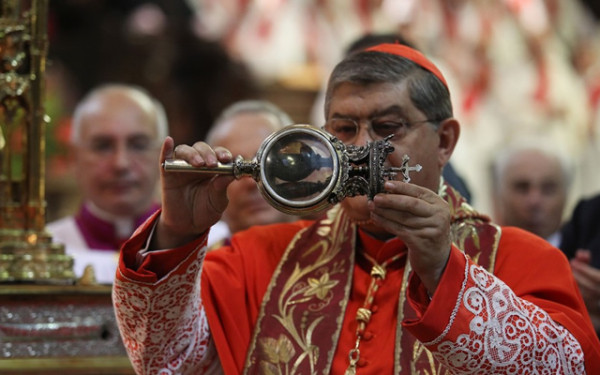
The miracle of San Gennaro (Saint Januarius) consists of the liquefaction of the saint’s blood, kept in a phial. The miracle happens three times a year in Naples Cathedral, where the remains of San Gennaro, the city’s patron saint, are kept. The dates of the miracle are 19 September, 16 December and the Saturday before the first Sunday in May. The phenomenon has supposedly been going on since 1389, the year it was first recorded.
The blood failing to liquefy is seen by the faithful as a sign of bad luck. It did not liquefy in 1939 and 1940, for example, at the start of the Second World War. Nor in September 1943, during the Nazi occupation, nor in 1973, the year of the cholera epidemic in Naples, nor in 1980, the year of the Irpinia earthquake, and more recently in 2020 and 2021, during the COVID-19 pandemic.
The miracle, described by the Church as a “prodigious event”, represents protection for the people of Naples. Sceptics, however, have an explanation: in 1991 three researchers from CICAP, Luigi Garlaschelli, Franco Ramaccini and Sergio Della Sala, managed to reproduce a similar effect with materials already available in the Middle Ages. According to their study, published in the journal Nature, the phenomenon could be explained by thixotropy, the property of some substances of becoming more fluid when shaken, as happens with ketchup.
The Sansevero Chapel Museum and the Veiled Christ
The Sansevero Chapel is full of mysteries and legends. To begin with, there are esoteric symbols, but above all there are two “anatomical machines” showing the circulatory system of a woman and a man. The two models were made by the Palermo physician Giuseppe Salerno and are a great mystery. To this day nobody knows how the doctor managed to preserve the arterial and venous system of the two subjects so perfectly.
There are two theories about how they were made: either a special substance, probably mercury-based, was injected into two corpses, or the venous system was reconstructed with beeswax and dyes. At the feet of the female “machine” there were also the remains of a foetus with umbilical cord and placenta, which were stolen a few decades ago.
The chapel, though, is perhaps more famous for the Veiled Christ by Giuseppe Sanmartino, sculpted in 1753. The statue shows the body of Christ covered by a transparent veil, all carved from a single block of marble. The veil is so well made that for many years people thought a real fabric had been used for it and then petrified through a “marbling” process. Today, however, we know the Veiled Christ is purely the work of the Neapolitan sculptor’s skill.
The Fontanelle Cemetery
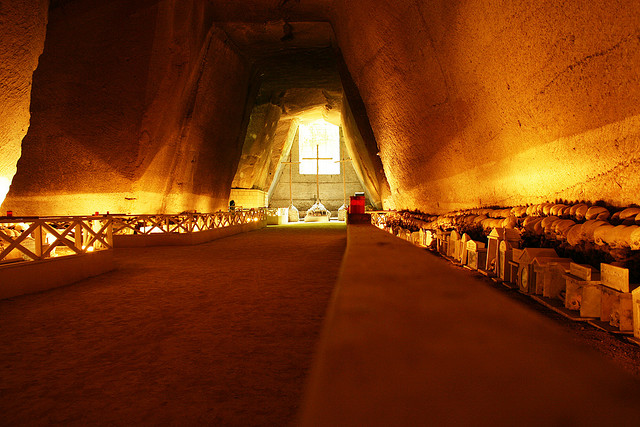
For years the Fontanelle Cemetery was devoted to the cult of the “anime pezzentelle” (the poor, abandoned souls). The cult began at the end of the 19th century and continued until 1969, when the Church banned it as too similar to some pagan rituals.
The cemetery lies in a tuff quarry that holds millions of bones, all strictly anonymous, kept there since the plague of 1656. Later those who could not afford a funeral and the victims of cholera (1836) were also buried there. After a flood, all the remains were washed out of the quarry and into the streets. The bones were later brought back into the quarries and arranged, and from then on the place became the city’s ossuary.
In 1872 the site was opened for worship, and people began adopting a skull (called a capuzzella), thereby adopting an abandoned soul, which was therefore called a “pezzentella”. The aim was to look after it and pray for the anonymous dead person, in order to receive favours once he or she had reached paradise.
The parish priest Gaetano Barbati arranged all the bones, placing the skulls on top of piles of tibias and long bones, and it is estimated that about 40,000 remains are still kept in the Fontanelle cemetery. The Church banned the practice of adopting a pezzentella soul, but you can still see skulls kept in makeshift cases, some bearing the year of “adoption”. Although the cult is banned, some devotees still place a small object on a skull, such as a coin or a bracelet, in a kind of new adoption.
The skull of Donna Concetta
Another legend is linked to the Fontanelle cemetery, that of the “capa che suda” (the sweating head). Many of the faithful believe that the skull of Donna Concetta exudes an oily substance that stains the hands of those who touch it. Legend has it that it is the sweat of the souls in purgatory.
The legend of the Captain
The legend of the Captain tells of a young woman who used to go and pray for the soul “of the Captain”. Her jealous fiancé went with her one day, stuck a bamboo cane into the skull’s eye socket, mocking it and inviting it to their wedding. On the day of the wedding a man in uniform turned up whom nobody knew. When the groom asked him who he was, he said it was the groom himself who had invited him, after blinding him. Then the bride, the groom and the guests all fell down dead.
Underground Naples and the munaciello
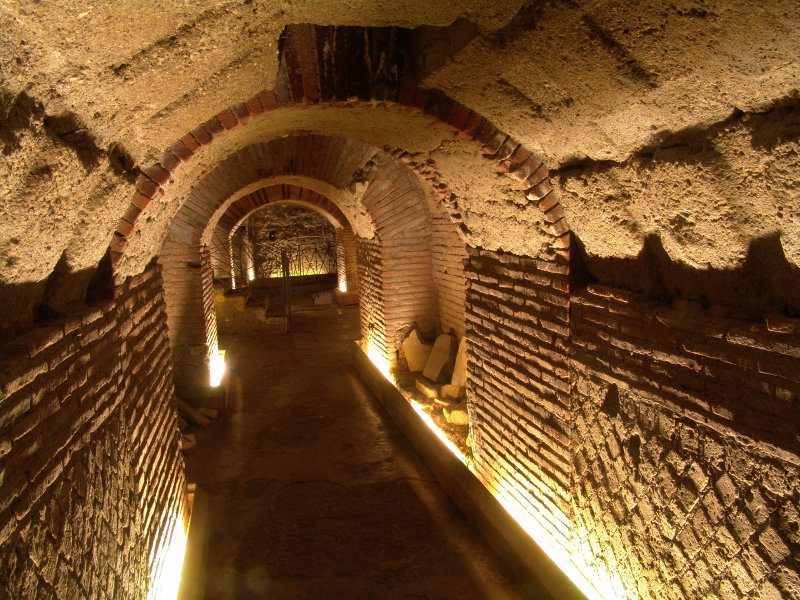
Beneath the city of Naples lies an underground Naples, made up of tunnels and labyrinths dug into the tuff. The first excavations are estimated to date back about 5,000 years, continued in the 3rd century BC by the Greeks to quarry tuff. Later the quarries were used as an aqueduct system. In the 17th century, however, the cisterns and aqueducts were no longer enough, and the Neapolitan nobleman Cesare Carmignano had a new aqueduct built. The old wells were left empty, and today you can walk through them on an atmospheric guided tour.
It is from these wells that the legend of the munaciello (the little monk) comes. The munaciello is a mischievous sprite of Neapolitan folklore, who sometimes steals money and sometimes gives it away.
The legend perhaps comes from the figure of the “pozzaro”, the man who worked in the cisterns that supplied water to Neapolitan homes. The pozzaro wore a hooded tunic that made him look like a monk, and thanks to his work he had access to every house. When someone paid him too little, it is said he would enter the house and steal what he was owed. Sometimes, instead, he would leave money or (stolen) jewellery as gifts for his lovers. When husbands asked their wives to explain a new ring or brooch, the women would reply that it was a gift from the munaciello.
Another legend says the original munaciello was the son of a noblewoman and a humble man. When her parents found out about the affair, they locked her in a convent. But the woman was already pregnant. After she gave birth to her son, who had a tiny body and a disproportionately large head, she was advised to have him work as a pozzaro. The boy wore a hooded cloak, and depending on its colour people thought he brought good or bad omens. If the cloak was red it was considered a good sign, while a black cloak was considered a bad sign.
Palazzo Donn’Anna, shadows and ghosts of fishermen lovers
In the Posillipo district, overlooking the sea, stands Palazzo Donn’Anna, one of the most beautiful and mysterious places in Naples. According to legend, its rooms are haunted by the shadows and ghosts of fishermen, the lovers of Donna Anna Carafa, wife of the viceroy Ramiro Núñez de Guzmán, Duke of Medina de las Torres. It is said that the noblewoman, after spending nights of passion with her lovers, would kill them by throwing them into the sea.
Other rumours say that one of the ghosts is that of Mercedes de las Torres, guilty of having kissed on stage, during a performance at a party, the nobleman Gaetano di Casapenna, Anna Carafa’s lover. From that day Mercedes disappeared and nothing more was heard of her.
Dracula’s tomb
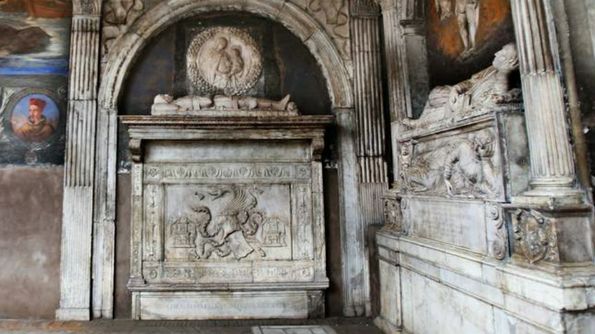
And what does Dracula have to do with Naples? Well, some scholars claim that Vlad III Țepeș of Wallachia, who supposedly inspired the character of Dracula, is buried in Naples. The date of Vlad’s death is unknown, but he is thought to have been killed in battle against the Turks between October and December 1476.
Some scholars, however, claim that he did fight the Turks but did not die, and was instead rescued by his daughter and taken to Italy. There he would have died and been buried in the church of Santa Maria la Nova. There are no written documents proving this theory and, unfortunately, the process to examine the contents of the tomb is very long.
Castel dell’Ovo
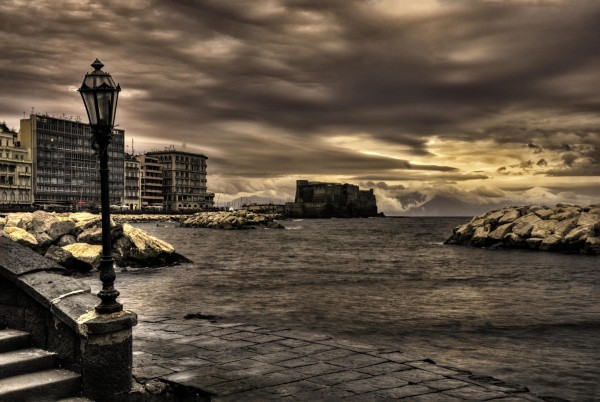
The legend of this castle lies in its very name (“Egg Castle”). It is said that the poet Virgil hid an enchanted egg in the castle’s dungeons. He put it in an iron cage containing a jug of water with the egg immersed in it, and then hung the cage from a beam in a secret room. According to legend, as long as the egg remains intact the castle and the city will be protected. To this day the egg has never been found.
This tour of mysterious Naples ends here. If you know other mysterious places in Naples, write them in the comments or send me an email.
🦋 Emadion lives through its readers. If this story kept you up at night, buy me a coffee: it helps me bring you the next nightmare.
☕ Support Emadion on Ko-fi