 Posted by
In today’s China torture is banned by law but remains widespread, especially against Falun Gong practitioners (persecuted since 1999), Tibetans and, since 2017, the Uyghurs of Xinjiang. Beatings, electric batons, force-feeding, the “tiger chair”, sleep deprivation, isolation and forced labour are documented by survivors, NGOs and a 2022 UN report.
I have already written about Chinese tortures in another article, but that one was about the ancient ones. Today I will tell you about the Chinese tortures still used as a means of repression. Torture in China, although technically illegal, is still widely used, above all on two groups of people:
- Falun Gong practitioners
- The residents of Tibet
What is Falun Gong
Today one of the groups most tortured by the Chinese government is made up of Falun Gong practitioners.
“Ok Lilith, but what is Falun Gong?”
If the people who practise it deserve to be tortured, Falun Gong must be something truly terrible, you will think. Instead it is a set of practices and exercises involving meditation, mental concentration and particular movements. It is meant to purify body and mind through a series of 5 exercises and was introduced to the public in 1992.
Although it has nothing to do with politics, the Chinese government considers it a threat to the Chinese Communist Party. Falun Gong is a very large organisation with many followers, and the Chinese government is afraid it cannot control it (the way it controls everything else). So in 1999 a nationwide crackdown began.
Why torture Tibetans?
Tibetans too have for years been victims of persecution and torture by the Chinese government, but why? Tibet is a region within China’s geopolitical borders, but for decades it has claimed its independence. The Chinese government will not hear of it and represses demonstrations, or any idea different from the Communist Party’s, with prison and torture.
Tortures used on both groups
Some tortures are used more on one group than on the other, while others are common to both. I decided to start with the Chinese tortures used in both cases.
Beatings
This is the simplest form of torture to carry out. Prisoners are beaten until they bleed, struck with sticks, belts, metal pipes or simply kicked and punched.
During this treatment the victims often have their wrists tied to a rope hanging from the ceiling, with only the tips of their toes touching the floor.
Some survivors have told their stories, like Phuntsog, a 33-year-old man, who says:
They beat me with a shovel so hard that the handle broke
Or like Wang Yukun, who recalls:
They fractured my left leg and destroyed my kneecap
Sometimes a mixture of water and chilli pepper is poured into the wounds, the eyes or the nose. Victims who survive often have to be hospitalised for many months to recover from their injuries. In prison, in fact, they have no right to any medical treatment, not even when their life is at stake.
Electric torture
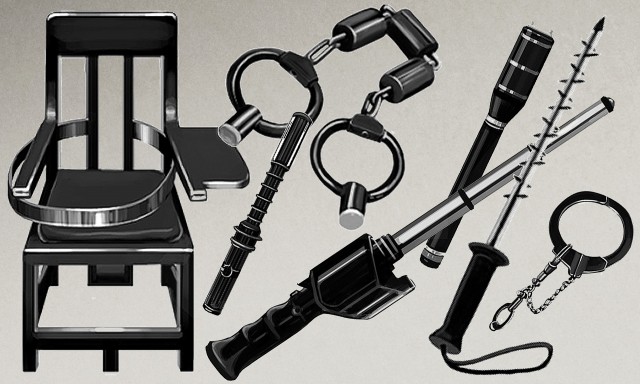
During beatings it is common for prisoners to be struck with electric batons. These are electrified truncheons that discharge high-voltage electricity into the victim and cause burns.
They are used on every part of the body but especially on the face, in the mouth, on the nipples and on the genitals, causing terrible pain and loss of consciousness. Each blow leaves a burn on the skin that can later become infected, which also makes the following shocks more painful.
Force-feeding
Force-feeding is also a torture used by the Chinese government. A tube is inserted into the prisoner’s nose and pushed down until it reaches the stomach. Then liquid food is poured into the tube, causing stomach pain.
Sometimes the torturers insert the tube very slowly to increase the pain, injuring the nose and the stomach. Other times the torture consists of inserting and pulling out the tube many times in a row. Or the tube is left in the stomach for hours while the prisoner, tied up, cannot remove it.
This method is used above all on prisoners who go on hunger strike in protest. What goes into the tube, however, is not always food. Sometimes substances such as vinegar, saline solutions, boiling water, urine or faeces are poured in to induce vomiting.
Forced labour
When they are not being tortured, prisoners are forced into hard labour. Many survivors remember being woken at 5 to sew clothes or make dried or plastic flowers. The shift starts at 5 in the morning and ends at 9 in the evening.
Guards receive a bonus if their prisoners produce more, so they make them work gruelling shifts. During the shift two short breaks are allowed for the two meals and a few for the toilet. If someone cannot finish the work in time, they have to keep going all night, which leads to sleep deprivation.
L.X recalls:
We made dried and plastic flowers. […] My hands were bleeding from the little wounds of the thorns
The products, which include clothes, sheets, pillows and little flags, are then exported. Prisons also have wheat fields, and prisoners are forced to grow and process the wheat, carrying sacks weighing up to 50 kg.
The chair
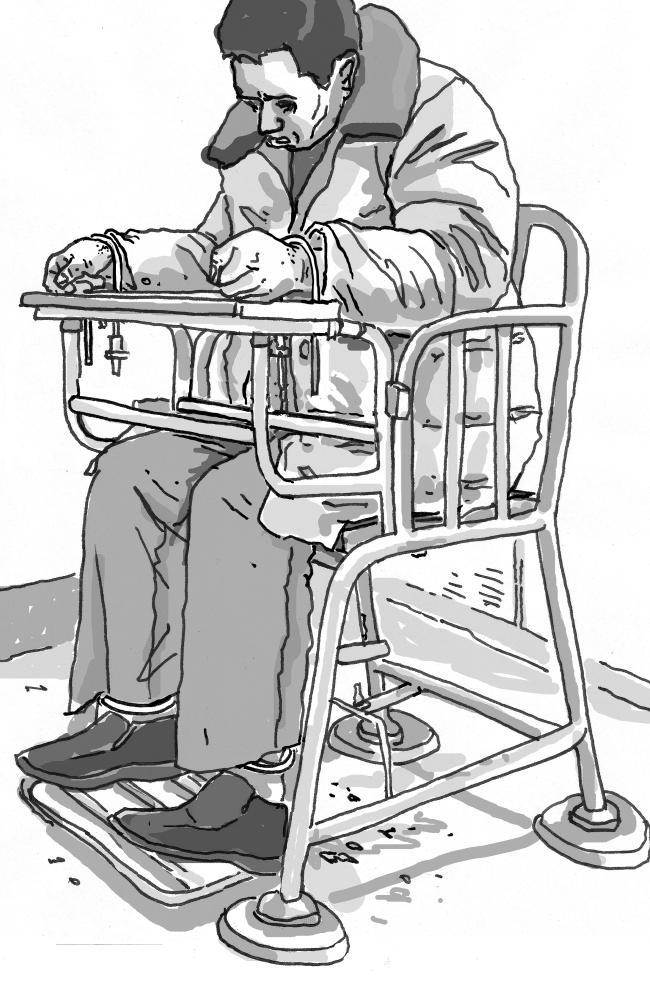
A widely used torture is the chair. The prisoner is tied hand and foot to a metal chair and left like that, sometimes for several days in a row. This causes excruciating pain and bleeding in the legs and buttocks.
In other cases victims are tied to the chair so that the upper body has no support at all and their whole weight rests on the legs.
Golog Jigme describes his experience with the chair:
The pain caused by the chair was so extreme that I did not feel the pain of the other tortures. When they beat me with the electric baton I felt no pain at all. I only smelled my own flesh burning.
Golog was tied to the chair for so long that his feet swelled until all his toenails fell off.
Deprivation of food, water and sleep
Food rations in Chinese prisons are very meagre. Two meals a day are served, but sometimes prisoners are left without food for days. When they are allowed to eat, the meal is not nourishing: rice boiled in water with sand, or spoiled food.
Very little water is given, which is extremely dangerous given how much blood prisoners lose. Some, desperate with thirst, are forced to drink from the latrine, risking infections.
Sometimes prisoners are forbidden to sleep. This is done by tying them in painful positions or exposing them to intense light and noise. If the prisoner tries to sleep, they are kicked and punched. Sleep deprivation can lead to a nervous breakdown and to both psychological and physical damage.
Isolation
Prisoners are not allowed to talk to each other or make eye contact. Sometimes, though, they are put in complete isolation. This means tiny cells where a single person barely fits. These cells are completely dark, with no window, bed or toilet, and prisoners are often chained to the door, unable to move. They are kept like this for days or entire months.
Sometimes they are put in metal cells which are then submerged in water up to the prisoner’s throat. This makes it impossible to sleep, or even to lean against the sides of the cage, since they are covered in spikes. If a prisoner loses consciousness, they drown.
Twisting and stretching of limbs and stress positions
Another torture that takes little effort is the twisting or overstretching of the limbs. This causes dislocated joints and excruciating pain. The torturers twist the prisoners’ arms behind their back, or use a rope, just like in the strappado.
The tiger bench
To stretch the legs, the so-called “tiger bench” is used instead. This is a wooden or metal board on which the prisoner is made to sit with legs stretched out. The hands are cuffed behind the back and the legs tied to the bench. Bricks are then placed under the feet until the legs are overstretched, causing severe pain.
Alternatively the prisoner is made to sit on the floor with legs straight. The upper body is pushed down onto the thighs and the prisoner is shoved under a bed. This position causes terrible pain in the legs and back, sometimes made worse by guards jumping on the bed.
Stress positions
Prisoners are forced to hold uncomfortable positions for hours or whole days: squatting, for example, or standing by a stool, or chained to doors. The pain of these unnatural positions is so strong that hunger, thirst and sleep often fade into the background.
Chinese tortures inflicted on Falun Gong followers
Some tortures are reserved for prisoners who practise Falun Gong, especially women.
Sexual abuse
Women who practise Falun Gong are sexually abused. Sometimes they are put, naked, in a men’s cell and the inmates are encouraged to rape the victim. Other times objects such as shoe brushes, toothbrushes or electric batons are inserted into the vagina or anus to cause injuries. Often, after the objects have torn the flesh, the area is sprinkled with chilli pepper.
Sexual torture of men includes rape by other inmates or guards, insertion of objects into the anus, and torture of the penis.
Forced abortion
Not even pregnant women are spared. On the contrary, they are often forced to abort. The abortion may be caused by repeatedly dropping the pregnant woman from various heights, by beatings or with drugs. Sometimes breastfeeding mothers are forcibly taken from their homes, leaving the newborn without its mother’s care to starve.
Roasting a whole sheep
This method was used above all on Falun Gong practitioners. The prisoner’s hands are tied behind the back. Then hands and feet are tied to a metal bar similar to a spit, and the prisoner is left in this position for several hours.
Chinese tortures inflicted on Tibetan prisoners
Some tortures are used especially on Tibetan prisoners, partly because of the climate of the region.
Exposure to cold
Prisoners are left to sleep outside in the cold, naked, or in cells with the windows wide open. Some say the cold is so intense that ice forms on the walls. This makes prisoners sick and weak, on top of depriving them of sleep.
Other times they are made to sit outside in a puddle of water. Because of the cold the water freezes, and sometimes the feet end up trapped in the ice.
Torture with boiling water or heat
Prisoners often have boiling water thrown on their head or body to cause burns, which then become infected. Other times they are handcuffed to a stove pipe that is then lit, so that their arms and face suffer serious burns.
Update: the Uyghurs of Xinjiang and the “tiger chair”
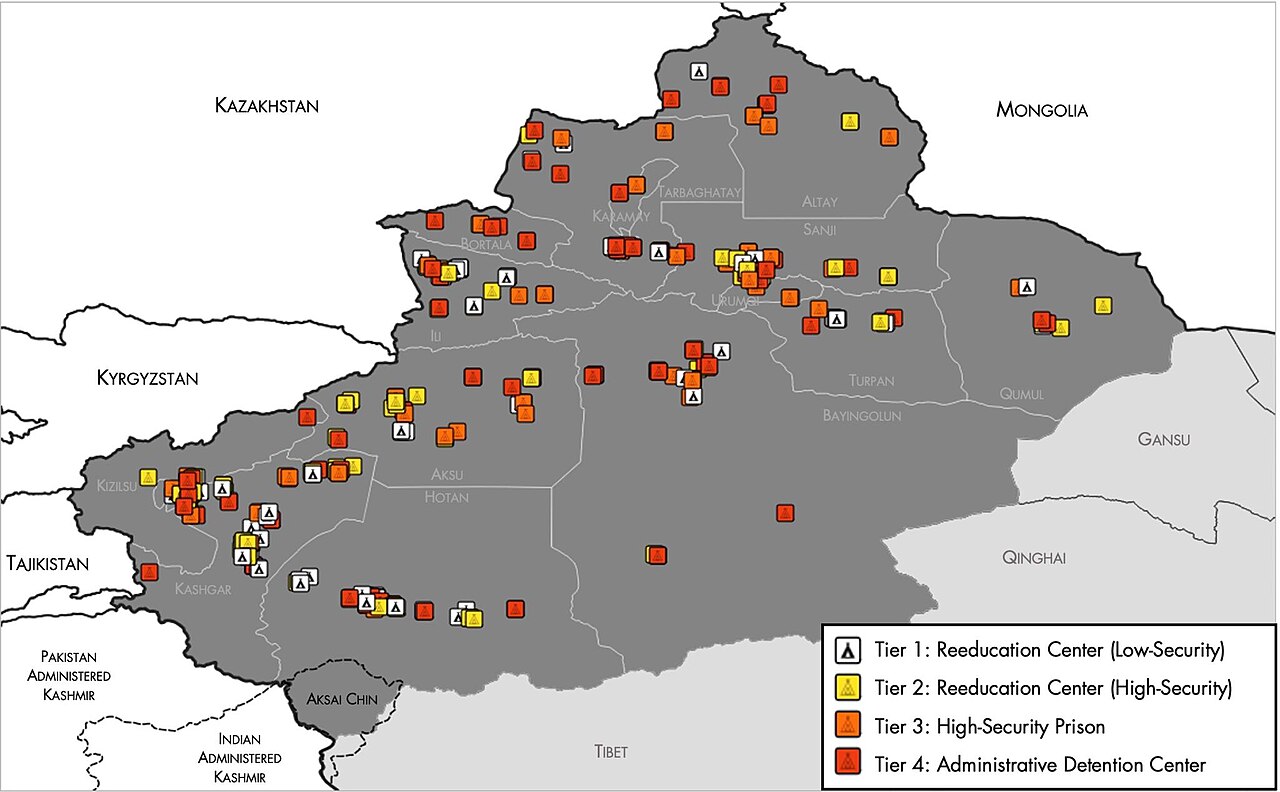
In recent years a third group has joined Falun Gong and Tibetans: the Uyghurs and the other Muslim minorities of Xinjiang. Since 2017, with the “Strike Hard” campaign against terrorism and extremism, the Chinese government has locked up a huge number of people in what it calls “vocational training centres”. The most cited estimates speak of more than a million detainees, a figure a UN committee found credible.
On 31 August 2022 the Office of the UN High Commissioner for Human Rights published a report finding credible the allegations of torture and ill-treatment in the camps, including sexual violence, and concluding that the arbitrary and discriminatory detention of Uyghurs may constitute crimes against humanity. Beijing rejected the report as slander and interference in its internal affairs.
And torture is not limited to political prisoners. In 2015 Human Rights Watch published the report Tiger Chairs and Cell Bosses, based on hundreds of court verdicts and interviews with 48 people, documenting how ordinary criminal suspects are also strapped for days into “tiger chairs” (the metal chairs I told you about above), hung by the wrists and left at the mercy of “cell bosses”, inmates the police put in charge of keeping the others in line.
One last thing: many of the testimonies about Falun Gong and Tibet in this article come from organisations linked to the two movements. That does not make them false (UN, Amnesty and Human Rights Watch reports describe very similar methods), but it is fair that you know.
These are the main tortures that Chinese prisoners suffer every day. The Chinese government denies every accusation of torture, but some survivors manage to escape from China and give their testimony.
The only limit to Chinese torture is the torturers’ imagination.
🦋 Emadion lives through its readers. If this story kept you up at night, buy me a coffee: it helps me bring you the next nightmare.
☕ Support Emadion on Ko-fiSources
- UN Human Rights Office report on Xinjiang, Wikipedia
- Human Rights Watch, Tiger Chairs and Cell Bosses: Police Torture of Criminal Suspects in China, 13 May 2015
- Persecution of Falun Gong, Wikipedia
- Xinjiang internment camps, Wikipedia