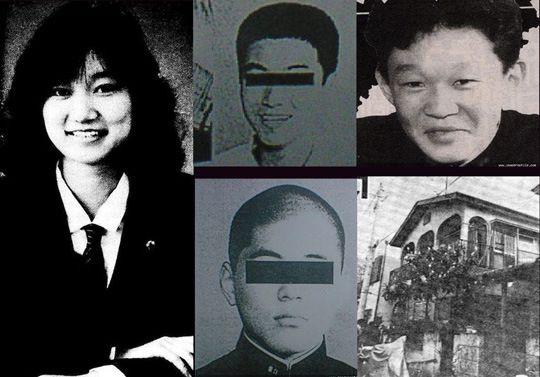
 Posted by
- Who: Junko Furuta, 17, a student from Misato, Saitama prefecture.
- When: abducted on 25 November 1988, died on 4 January 1989, after 40 days of captivity.
- Where: in a house in Tokyo’s Adachi ward.
- The culprits: four boys aged 16 to 18, involved in petty crime.
- Aftermath: the lenient sentences outraged Japan and contributed to the 2000 reform of the juvenile law.
Junko Furuta was a 17-year-old girl who in 1988 was abducted, tortured and killed by four boys: Hiroshi Miyano (18), Jō Ogura (17, who later changed his surname to Kamisaku), Shinji Minato (16) and Yasushi Watanabe (17), petty criminals on the fringes of the Japanese mafia.
What follows is the story of her 40 days of hell.
The abduction
On 25 November 1988, while cycling home from her part-time job, Junko was abducted. It is often said she was targeted because she had dared to turn down one of them. In fact, according to the trial reconstruction, that evening Miyano and Minato were riding around Misato on a motorbike looking for a girl to attack: Minato knocked her off her bike and Miyano, pretending to pass by chance, offered to walk her home. Then he threatened her, saying he was yakuza.
She was taken to the house of Minato’s parents, in Tokyo’s Adachi ward, where she would remain for 40 days, suffering atrocious torture.
To avoid suspicion, the kidnappers forced Junko to call her parents and say she had run away from home. She also had to say she was fine and did not want to be looked for.
That way nobody would look for her, and her tormentors were free to do as they pleased.
Minato’s parents, who lived in the same house, were told that Junko was one of the boys’ girlfriend. As they later stated, they immediately realised something was wrong, but did not ask too many questions because they were afraid of their son’s violent temper.
The 40 days of captivity

For forty days Junko suffered repeated sexual violence and torture of every kind, from her kidnappers and from other boys who were invited to the house. I will not report the details, out of respect for a girl who was only 17 at the time: suffice it to say that the medical reports and trial testimony described extremely serious injuries all over her body.
She was barely fed, beaten repeatedly on the face and body, and in the end her injuries were so severe that she could only crawl.
One day, taking advantage of a moment when the boys were distracted, Junko tried to call the police, but she was caught and punished even more harshly. One night they forced her to sleep on a balcony in the December cold. Her tormentors also took several photos, later used as evidence at the trial.
On 4 January 1989, after losing money at mahjong the night before, Miyano decided to take out his anger on her: the four beat her for about two hours, and Junko died shortly afterwards.
Her body was then put into a drum filled with concrete and dumped on a plot near a construction site on Wakasu island, in Tokyo’s Kōtō ward.
The discovery of the body
Her body was found almost by chance. In early 1989 Miyano and Ogura were arrested for the rape of another, 19-year-old woman and, during questioning, Miyano believed Ogura had already confessed to Junko’s murder and told police where to find the body. The drum was recovered on 29 March 1989 and Junko was identified by her fingerprints. The others were arrested soon after.
Since they were minors their identities were kept secret, but a weekly magazine published them. In July 1990 they were all convicted and the following year, on appeal, three of them received longer sentences: Miyano 20 years (the prosecution had asked for life), Ogura 5 to 10 years, Minato 5 to 9 and Watanabe 5 to 7. Sentences that much of the Japanese public found far too lenient for such a crime.
Although many people knew Junko had been abducted and where she was, nobody would help her for fear of reprisals.
The crime deeply shocked the public, which demanded harsher sentences for minors. Following this and other crimes committed by minors, in 2000 the Japanese juvenile law was reformed, and today young people from the age of 14 can be tried in an ordinary court (previously only from 16).
What happened to the killers
None of the four stayed in prison for long, and almost all of them went back to crime once released.
Hiroshi Miyano was released in 2009 and changed his surname to Yokoyama. In 2013 he was arrested for fraud, but not charged.
Jō Ogura was released in 1999 and took the surname Kamisaku. In 2004 he was arrested again for abducting an acquaintance and beating him for hours, and was sentenced to four years. He died in 2022, aged 51.
Shinji Minato was released in 1998. In 2018 he was arrested for attempted murder after attacking a 32-year-old man with a baton and a knife over a parking dispute. In 2019 he received a suspended sentence of a year and a half.
Yasushi Watanabe was released in 1996 and died in 2021, aged 49.
Several films and a manga have been based on Junko’s story. In many ways it recalls the case of Ah Map, a Hong Kong girl tortured and killed by members of the local underworld.
🦋 Emadion lives through its readers. If this story kept you up at night, buy me a coffee: it helps me bring you the next nightmare.
☕ Support Emadion on Ko-fi