
 Posted by
- Who: Raymond Martinez Fernandez (1914-1951) and Martha Jule Beck (1920-1951).
- Nickname: “the honeymoon killers” or “the lonely hearts killers”.
- How they operated: they lured lonely women through lonely hearts ads, then robbed them.
- Confirmed victims: three, Janet Fay, Delphine Downing and her little girl; suspected of many more.
- End: executed together in the electric chair on 8 March 1951.
Raymond Martinez Fernandez and Martha Jule Beck were an American serial killer couple, known as the honeymoon killers. The nickname comes from the fact that Raymond promised to marry the women he would then kill.
Biography
Raymond Martinez Fernandez
Raymond was born on 17 December 1914 in Hawaii to Spanish parents, who moved shortly after his birth to Bridgeport, Connecticut. Little is known about his childhood; as a young man he went to work on an uncle’s farm in Spain, where he married a local girl, Encarnación Robles, and had four children.
He abandoned his family, however, and served in both the Spanish merchant navy and British intelligence during the Second World War.
After the war he had an accident in which he fractured his skull and injured his frontal lobe. This trauma may have caused his social and sexual behaviour.
After the accident he was taken to hospital and treated, but after his release he was arrested for petty theft. In prison his cellmate taught him voodoo and black magic which, according to Raymond, gave him an irresistible charm over women.
After serving his sentence he moved to New York, where he began answering lonely hearts ads, seducing women and then robbing them. He was never arrested for these thefts because almost none of the women reported him, out of shame.
Martha Jule Beck
Martha Jule Seabrook was born on 6 May 1920 in Milton, Florida. She was always overweight, which, as was common at the time, was blamed on a glandular problem, and this caused early puberty. At her trial she said she had had a very difficult childhood and had been mistreated by her mother.
According to one anecdote, as a girl she ran away for a day to an uncle’s house, taking with her a 10-year-old boy who would later become the writer Truman Capote: he told the story himself in a 1957 interview. After finishing high school she trained as a nurse, but struggled to find work because of her weight. She became an undertaker’s assistant and then, during the war, a nurse at a military hospital in California, where she became pregnant.
The baby’s father would not marry her, and Martha went back to Florida and told everyone the father of the child she was carrying was a soldier killed in battle. The story even made the local paper, and the whole town rallied round her. Later she became pregnant by a Pensacola bus driver, Alfred Beck; they married hastily and divorced six months later.
Alone with two children, she took refuge in a fantasy world, reading romance novels and watching romantic films. In 1946 she found work at a children’s hospital, and in 1947 she placed an ad in a lonely hearts magazine, which Raymond answered.
The honeymoon killers’ scams
Raymond went to visit Martha and stayed with her for a while. Martha told everyone they were getting married and, while she organised the wedding in Florida, Raymond went back to New York.
Shortly after, she was suddenly fired and decided to abandon her children to join her beloved in New York.
Raymond thought that leaving her children to be with him was a sign of unconditional love, and confessed his crimes to her. Martha was not shocked; on the contrary, to devote herself entirely to him she left her children with the Salvation Army and wanted to take an active part in the thefts that followed.
Raymond would keep answering ads and Martha would pretend to be his sister, making him more credible in the eyes of the victims. Martha, however, was extremely jealous and did everything to stop Raymond having sex with his victims. When it happened, her reaction was violent.
The murders
In 1949 they committed the three murders for which they went down in history. Raymond had answered the ad of a 66-year-old widow, Janet Fay, who got engaged to him and moved into his Long Island flat.
Martha found them in bed together and, blinded by jealousy, took a hammer and smashed Janet’s skull. Raymond finished her off by strangling her and got rid of the body, but the victim’s family began to be suspicious.
The couple fled to Michigan, to Wyoming Township near Grand Rapids, where they met a 28-year-old widow, Delphine Downing, who had a two-year-old daughter, Rainelle. On 28 February Delphine was very agitated and Raymond gave her sleeping pills to calm her.
Seeing her mother in that state, the little girl began to cry and Martha, irritated, gripped her by the throat without killing her. Afraid of how Delphine would react on seeing the bruises on the child’s neck, Raymond decided to shoot her in her sleep.
The couple stayed in the house for a few days, until Martha, irritated again by the little girl’s crying, killed her too.
The arrest
They hid the bodies in the basement, but the neighbours were by then suspicious about Delphine’s absence and called the police, who on 1 March 1949 went to the house and arrested the couple.
Michigan, where they were, did not have the death penalty, so Raymond confessed at once, thinking this would save him from extradition to New York. He was wrong: both were extradited and Raymond tried in vain to retract his confession.
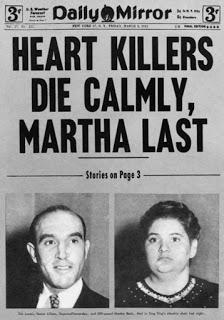
The press attributed up to 17 murders to them, which they always strongly denied, and the only one for which they stood trial was that of Janet Fay. The lonely hearts killers were sentenced to death and executed on 8 March 1951 in the electric chair at Sing Sing prison.
During the trial they declared their love for each other, and their last words were also of love.
Several films have been based on this story; I personally have seen and enjoyed “The Honeymoon Killers” (1970), which I recommend to everyone. Their story also inspired the Mexican film “Deep Crimson” (1996), “Lonely Hearts” (2006) with John Travolta, and the French-Belgian “Alleluia” (2014).
🦋 Emadion lives through its readers. If this story kept you up at night, buy me a coffee: it helps me bring you the next nightmare.
☕ Support Emadion on Ko-fi
Notevole anche il ‘romanzato’ Alléluia del belga Fabrice Du Welz del 2014.