Posted by
In short
- When: the night between 1 and 2 February 1959.
- Where: on the eastern slope of Kholat Syakhl, in the northern Urals, about 1.7 km from the pass now named after Igor Dyatlov.
- Victims: nine experienced hikers, almost all students and graduates of the Ural Polytechnic Institute.
- Causes of death: six from hypothermia, three from severe trauma.
- Official version (2020): a slab avalanche forced the group to flee the tent at night, in darkness and a snowstorm.
Although the Dyatlov Pass incident happened on the night of 2 February 1959, and it has been widely discussed because of how unusual it is, I only discovered it very recently. And I was fascinated.
The mystery
It all starts with an expedition of 9 hikers found dead on the slope of a mountain in the northern Urals, Kholat Syakhl, which in the language of the Mansi, the local indigenous people, means “dead mountain”. The nearby pass was later named “Dyatlov Pass”, after the leader of the expedition.
The nine hikers were found hundreds of metres from their tent, some in underwear, barefoot, in socks or wearing a single shoe, without clothes suitable for temperatures that night of around -30 °C, with very strong wind, and without any survival gear.
The mystery arises, besides the strange position of the bodies, from the fact that in that period many people reported seeing strange orange glowing spheres in the sky, from the traces of radioactivity found on one victim’s clothes and from the brownish colour that, according to one witness, the bodies had at the funeral.
The expedition
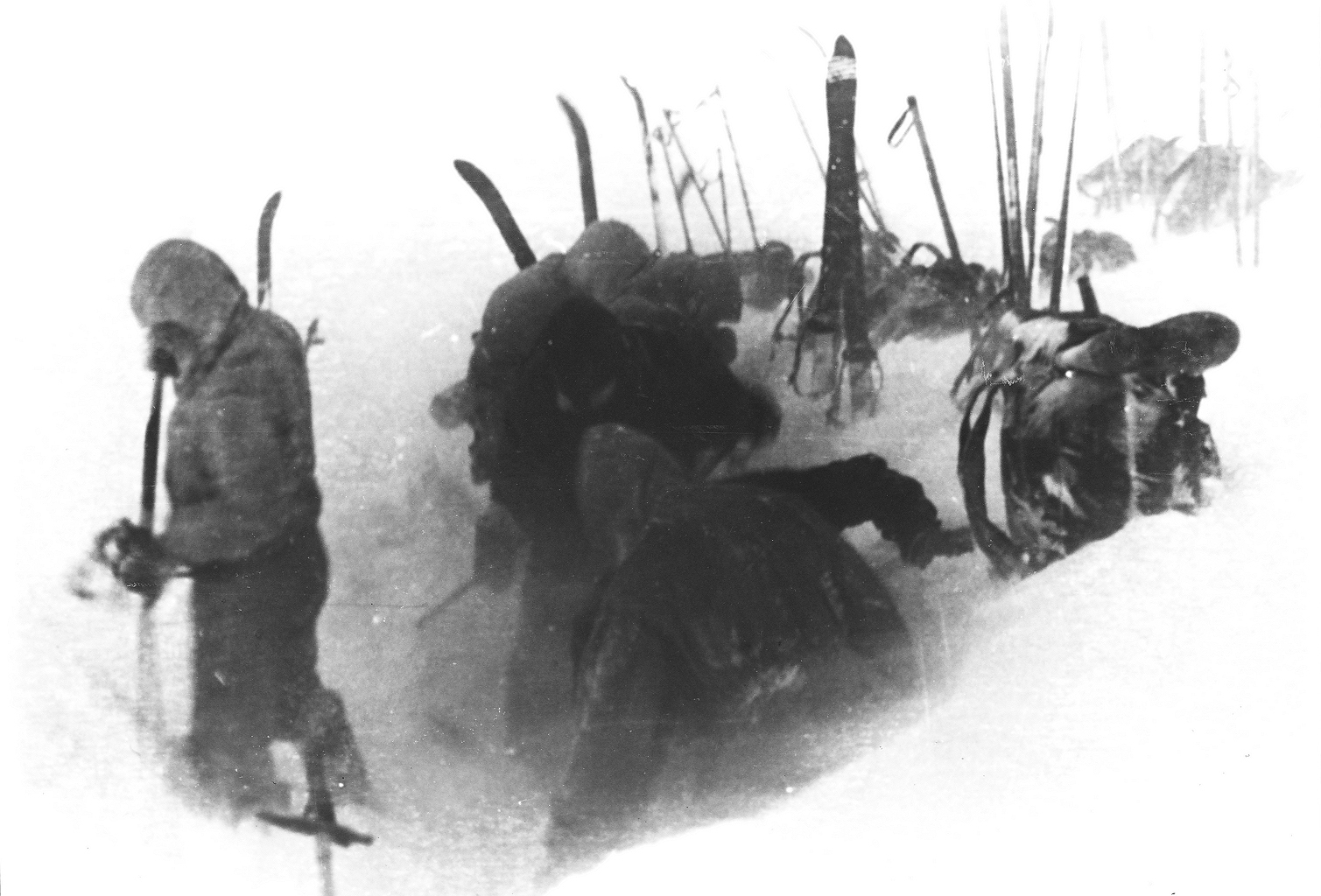
Ten young people, eight men and two women, almost all students or graduates of the Ural Polytechnic Institute in Sverdlovsk (today Yekaterinburg), organised this cross-country ski expedition to reach Mount Otorten, about ten kilometres further north. The leader was Igor Dyatlov, a 23-year-old radio engineering student. All were experienced hikers and on their return would receive Grade III certification, the highest in the Soviet Union at the time. The route, about 300 km long, was rated the most difficult category, and February is the worst time to tackle it.
Thanks to the diaries and cameras found, the stages of the journey can be reconstructed up to the day before the incident: on 25 January they reached the town of Ivdel by train, on the 26th they rode a truck to Vizhai, the last inhabited settlement, and on 27 January they set off.
The next day one of them, Yuri Yudin, fell ill with severe knee and joint pain and left the expedition, unknowingly saving his life. He was the only survivor, and spent his whole life trying to understand what had happened to his friends. He died in 2013.
On 31 January they reached the edge of a highland and left food and equipment in a cache in the woods for the return trip, and the next day they began to cross the pass.
They had planned to cross the pass and camp on the other side, but the weather worsened, with a snowstorm that made them lose their bearings and pushed them west, towards the top of Kholat Syakhl.
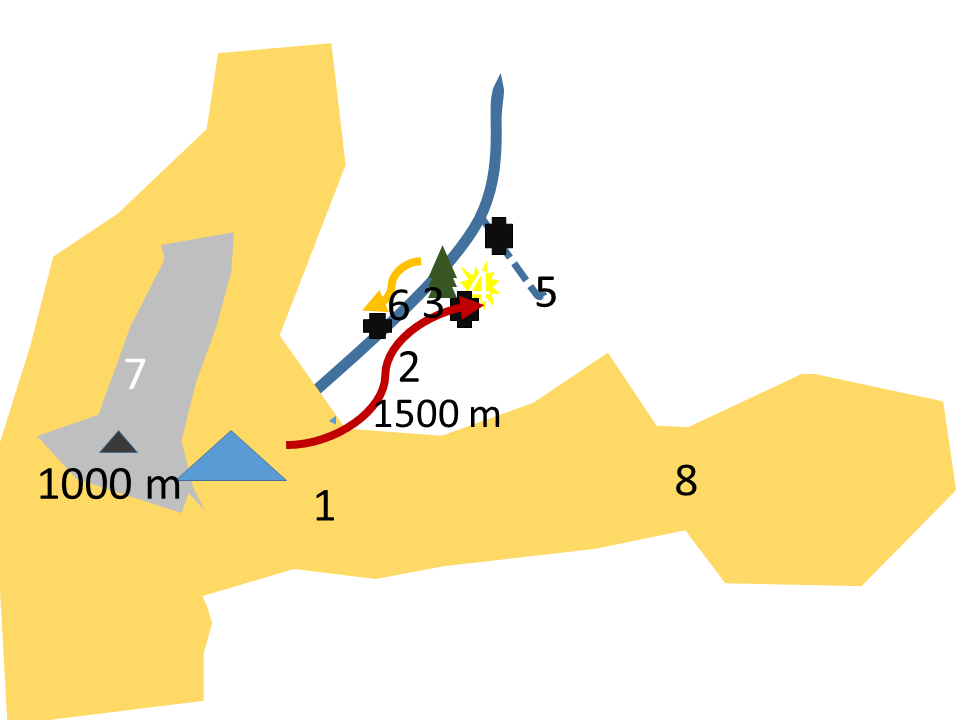
When they realised they were on the wrong route they decided to camp on the slope, instead of descending a kilometre and a half to the woods, where they would have had more shelter. From that moment nobody knows for sure what happened to them.
The first searches
Dyatlov had promised to send a telegram to their sports club on returning to Vizhai, no later than 12 February. Delays of a few days were normal and at first nobody worried, but on 20 February, under pressure from the families, the search began: first volunteer students and teachers, then the army, police, planes and helicopters.
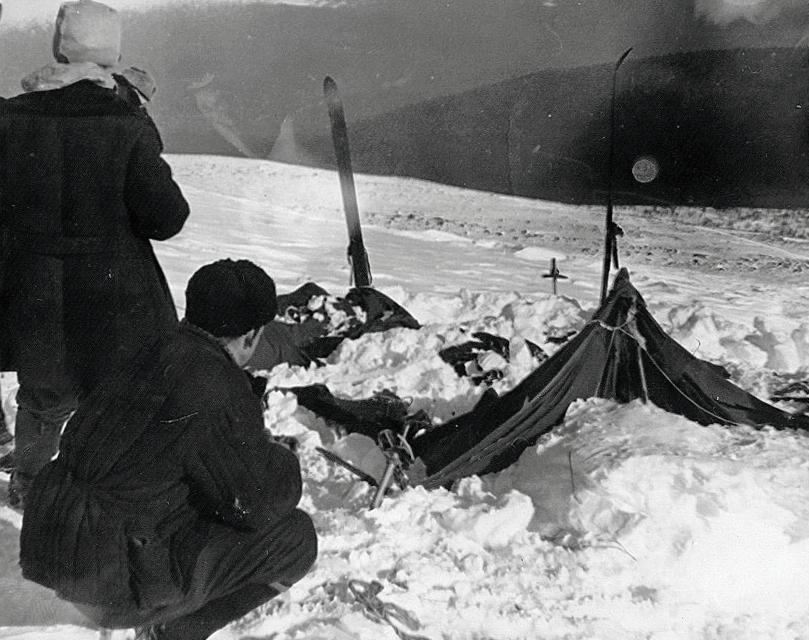
The tent was found on 26 February, half collapsed and covered in snow. All their belongings and shoes were still inside. Investigators established it had been cut open from the inside. From there ran the footprints of nine people in socks, a single shoe or even barefoot, heading down towards the woods, about a kilometre and a half away.
At the edge of the woods, under a large Siberian pine, searchers found the remains of a small fire and the first two bodies, those of Yuri Krivonischenko and Yuri Doroshenko, barefoot and in underwear. The branches of the pine were broken up to five metres high, as if one of them had climbed up to try to see the tent.
Three more bodies, those of Igor Dyatlov, Zinaida Kolmogorova and Rustem Slobodin, were found between the pine and the camp, in positions suggesting they were trying to get back to the tent.
The other 4 bodies were not found until 4 May, under four metres of snow, in a ravine about 75 metres from the pine, at the bottom of a stream: those of Lyudmila Dubinina, Semyon Zolotaryov, Alexander Kolevatov and Nikolai Thibeaux-Brignolle. They were better dressed than the others, and some wore the clothes of companions who had died first: Lyudmila had Krivonischenko’s burned, torn trousers and a foot wrapped in a piece of jacket.
The autopsies
The first five had died of hypothermia. Slobodin had a small skull fracture, not considered fatal. The autopsies of the four bodies found in May, however, changed everything.
Thibeaux-Brignolle had very severe skull injuries, while Dubinina and Zolotaryov had badly fractured chests. Forensic examiner Boris Vozrozhdenny said such injuries were comparable to those caused by a car crash, but there were no external wounds, as if the bodies had been crushed by enormous pressure.
All four also had soft tissue damage to the head and face. Lyudmila Dubinina was missing her tongue, eyes, part of her lips and facial tissue and a fragment of skull bone; Zolotaryov was missing his eyes, Kolevatov his eyebrows. According to the examiner these injuries happened after death, because the bodies had lain for months in the running water of the stream.
The police began investigating and established the following:
- the tent had been ripped open from the inside and everyone had left of their own accord, on foot, but without suitable clothes and equipment to survive;
- the victims died six to eight hours after their last meal, and there was no trace of other people nearby;
- in addition, some of one victim’s clothes showed traces of radioactive contamination.
At first the Mansi, who herded reindeer in the area, were suspected, but around the tent there were only the hikers’ footprints and no signs of a struggle. According to the examiner, moreover, the fatal injuries could not have been caused by human beings. The inquest closed in May 1959 concluding that the young people had died because of a “compelling natural force”, and the files ended up in a secret archive.
These elements, together with reports of lights from the area, led people to formulate various theories, including the UFO hypothesis. Another group of hikers, about fifty kilometres further south, said they saw strange orange spheres in the sky to the north that night, and similar spheres were seen around Ivdel throughout February and March 1959, including by the military and the weather service. These reports, however, never made it into the inquest and only came out years later.
Hypotheses
For decades nobody could give a definite explanation: some talk about an avalanche, others about UFOs or supernatural forces.
Another fact discovered after the incident was that the Soviet military was carrying out experiments in the area, including tests of parachute mines, which explode in mid-air and cause severe internal injuries with few external signs. Could these have frightened the hikers?
Were UFOs or aliens involved in these experiments? Something frightened 9 experienced hikers so badly that they cut their tent from the inside and ran away almost naked, at night, at -30 degrees, without equipment.
Why did they have to cut the tent? Why not use the entrance? Was it blocked by something or someone? And why were some in their underwear?
Any hiker (experienced or not) knows perfectly well that going out without adequate protection, at minus 30 degrees and at night with poor visibility, means death. What terrified these 9 young people so much?
The avalanche
The official answer came sixty years later. In 2019, at the families’ request, the Russian authorities reopened the case and on 11 July 2020 prosecutor Andrey Kuryakov announced the conclusion: an avalanche. Investigators reconstructed that that night there was a snowstorm with winds up to 100 km/h and temperatures close to -40 °C, conditions that those who arrived three weeks later, in good weather, could not imagine.
By digging the tent platform into the snow, the hikers would have weakened the snowpack above them. During the night a slab of snow, weighed down by fresh snow, would have begun to slide slowly, pressing on the tent starting from the entrance. With the entrance blocked and terrified of being buried alive, they cut through the fabric and went down towards the woods in search of shelter, with whatever they were wearing.
“It was a heroic struggle. There was no panic, but they had no chance to save themselves under the circumstances”, said Kuryakov. According to this reconstruction, everything they did afterwards was by the book: they moved away from the danger zone, sheltered in the woods, lit a fire and dug a snow cave. The four found in May would have fallen into a snow hollow above the stream, suffering the fractures.
In 2021 Swiss researchers Johan Gaume of EPFL and Alexander Puzrin of ETH Zurich published in Communications Earth & Environment a computer simulation showing how even a small snow slab on a 28-degree slope could damage the tent and cause injuries like those suffered by the group.
Not everyone is convinced, though. No clear signs of an avalanche were found at the site, the first bodies were covered by only a thin layer of snow, and in more than a hundred later expeditions nobody has ever reported avalanche conditions at that spot. The footprints, moreover, look like those of people walking at a normal pace, not running in panic.
Other hypotheses
In 2019 a Russian-Swedish expedition proposed a violent katabatic wind, a cold air current that rushes downhill with sudden force, similar to the one that killed eight hikers on Mount Anaris, in Sweden, in 1978. Writer Donnie Eichar, in his 2013 book “Dead Mountain”, suggested instead that the wind around the summit produced infrasound capable of triggering panic attacks.
One anomaly that drew most attention was the radioactive traces on the clothes. How could they have been contaminated? One of them had worked at a nuclear facility, it’s true, and some of his clothes may have been contaminated. Supporters of the radiological weapons test hypothesis point out, however, that such contamination would have affected everyone, not just some of one person’s clothes.
And the brownish colour of the bodies? Skin colour ranging from brown to orange is actually typical of people who die of extreme cold.
Maybe they were poisoned by some substance that caused hallucinations, but nothing was found at the autopsy.
The missing tongue, which gave rise to the most macabre theories, can be explained by the body lying for months in a stream, where water and scavengers attack the soft tissues of the face first.
Or perhaps, connecting all the dots, it could have been removed deliberately by someone? But by whom? No traces of humans were found nearby. Could it have been non-human beings?
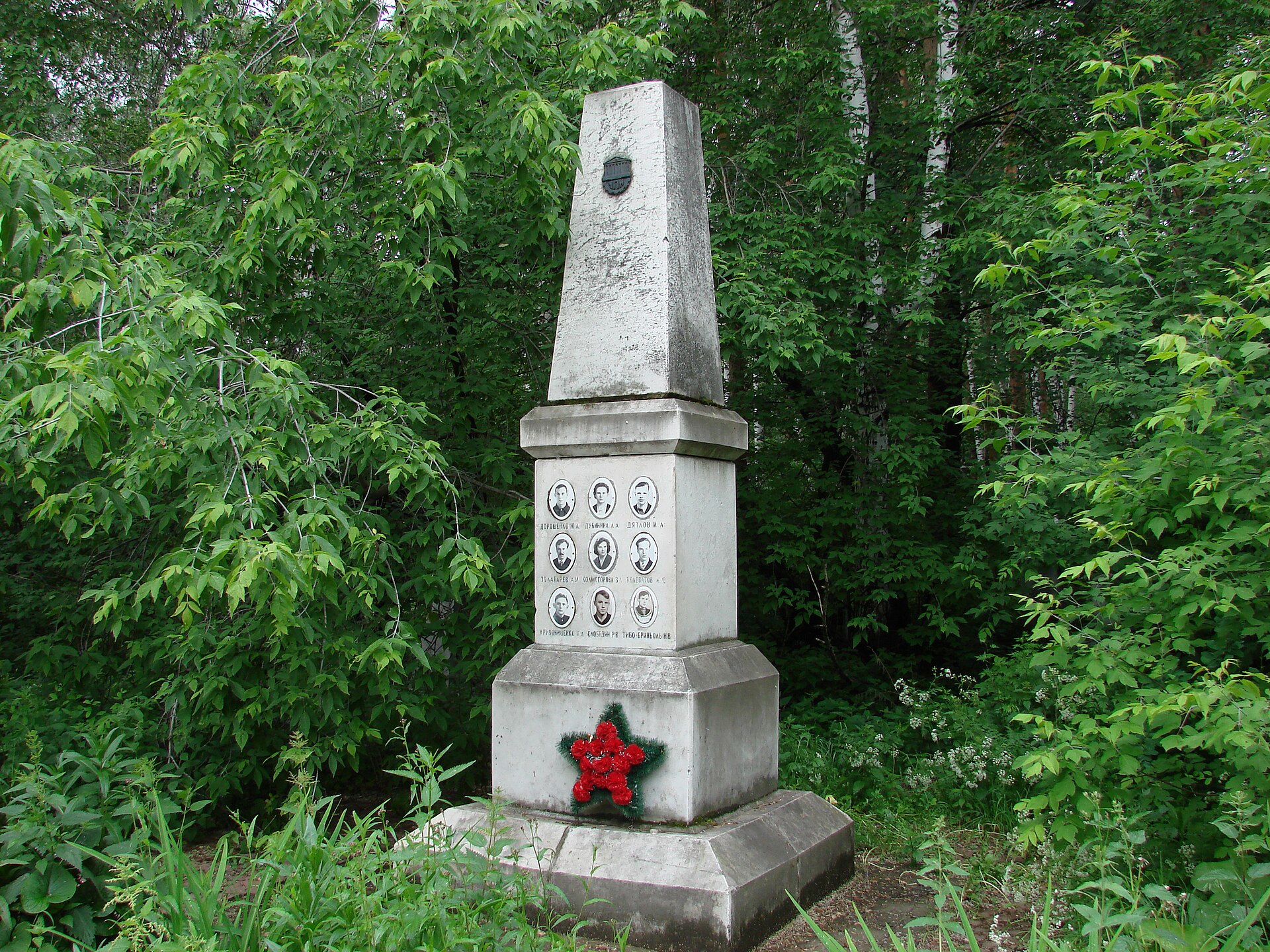
What is certain is that something frightened the 9 young people to death, an avalanche, the wind or something darker, driving them to flee into the night towards a terrible end. Today a plaque stands at the site in their memory, and in Yekaterinburg the Dyatlov Foundation keeps searching for answers.
🦋 Emadion lives through its readers. If this story kept you up at night, buy me a coffee: it helps me bring you the next nightmare.
☕ Support Emadion on Ko-fi