 Posted by
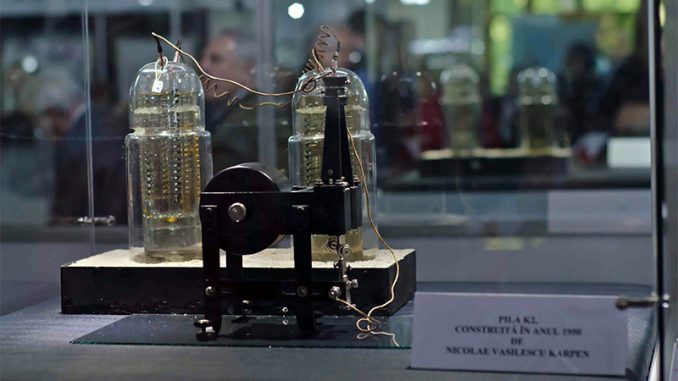
Karpen’s pile, built in 1950 by Romanian scientist Nicolae Vasilescu Karpen, is a pair of cells with gold and platinum electrodes in sulphuric acid that, according to the Bucharest museum that keeps it, still gives a voltage of about 1 volt. It is not a “perpetual” battery, though: scientists explain it with a very slow reaction and minimal consumption, even if nobody has ever studied it up close with modern instruments.
In a display case at the National Technical Museum in Bucharest sits an object that doesn’t look like much: two small glass cylinders, a few wires, a tiny motor. Yet for years newspapers around the world have called it “the battery that never runs down.” This is Karpen’s pile, built in 1950 by one of Romania’s leading scientists of the 20th century. According to the people who look after it, it still produces a voltage. Some say it proves the laws of physics need rewriting. Physicists see a much smaller puzzle, but still an interesting one.
Who was Nicolae Vasilescu Karpen?
First, the name. Many websites, including English ones, call the inventor “Vasile Karpen”. His real name was Nicolae Vasilescu. He was born in Craiova, southern Romania, on 10 December 1870 by the Julian calendar then in use in Romania, which is 22 December in ours. His father, Ion Vasilescu, was an army captain. His mother, Maria Nenciu, was 21. The family owned land in the village of Carpen, near Craiova. That is where “Karpen” comes from: a government decision in 1899 let him add it to his surname. He wrote it without a hyphen. After his death the Romanian Academy always used one, and both spellings are still around.
After the Carol I high school in Craiova, he studied at the National School of Bridges and Roads in Bucharest and graduated as an engineer in June 1891, top of his class. He spent three years at the Ministry of Public Works, building roads and railways, then went to Paris. There he studied at the École supérieure d’électricité and the Sorbonne, and in 1904 earned a doctorate in physics with a thesis on the magnetic effects of moving charged bodies. His supervisor was Gabriel Lippmann, who won the Nobel Prize four years later. Some Romanian biographies say Henri Poincaré and Henri Moissan also sat on the examining board.

Many accounts say he was made a professor at the University of Lille. His most careful biographer, the academician Andrei Nicolaide, found no official record of that appointment, only a series of lectures at Lille’s electrotechnical institute. Either way, by 1905 Karpen was back in Romania as the first professor of electrical engineering at his old school.
The man who built a university
From then on his career was remarkable. He built the Băneasa radio-telegraph station near Bucharest, which during the First World War could reach about 2,000 kilometres. He worked on the Berești railway tunnel on the Bârlad–Galați line and on bringing electricity to towns such as Câmpina and Constanța. In 1909 he sent a note to the French Academy of Sciences proposing high-frequency carrier currents for long-distance telephone lines, an idea well ahead of its time.
In 1918 he became director of the School of Bridges and Roads, and in 1920 he turned it into the Polytechnic University of Bucharest, serving as its first rector until 1940. He joined the Romanian Academy in 1923 and later served as its vice-president. In 1931 he was briefly Minister of Industry and Trade. His interests ranged widely: elasticity, bird flight, osmotic pressure, thermodynamics, electrochemistry. He published more than seventy papers over half a century.
The communist takeover changed his standing. In 1948 he was expelled from the Academy, like many intellectuals tied to pre-war Romania, and was only reinstated in 1955. He kept working into old age and died in Bucharest on 2 March 1964, aged 93 (many sources say 94).
The “K piles”
Of all his work, the part that made him famous abroad is also the most disputed. Karpen believed he had found something new about how electrochemical cells work. He developed an “electronic” theory of liquids, holding that liquids also contain free electrons, and used it to explain the voltage of batteries. In 1923 he published a paper in Paris titled La force électromotrice des piles et l’attraction moléculaire.
Out of these ideas came a series of devices he called “K piles”, numbered K1, K2 and so on. He described them as “thermoelectric piles at uniform temperature”: devices that, in his view, could make electricity from nothing but the heat of their surroundings, with no temperature difference needed. That claim is exactly what people have argued about for a hundred years.
On 12 February 1924 Karpen filed French patent no. 577,087, published on 30 August that year as Pile électrique (some Romanian texts give a different title, “Instrument de précision en électricité”). You will also see the dates 1908, 1920 and 1922 online, but the registered French patent is from 1924. According to physicist Cristian Presura, writing for HotNews, the patent describes the general idea of drawing energy from the environment rather than how to build the device.
Karpen kept working on cells for the rest of his life. At the 1938 International Electrotechnical Congress in Prague he presented a cell running on a dissolved liquid fuel, which his admirers see as an early fuel cell. In the 1950s he was still publishing on a silver chloride cell and an “oxygen concentration cell”. And in 1950 he built the prototype that everyone knows today.

How the museum’s pile works
The device is two cells wired in series. Each has one gold electrode and one platinum electrode (or platinum-coated gold, according to the description published by the Romanian engineers’ association AGIR), sealed in a glass cylinder and immersed in very pure sulphuric acid. The two cells drive a tiny galvanometer-type motor, similar to the movement of a measuring instrument. The motor turns a small blade linked to a switch. Every half turn the circuit opens, and on the next half turn it closes again.
The timing is deliberate. Karpen set it so that while the circuit is open the cells have time to “regenerate”, recovering the voltage they lost while supplying current. The motor does no useful work. Its only job is to show that the cells really produce electrical energy. And they produce very little of it: the whole system runs on tiny currents.
The choice of materials is a big part of why it lasts. In an ordinary battery one electrode is used up: the metal corrodes and dissolves into the electrolyte, and when it’s gone the battery is dead. Gold and platinum are noble metals that sulphuric acid barely touches. Descriptions of the prototype say that after decades they show no visible corrosion.
From the scientist’s home to the museum
After Karpen’s death the pile was kept for a while at the Romanian Academy, where it had been on display. It was then donated to the Technical Museum, founded in Bucharest in 1909 by engineer Dimitrie Leonida and housed in Carol I Park. According to speakers at an AGIR memorial meeting in 2014, the donor was Matei Marinescu, son of the famous neurologist Gheorghe Marinescu, a friend of Karpen’s. Another study describes him instead as the scientist’s son-in-law. The museum’s register records its arrival on 31 August 1979, as inventory number 22.

The year 1979 comes with one of the most repeated stories. According to an account published by Jurnalul Național, the Militia, the police of Ceaușescu’s regime, wanted to seize the gold and platinum in the pile that year. Finding only very thin foils of little value, they supposedly locked the object in a safe. Treat this with caution: it comes from a popular book and cites no documents.
What is certain is that for years the public couldn’t see the pile. The museum kept it locked away for fear of theft, because it couldn’t afford proper security. When the story went international in 2010, picked up by the International Business Times and Gizmodo, reports still said it wasn’t on display. Since 2013, after restoration, it has been back in a display case, and that year Romanian public television TVR ran a report on it.
The measurements: what we actually know
This is the heart of the mystery, and its weakest part. One figure appears everywhere: the pile still gives about 1 volt, the same as in 1950. English-language sources say a Romanian newspaper took the measurement. It is most likely the article “Pila nemuritoare” (“The immortal pile”), published in the daily Ziua on 11 March 2006.
Everything else is much less clear. None of the sources we checked gives figures for current, power or total energy produced over seventy years, or a series of readings over time. According to Presura, visitors can’t see the pile working because it sits under a glass cover. The voltage is checked two or three times a year by lifting the cover and connecting two wires to a voltmeter. He also says the museum has never asked for a technical assessment, since it treats the object as heritage not to be touched. In short, it’s not clear whether the little motor still turns as it did in 1950, or whether today only an open-circuit voltage is measured. Those are very different things.
Italian articles often claim that researchers in Paris, Bucharest and Bologna tried and failed to build a larger version. We found no primary sources for these attempts.
Does it really break the laws of physics?
The problem isn’t that a battery lasts a long time. The problem is how Karpen explained it. The second law of thermodynamics, in Lord Kelvin’s version, says you can’t build a machine that runs in a cycle and turns heat from a single source at constant temperature into work. A heat engine needs a hot side and a cold side. A battery that ran forever on nothing but the warmth of room air would be a “perpetual motion machine of the second kind”, exactly what the second law rules out.
That’s why physicists push back when the press talks about an “inexhaustible battery” or “perpetual motion”. It happened in 2018. In a press release about the Geneva inventions fair, Romania’s Ministry of Research described Karpen’s pile as a perpetuum mobile that produces energy without outside input. After criticism from several researchers, including Octavian Micu of the Institute of Space Science, the ministry pulled the text, calling it “a personal interpretation” by whoever wrote it.
But most scientists who have looked at the pile seriously don’t think it breaks thermodynamics. They think it simply isn’t a perpetual motion machine.
The scientific explanations
The simplest explanation comes from Presura: a very slow chemical reaction is taking place inside, and the pile lasts because it uses almost nothing. The motor draws tiny currents, and only now and then. The electrodes don’t corrode. The system is sealed. A small energy source, used very sparingly, can last for decades. Sooner or later, though, it will run out.
Many Romanian specialists class the device as a concentration cell, where the voltage comes from a difference in the concentration of a substance near the two electrodes. Karpen himself, in the 1950s, wrote about an “oxygen concentration cell”. In such a cell, oxygen dissolved in the acid, settling differently on gold and on platinum, can be enough to create a voltage. Around 1 volt is entirely plausible for electrodes like these in sulphuric acid.
In 2015 two Romanian chemists, Nicolae Vaszilcsin and Dănuț-Ionel Văireanu, published a different analysis in Revista de Chimie. They argue Karpen’s pile isn’t really a concentration cell at all, but something like an electrochemical double-layer capacitor. Charge builds up on the electrode surfaces, discharges when the circuit closes and rebuilds when it opens. That recharging, they say, is a spontaneous process that absorbs heat from the surroundings through small temperature differences between the solution near the electrode and the environment. Without those differences the pile winds down and the motor eventually stops. Their conclusion is clear: it does not violate the second law.
Still, nobody has yet been able to open the prototype and study it with modern instruments. The explanations are plausible, but they remain theories about an object no one has examined up close.
The online legends
Online, Karpen’s pile has taken on a life of its own. You’ll read that it “inspired NASA”, that “the Americans used it to go to the Moon”, that Ceaușescu hid it, that the secret was muddied on purpose to stop anyone mass-producing it.
The NASA story traces back to a remark attributed to Ionel Solomon, a French physicist of Romanian origin and president of the French Physical Society, who reportedly said Karpen invented a fuel cell decades before the Moon landing. Even if the quote is genuine, it refers to the 1938 fuel cell, not the K pile in the museum. The fuel cells on the Apollo missions came out of different research. None of the sources that repeat the quote show any concrete link.
The myth still has real-world effects, though. In 2022 Romania’s Ministry of Defence, through its research agency, signed an agreement with the Polytechnic University of Bucharest, several research institutes and a Belgian car maker. One of its aims was to build a mathematical and experimental model of the “Vasilescu-Karpen pile”, described in the agreement as a “potential perpetuum mobile”. No results have been published so far.
A small mystery, but a real one
Strip away the hype and what’s left? A real, respected scientist who did important engineering work for his country and who, on batteries, probably chased the wrong idea. An object built with great care more than seventy years ago that, according to its keepers, still gives a measurable voltage. And a question nobody has fully closed: how much energy has that pile really produced, and where exactly does it come from?
The answer is probably mundane: a slow reaction, a tiny current, excellent materials. But until someone opens those two glass cylinders with the right instruments, Karpen’s pile will stay where it is, in its museum in Carol I Park, doing what it has done for more than seventy years: giving its small voltage, and keeping the argument going.
🦋 Emadion lives through its readers. If this story kept you up at night, buy me a coffee: it helps me bring you the next nightmare.
☕ Support Emadion on Ko-fiSources
- Reuniune comemorativă Nicolae Vasilescu Karpen – Univers Ingineresc, AGIR, 2014 (Romanian)
- Andrei Nicolaide, Biographical and scientific clarifications on Nicolae Vasilescu Karpen – Univers Ingineresc, AGIR, 2014 (Romanian)
- Andrei Nicolaide, Considerations on the biography of the scientist Nicolae Vasilescu Karpen (1870-1964) – CRIFST, Romanian Academy
- Mihai Olteneanu, Nicolae Vasilescu-Karpen 1870-1964 – Univers Ingineresc, AGIR, 2005 (Romanian)
- Patent FR577087A, Pile électrique, N. Vasilesco-Karpen, 1924 – Google Patents (French)
- N. Vaszilcsin, D.-I. Văireanu, Considerations Regarding the Mechanism of Electrical Energy Generation in Karpen’s Cells – Revista de Chimie, 2015
- Cristian Presura, Statul paralel cu știința sau povestea pilelor Karpen – HotNews, 2018 (Romanian)
- Gafă la Ministerul Cercetării, care a lăudat invenția românească perpetuum mobile – HotNews, 2018 (Romanian)
- Ministry withdraws the Karpen pile press release – HotNews, 2018 (Romanian)
- Dispozitivul secret care sfidează regulile – Adevărul, 2018 (Romanian)
- Pila Karpen, printre cele mai mari enigme ale tehnicii mondiale – Jurnalul Național, 2018 (Romanian)
- Defence Ministry–Polytechnic agreement on the Vasilescu-Karpen pile – Economedia, 2022 (Romanian)
- Cine este românul care a inventat dispozitivul care nu trebuia să existe – Newsweek România, 2024 (Romanian)
- Nicolae Vasilescu-Karpen – Wikipedia
- This Battery Has Been Working for 60 Years – Gizmodo, 2011