
 Posted by
The Voynich manuscript is an illustrated 15th-century book written in a language and an alphabet that no one, even today, has managed to read.
In the quiet of Yale University’s Beinecke Rare Book & Manuscript Library rests one of history’s greatest riddles: the Voynich Manuscript. For centuries it has challenged linguists, cryptographers and historians. Its roughly 240 vellum pages (some, it seems, have been lost) are packed with incomprehensible characters, written left to right with a regularity that suggests a structured language. Yet no one has ever deciphered them, much like the rongorongo of Easter Island.
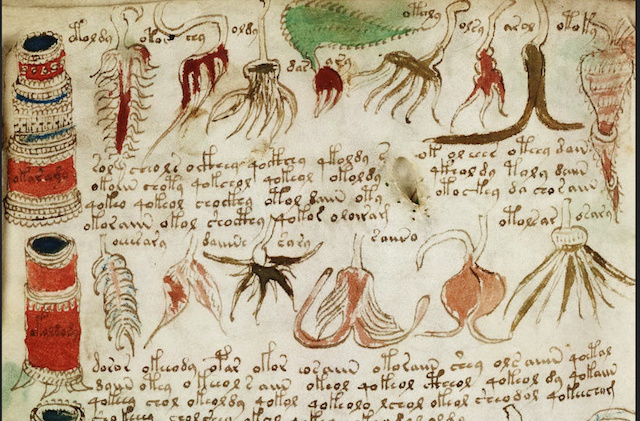
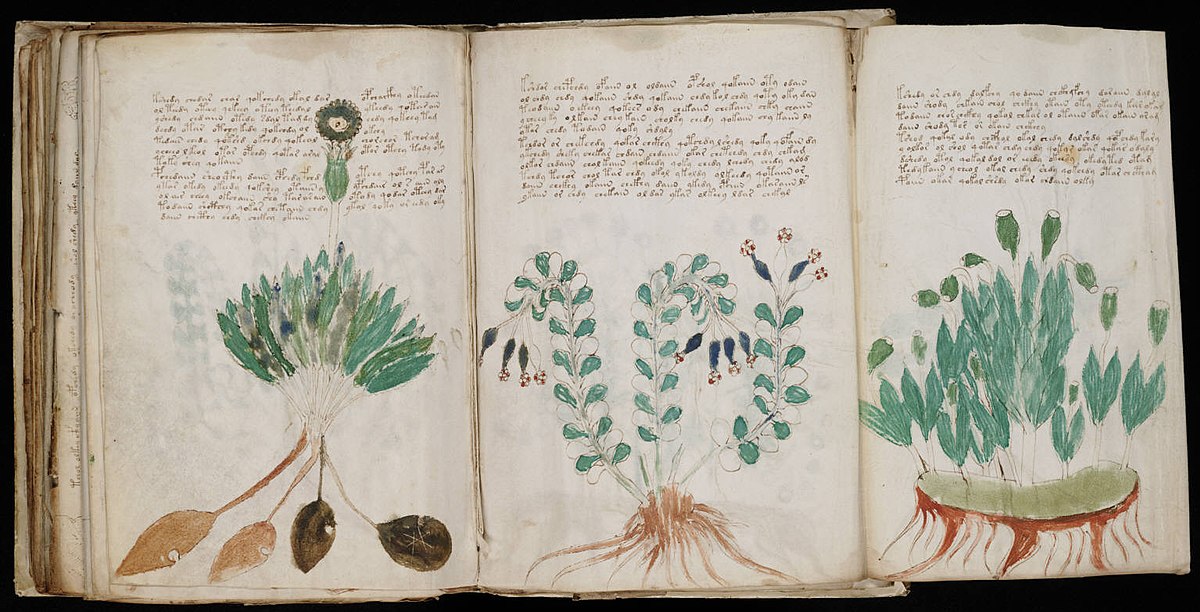
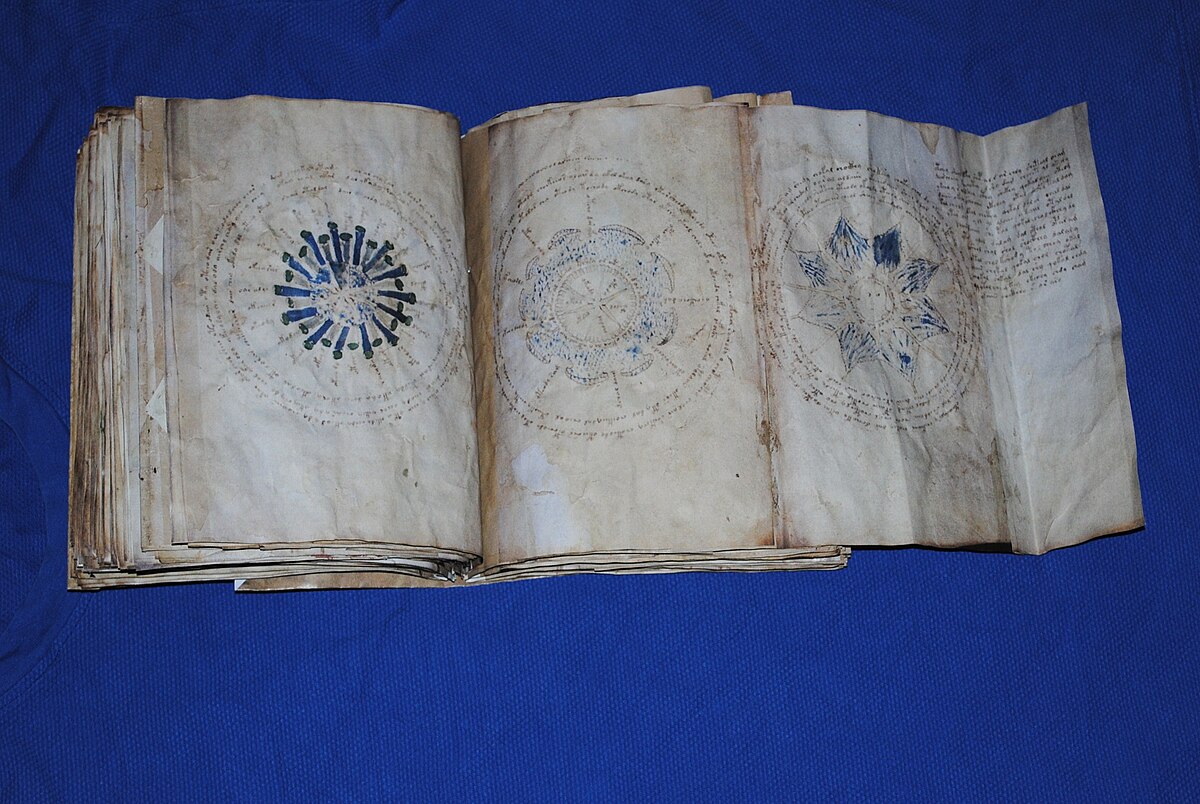
Adding to the mystery are the bizarre illustrations: plants unknown to botany, celestial diagrams, naked female figures bathing in pools connected by strange tubes. A bestiary of images that seems to come out of a dream, or perhaps from some ancient, lost knowledge.
Ever since the bookseller Wilfrid Voynich bought it in 1912, the manuscript has generated theories of every kind: Renaissance alchemy, lost languages, medieval medicine, an elaborate hoax. Every year someone announces they have deciphered it, but the Voynich still keeps its secret.
The history of the manuscript
Many hypotheses have been put forward about this mysterious manuscript, but let’s start with the facts.
The book was bought by Wilfrid Voynich, a book dealer of Polish origin, from the Jesuit college at Villa Mondragone, near Frascati, in 1912. And it is to him that the manuscript owes its name.
Inside, Voynich found a letter dated Prague, 19 August 1665 (or 1666), written by Johannes Marcus Marci, physician and rector of the University of Prague. Marci was sending the book to Rome, to the Jesuit Athanasius Kircher, one of the most famous scholars of the time, so that he might try to decipher it. In the letter he said he had inherited it from a friend, the Prague alchemist Georg Baresch, and passed on a rumour: the book had supposedly belonged to Emperor Rudolf II of Habsburg, who paid 600 ducats for it, believing the author was the English friar Roger Bacon. On the first page, moreover, the erased signature of Jacobus Horcicky de Tepenec, a chemist at Rudolf’s court, has been identified.
After acquiring it, Voynich spent years trying to decipher the manuscript, involving scholars and cryptographers without success. When he died in 1930 the volume passed to his wife Ethel Voynich, author of the famous novel The Gadfly, who in turn left it to her friend Anne Nill. In 1961 the manuscript was sold to the antiquarian bookseller Hans P. Kraus who, unable to find a buyer willing to pay his asking price, donated it in 1969 to Yale’s Beinecke Library, where it is still kept under the shelfmark MS 408.
For a long time the book was thought to date from the 16th century. In 2009, however, radiocarbon dating of the vellum, carried out at the University of Arizona, established that it was made between 1404 and 1438. That rules out Roger Bacon, who died in 1292, as well as many of the Renaissance forgers who had been suggested.
The Voynich manuscript (Beinecke MS 408) is an illustrated codex of about 240 pages, with vellum dated between 1404 and 1438, written in an unknown alphabet. It is named after the bookseller who bought it in 1912 and has been at Yale since 1969. No proposed decipherment has so far been accepted by scholars.
The theories
One of the most widely accepted theories is that it is a medieval herbal, perhaps a compendium of botanical and pharmacological knowledge encrypted to protect trade secrets. The plants drawn, some of which seem to combine parts of different species, might represent remedies known only to a few.
Other scholars think of an artificial language, created for esoteric or philosophical purposes, or of an encrypted text. Between the Middle Ages and the Renaissance secret writing systems were fashionable, as figures such as John Dee and Kircher himself show.
Then there are those who believe it is a hoax, perhaps made to swindle a wealthy collector like Rudolf II, known for his passion for the occult. According to this hypothesis, the meaningless words would have been generated with some mechanical trick, such as tables or grilles.
There is no shortage of wilder explanations: an extraterrestrial message, an Asian language transliterated into Western characters, even the diary of a time traveller.
The greatest cryptographers of the 20th century also racked their brains over the manuscript. During and after the Second World War William and Elizebeth Friedman, Prescott Currier and John Tiltman worked on it, the same people who had broken military codes. None of them cracked it.
A structure that looks like a language
In 2013 two studies published in PLOS ONE, one by the group of Brazilian physicist Diego Raphael Amancio (University of São Paulo) and one by Marcelo Montemurro and Damián Zanette (University of Manchester), analysed the text with statistical methods. Both concluded that the distribution of the Voynich “words” resembles that of natural languages: it follows the so-called Zipf’s law, and some words appear mainly in sections devoted to a particular theme, as happens in real texts.
This does not mean the text has been understood, but it makes the idea of a random sequence of meaningless symbols less likely. The fundamental questions remain open: is it a forgotten language, a code or a constructed language? Without a “Rosetta Stone” linking the Voynich to a known language, decipherment remains out of reach.
The announced solutions
In 2014 Stephen Bax, professor of linguistics at the University of Bedfordshire, proposed a provisional reading of some words related to plants and the constellation Taurus, and of 14 signs of the alphabet. Bax started from images of recognisable subjects to work out their names and suggested it was neither a hoax nor a code, but an extinct language or dialect.
In 2018 a team from the University of Alberta led by Greg Kondrak applied computational linguistics techniques, suggesting the text might be encoded Hebrew, with words stripped of vowels and letters rearranged. Experts on medieval manuscripts, however, remained sceptical.
In May 2019 Gerard Cheshire, a research assistant at the University of Bristol, claimed to have deciphered it and that it was written in a “proto-Romance” language. The palaeographer Lisa Fagin Davis, one of the leading experts on the manuscript, rejected the proposal, and the University of Bristol distanced itself from the work, removing the story from its website.
Other “solutions” have appeared over the years, from Old Turkic to anagrammed Italian to Aramaic. None has convinced scholars. So much so that the 2026 international Voynich conference stated in its call for papers that proposed “solutions” would not be accepted.
The latest discoveries
In September 2024 Lisa Fagin Davis published multispectral images of ten pages, taken in 2014 by the Lazarus Project. Under light invisible to the human eye, three columns of hidden letters appeared in the margin of the first page: two of Latin letters and one of Voynich characters. According to Davis the handwriting is that of Marci himself, who owned the book between 1662 and 1665. It could be one of the earliest decipherment attempts in history. The images also show no trace of older erased texts, another sign that the manuscript is a genuine medieval document.
In November 2025 researcher Michael Greshko published the so-called Naibbe cipher in the journal Cryptologia: a method using dice and playing cards, tools available in the 15th century, to turn a Latin or Italian text by hand into something that closely resembles the Voynich, with words of similar length and structure. Greshko himself stresses that it is not how the manuscript was made and that it does not prove the text has meaning. It does show, however, that such a cipher was within reach of a medieval scribe.
Artificial intelligence has not worked the miracle either, for now. Algorithms find patterns and probabilities, but without a parallel text in a known language even the most advanced systems are groping in the dark.
A puzzle still incomplete
After centuries of study, the Voynich Manuscript remains one of the most stubborn intellectual challenges in history. Each generation of researchers has hit the same wall that stopped Marci and Kircher in the 17th century. Perhaps it is precisely this difficulty that makes it so fascinating.
In an age when science seems able to explain almost everything, the Voynich reminds us that there are still riddles capable of resisting the advance of knowledge.
Want to try deciphering the manuscript? You can browse it online here.
🦋 Emadion lives through its readers. If this story kept you up at night, buy me a coffee: it helps me bring you the next nightmare.
☕ Support Emadion on Ko-fiSources
- Wikipedia – Voynich manuscript
- The Art Newspaper – Voynich Manuscript scans reveal early decoding attempt (2024)
- Lisa Fagin Davis – Multispectral Imaging and the Voynich Manuscript
- The Art Newspaper – Can a new cipher help to explain the Voynich Manuscript? (2026)
- University of Malta – Voynich 2026, call for papers
- Yale, Beinecke Library – MS 408 digitised
This book is written in god language… In Hindi “Dev Lipi” that is mean this language use by Indian god and goddess..