 Posted by
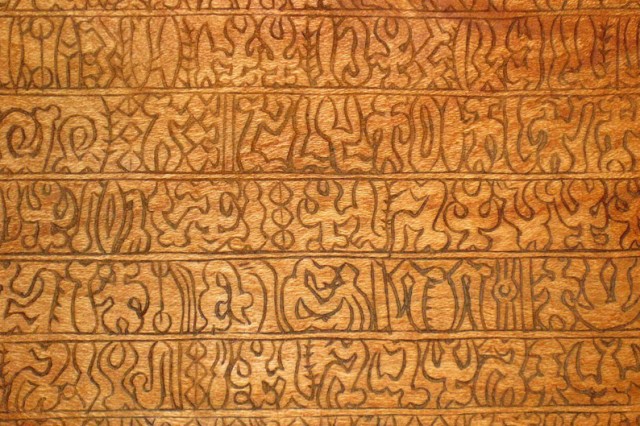
Rongorongo is a system of glyphs carved on wooden tablets from Easter Island, discovered by Europeans in 1864 and never deciphered. Only about two dozen objects survive, scattered in museums around the world. For years it was thought to have arisen after contact with Europeans, but a 2024 study dated one tablet to the mid-15th century: it could be one of the very few independently invented writing systems in history.
Rongorongo is a system of writing, or perhaps proto-writing, discovered on Easter Island. Discovered in the 19th century, it has still not been deciphered.
Rongorongo
This system of glyphs was found on wooden objects, mostly tablets, discovered by Europeans in the 19th century. All the inscribed objects ended up in museums or private collections and not a single one remains on Easter Island, although some rocks bear petroglyphs that may include short inscriptions.
The name rongorongo means “to recite, to chant” in the Rapa Nui language: according to oral tradition, only a small elite could read it and the tablets were sacred.
Despite countless attempts, no one has yet managed to decipher the content of the mysterious tablets. Only some information that looks like a calendar, and perhaps genealogies, has been identified.
Peculiarities
This script has several peculiarities, first of all its direction of writing, called reverse boustrophedon.
You start reading from the bottom left corner, continue to the right and, at the end of the line, turn the tablet 180 degrees and keep reading from left to right.
The carved glyphs mainly represent geometric shapes and stylized figures of humans, animals, plants and objects. Almost all the symbols representing people or animals have their heads pointing up and, if shown in profile, face the direction of writing. Many figures have protuberances on each side of the head, possibly representing eyes.
There are human figures, fish, turtles, birds and local plants, and only a few of them resemble the symbols found on the island’s rocks. In a third of the tablets the lines are carved into shallow fluting cut into the wood.
Where does this script come from?
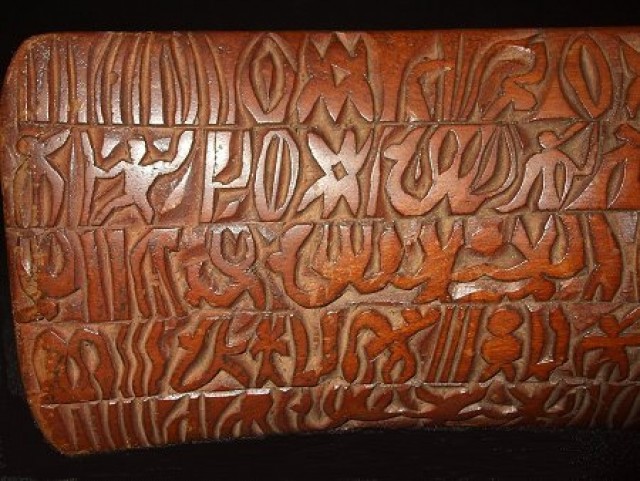
According to legend, the founders of the Rapa Nui civilization brought plants to the island and, with the plants, 67 tablets from their homeland.
There is no evidence, however, that other Polynesian or South American civilizations had a writing system that could have reached Easter Island. The island was settled around 1200, so rongorongo must have arisen after that date.
If rongorongo really is an independently invented script, it would be one of the very few examples of the invention of writing in all of human history.
Some scholars, however, have suggested that the Rapa Nui invented it after seeing Europeans write: in 1770 a Spanish expedition had the chiefs sign a treaty of annexation, and they signed it “with certain characters in their own form of script”. They would not have copied the alphabet, but the very idea of writing.
For a long time the only tablet carbon-dated seemed to confirm this: it was later than 1680. On the other hand, glyph 67 is thought to represent the Easter Island palm, which disappeared around 1650, suggesting the script is at least that old.
In February 2024, however, a study of the tablets kept in Rome changed everything: one of them was securely dated to the mid-15th century, long before the arrival of Europeans.
It must be remembered that the dating concerns the wood, not the carvings, which could be more recent. But if they are of the same age, rongorongo really did arise on the island without any outside influence.
Discovery by Westerners
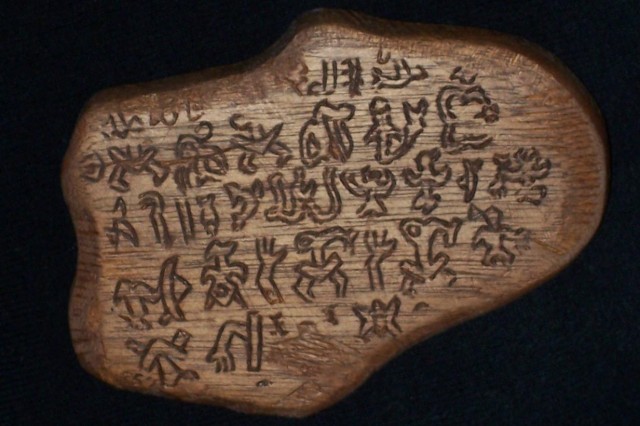
Apart from the mention by the 1770 Spanish expedition, the first tablets were described in 1864 by Eugène Eyraud, a missionary who had come to the island to evangelize the natives.
Eyraud wrote that every house had tablets with carved glyphs and that each glyph had a name, but that the islanders did not seem to attach much importance to them, as if they were the remains of a forgotten script.
In the 1860s the island was raided by Peruvian slave traders, who deported and killed a great many people, while diseases brought by Europeans did the rest. Almost everyone who knew the script disappeared.
Over time the tablets came to be seen as mere objects and were sometimes burned by the islanders themselves as firewood. That is another reason so few remain.
Today there are about two dozen objects with rongorongo inscriptions, including tablets, a chieftain’s staff, a statuette and two ornaments, many of them damaged or burned. This scarcity is one of the reasons deciphering it is so hard. So rongorongo remains, for now, a great unsolved mystery, perhaps comparable to that of the Voynich manuscript.
🦋 Emadion lives through its readers. If this story kept you up at night, buy me a coffee: it helps me bring you the next nightmare.
☕ Support Emadion on Ko-fi