 Posted by
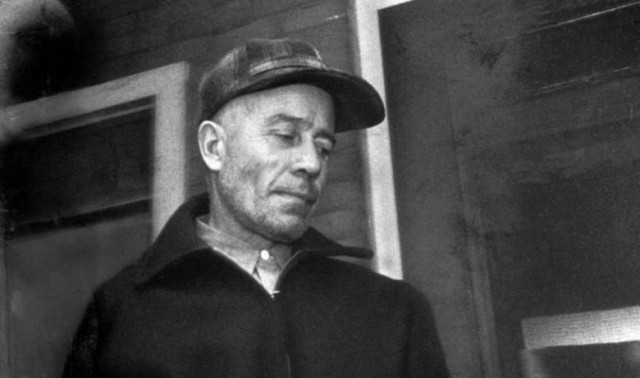
Ed Gein was a murderer and grave robber who went down in history as the Butcher of Plainfield. With the bones and skin of corpses he dug up from his Wisconsin town’s cemeteries, he made furniture, masks and clothing. His story inspired some of horror cinema’s most famous villains: Norman Bates in Psycho, Leatherface in The Texas Chain Saw Massacre and Buffalo Bill in The Silence of the Lambs.
Edward Theodore Gein (La Crosse, 27 August 1906 – Madison, 26 July 1984) was an American murderer and body snatcher. He confessed to killing two women, Mary Hogan in 1954 and Bernice Worden in 1957, and to stealing corpses for years from the cemeteries of Plainfield, Wisconsin, to make objects from their skin and bones. Found legally insane, he spent the rest of his life in a psychiatric hospital.
Childhood
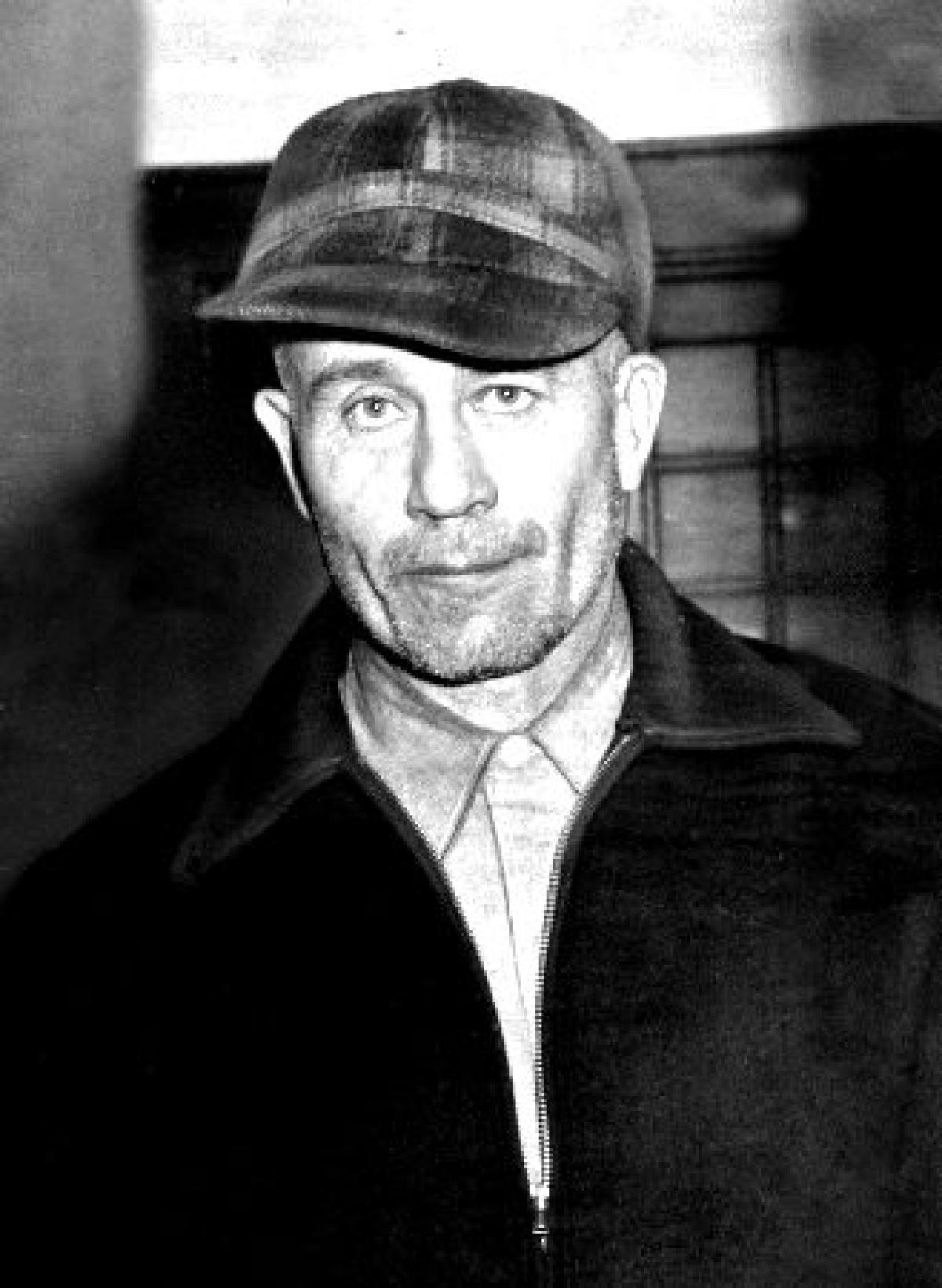
As with almost every serial killer, Ed’s childhood and youth were decisive. He was born on 27 August 1906 in La Crosse County, Wisconsin, the second and last son of George and Augusta Gein, both of German descent. His older brother was called Henry.
His father was a violent alcoholic who regularly beat his sons and often changed jobs, and his mother despised him for it. Augusta, on the other hand, was fanatically religious: every afternoon she read the Bible to her sons, mostly passages from the Old Testament and the Book of Revelation about death, murder and divine retribution. She warned them against the corruption of the world and against alcohol, and maintained that all women were naturally promiscuous and instruments of the Devil.
At first the family lived in La Crosse, where the father also owned a grocery store. Then they sold it and moved to an isolated farm in Plainfield, where Augusta could keep away outsiders who might “corrupt” her sons. Ed left the farm only to go to school. He was a shy boy, and classmates and teachers remembered him as “strange”, with sudden bursts of laughter, as if laughing at jokes only he knew. According to family acquaintances, his mother punished him whenever he tried to make friends. Ed idolised her, to the point of obsession.
The strange death of his brother
His father died of heart failure on 1 April 1940, and Ed and Henry started doing odd jobs in town to support the family. Locally they were considered reliable and honest, and Ed often babysat for neighbours. Henry, however, began dating a divorced mother of two and planned to move in with her. He was worried about his brother’s unhealthy attachment to their mother, and when he spoke ill of her in front of Ed, Ed was deeply hurt.
On 16 May 1944 Henry was burning brush near the farm, but the fire got out of control and the fire brigade had to step in. At the end of the day, once everything was out, Ed reported his brother missing. Henry was found dead, face down, with no burns. Heart failure was suspected, and the coroner gave asphyxiation as the cause. According to biographer Harold Schechter, however, he had bruises on his head. There was no investigation and no autopsy, but years later more than one researcher came to suspect that this death was Ed’s first crime.
Soon afterwards Augusta suffered a paralysing stroke, and Ed devoted himself entirely to her. She died on 29 December 1945, aged 67. Ed lost, as Schechter wrote, “his only friend and one true love”, and was left completely alone in the world.
The grave robber
After his mother’s death Ed boarded up the rooms she had used, leaving them untouched, while the rest of the house became ever more squalid. He lived in a small room next to the kitchen. He began reading pulp magazines and stories about cannibals and Nazi atrocities, particularly those about Ilse Koch, accused of using the skin of tattooed prisoners to make lampshades.
Between 1947 and 1952, he later said, he made about forty nocturnal visits to three local cemeteries, in a “daze-like” state. On about thirty of them he came to before doing anything, tidied the grave and went home empty-handed. The other times he dug up the bodies of recently buried middle-aged women who he thought resembled his mother and took them home, where he tanned their skin to make his objects. In all he admitted robbing nine graves.
His most insane project was a “woman suit”: he wanted to become his mother, to literally crawl into her skin. He denied ever having had sex with the corpses, explaining that “they smelled too bad”.
The murders
On 8 December 1954 Mary Hogan, 51, a tavern owner, disappeared. The case remained unsolved until 1957.
On the morning of 16 November 1957, in the middle of deer-hunting season, Bernice Worden, 58, owner of a Plainfield hardware store, vanished. That afternoon her son, Deputy Sheriff Frank Worden, went into the store and found the cash register open and blood on the floor. He remembered that Ed Gein had been in the evening before and was due back that morning for a gallon of antifreeze. The last receipt his mother had written was for that antifreeze. That same evening Gein was arrested at another grocery store, and the sheriff had his farm searched.
The horror at the farm
In a shed on the farm, officers found Bernice Worden’s body: decapitated and hung upside down by the legs, with a crossbar at the ankles and ropes at the wrists, the torso “dressed out like a deer”. She had been killed with a .22 rifle, and the mutilations had been made after death. In the house they found:
- whole human bones and fragments;
- a wastebasket made of human skin;
- several chairs covered in human skin;
- human skulls mounted on the bedposts;
- female skulls, some with the tops sawn off;
- bowls made from human skulls;
- a corset made from a woman’s torso, skinned from the shoulders to the waist;
- leggings made from human leg skin;
- masks made from the skin of women’s faces;
- Mary Hogan’s face mask in a paper bag and her skull in a box;
- Bernice Worden’s head in a burlap sack and her heart in a plastic bag in front of the stove;
- nine vulvas in a shoebox;
- a belt made of female nipples;
- four noses;
- a pair of lips used as a window-shade drawstring;
- a lampshade made from the skin of a human face.
All these objects were photographed at the state crime laboratory and then “decently disposed of”. The graves Gein pointed out were opened to check his confession, partly because investigators doubted such a slight man could dig up a coffin alone in one night. But the boxes were only two feet down in sandy soil, and the graves had been robbed right after the funerals, before they were fully closed. Everything matched his account. During questioning Gein also confessed to the murder of Mary Hogan, but said he did not remember the details.
A teenager whose parents were friends of Gein said Ed had shown him “shrunken heads”, supposedly sent by a cousin who had fought in the Philippines. They were in fact human facial skins, carefully peeled from corpses and used as masks.
Gein was also suspected in other disappearances in Wisconsin in those years, including two hunters in 1952 and a neighbour in 1954, but lie-detector tests did not link him to any other crime.
The best-known case is that of Evelyn Hartley, a 15-year-old girl who vanished in October 1953 in La Crosse, Gein’s hometown, while babysitting a 20-month-old child. Around a thousand people searched for her, but she was never found. After Gein’s arrest many people thought of him, but the police ruled him out, and to this day there is no evidence he was involved.
And then there is a detail that sent shivers through quite a few people in Plainfield: Gein often gave his neighbours meat he said was venison, even though nobody knew him as a hunter. After his arrest, many wondered where that meat had really come from.
The woman who said she almost married him
A few days after the arrest, a Plainfield woman, Adeline Watkins, told the Minneapolis Tribune that she had been Ed’s girlfriend for twenty years, that she had almost married him and that she was the one who ended it. She described him as kind and sweet, a man she talked with about books and the murders they read about in the papers. About two weeks later, however, she took back most of it in the Stevens Point Journal: she said the story had been exaggerated, that she had only seen him with some regularity since 1954, and she denied ever calling him “sweet”.
The trial
On 21 November 1957 Gein pleaded not guilty by reason of insanity. He was diagnosed with schizophrenia and found unfit for trial, so he was committed to the Central State Hospital for the Criminally Insane in Waupun and later to the Mendota Mental Health Institute in Madison. In 1968 doctors decided he was able to take part in his defence. The trial, without a jury, began on 7 November 1968 and lasted a week: Gein claimed that the shot that killed Bernice Worden went off by accident while he was examining a rifle in her store. Judge Robert Gollmar found him guilty on 14 November, but in a second trial on his sanity ruled him “not guilty by reason of insanity”. Because of the costs, he was tried only for the Worden murder.
During one interrogation, Sheriff Art Schley reportedly slammed Gein’s head against a wall, and as a result his first confession was ruled inadmissible. Schley died of heart failure in 1968, aged 43, before the trial. Many who knew him said he had never recovered from the horror of the case.
The end
Gein’s farm was due to be auctioned on 30 March 1958, amid rumours that it might become a tourist attraction. But at dawn on 20 March it was destroyed by fire. Arson was suspected, but the cause was never established, and the fire chief was none other than Frank Worden, Bernice’s son. When Gein heard, he shrugged and said: “Just as well.” His Ford, which he had used to carry the bodies, was sold at auction for 760 dollars to a carnival sideshow operator, who charged 25 cents to see it. Its whereabouts today are unknown.
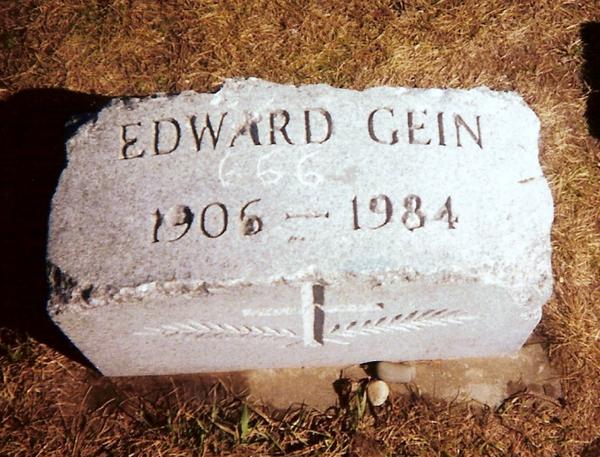
Ed Gein died at the Mendota Mental Health Institute on 26 July 1984, aged 77, of respiratory failure caused by lung cancer. He is buried in Plainfield Cemetery, between his parents and his brother. Over the years souvenir hunters chipped pieces off his headstone, until in 2000 it was stolen. It was recovered in 2001 near Seattle and is now kept by the county sheriff, while the grave remains unmarked.
Ed Gein in popular culture
Gein’s story reached a wide audience through Robert Bloch’s 1959 novel Psycho, which Alfred Hitchcock adapted into his famous film the following year. Since then it has inspired films such as Deranged and The Texas Chain Saw Massacre (both 1974), Rob Zombie’s House of 1000 Corpses and characters such as Buffalo Bill in The Silence of the Lambs. In October 2025 Netflix devoted the third season of Ryan Murphy’s anthology series to him, Monster: The Ed Gein Story, with Charlie Hunnam in the title role. Hunnam then returned in the following season, devoted to Lizzie Borden, as her father Andrew.
What’s true in the Monster series
The series put Gein back among the most searched names on Google, but it mixes fact and fiction quite a lot:
- Adeline Watkins really existed, but in the series she becomes his partner and almost an accomplice in the grave robbing: in reality there is no evidence of anything like that;
- Gein never helped the FBI catch Ted Bundy: the finale suggests it is only his fantasy;
- the necrophilia shown on screen is not confirmed, and Gein always denied it;
- Leatherface’s chainsaw has nothing to do with Gein, it was director Tobe Hooper’s idea. The skin masks, on the other hand, do;
- the Nazi atrocity magazines he read and the story of the stolen headstone, on the other hand, are true.
🦋 Emadion lives through its readers. If this story kept you up at night, buy me a coffee: it helps me bring you the next nightmare.
☕ Support Emadion on Ko-fiSources
- Wikipedia – Ed Gein
- TheWrap – Breaking Down Fact and Fiction in Monster: The Ed Gein Story
- What’s on Netflix – The True History Behind Monster: The Ed Gein Story
- History vs. Hollywood – How Accurate is Monster: The Ed Gein Story?