
 Posted by
Girolamo Segato is known as “the petrifier”. An explorer, cartographer and Egyptologist, in the 19th century he developed a mysterious technique for turning human bodies and organs into something that looks like stone, while preserving their colours and elasticity. His secret died with him.
Girolamo Segato (Sospirolo, 13 June 1792 – Florence, 3 February 1836) was an Italian cartographer, naturalist and Egyptologist. In Florence he developed a technique for “petrifying” human and animal tissue that preserved its colours and elasticity. He burned his notes and the technique has never been replicated. Many of his specimens are kept at the Anatomy Museum of the University of Florence.
Who was Girolamo Segato

Girolamo Segato was born on 13 June 1792 in the former Carthusian monastery of San Marco at Vedana, near Sospirolo, in the province of Belluno, where his family ran a farm. As a child he was thoughtful and unsociable, but lively, and spent his days close to nature. He learned the basics of science from the village priest, Antonio Bagini. After a brief spell as an accountant in Treviso he returned to school in Belluno, where he was taught by the naturalist Tomaso Antonio Catullo.
Egypt

From 1818 he took part in several archaeological expeditions to Egypt, where he became an Egyptologist and grew fascinated by mummification techniques. He even had himself lowered into a shaft inside the Step Pyramid of Saqqara and only came out three days later. Like many travellers of the time, he carved his name on the monuments he visited: his signature can still be seen on the Temple of Dendur, which stands in the Metropolitan Museum in New York. Most of the material gathered on those journeys, sadly, was lost.
The petrifier
In 1823 he returned to Italy and settled in Florence. There he resumed his Egyptological studies but concentrated above all on embalming techniques, and developed a unique method: a kind of mineralisation of tissue, improperly called “petrification” because the specimens look as if they were made of stone.
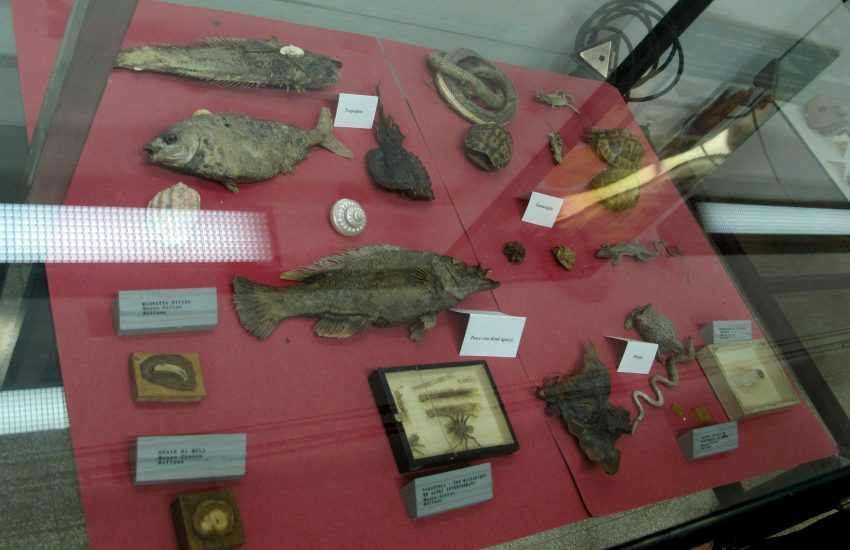
The most incredible feature of his technique is that the treated tissues keep their original colours as well as their consistency and elasticity. Segato applied it to dozens of specimens, mostly parts of the human body, but also animals: snakes, frogs, toads, fish and birds. He probably used different techniques for different pieces.

Among his most striking works are tables whose tops are made of petrified tissue arranged like a mosaic. One of them is at the Royal Palace of Caserta, in the Summer Room of the Historic Apartments.
The lost secret

His talent, however, brought him no luck. Rumours spread that he had learned his knowledge from Egyptian magic, and he was accused of witchcraft. He was defended by Pope Gregory XVI, a fellow native of the Belluno area.
Segato offered the Grand Duke of Tuscany a table of petrified flesh, asking him in return to fund his research, but the Grand Duke refused. Embittered, before he died he destroyed all his notes. It is said that on his deathbed he wanted to reveal the secret to his friend Pellegrini, known as “Pellegro”, but death came first. He died in Florence on 3 February 1836, aged 44. Despite many studies and attempts at imitation, his technique remains a mystery to this day.
He was buried in the Basilica of Santa Croce, alongside some of Italy’s greatest figures. His tombstone reads:
Here lies, decomposed, Girolamo Segato, who would be seen whole and petrified had his art not perished with him. He was an unusual glory of human wisdom, an all too usual example of unhappiness.
Some of his “petrified” specimens, perfectly preserved, can still be seen at the Museum of Human Anatomy of the University of Florence.
🦋 Emadion lives through its readers. If this story kept you up at night, buy me a coffee: it helps me bring you the next nightmare.
☕ Support Emadion on Ko-fi