 Posted by
On 18 December 1996, in a cemetery in Annandale, Virginia, an unknown woman was found dead next to a small Christmas tree. For 25 years she remained the “Christmas Tree Lady”. In 2022 genetic genealogy gave her back her name: Joyce Marilyn Meyer Sommers, 69, originally from Davenport, Iowa.
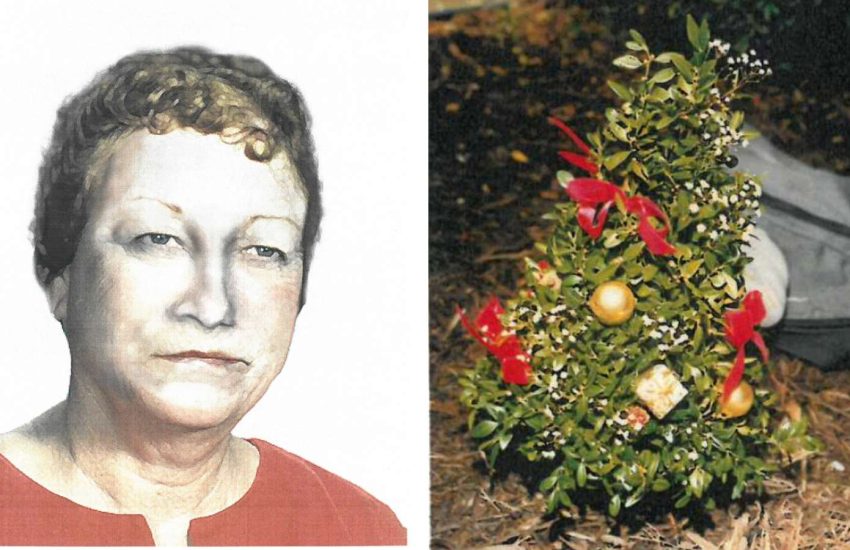
On 18 December 1996, in Annandale, Virginia, a caretaker at Pleasant Valley Memorial Park found the body of a woman. She was there, in the section of the cemetery reserved for children, and next to her was a small decorated Christmas tree. She had no documents, no name. Just two envelopes and essential instructions for what was to happen afterwards. The police established there had been no murder: it was a suicide. Yet for a quarter of a century that woman remained a shadow with no identity, handed a nickname that sounds almost gentle and instead weighs like a stone: “Christmas Tree Lady”.
Then, in 2022, technology broke the spell. The missing name came late, but it came: Joyce Marilyn Meyer Sommers. This is her story, as far as it has been possible to piece together. And above all it is the story of an uncomfortable question: what does it really mean to “disappear”, when the modern world no longer forgets anyone?
A gesture meant to be final
The case officially began on 18 December 1996, when officers were called to Pleasant Valley Memorial Park on Little River Turnpike. The woman carried no identification, and what she left behind was not meant to help anyone recognise her: it was only meant to close things. A small Christmas tree was also found, the detail that immediately turned that anonymous body into a “storyable”, almost symbolic figure: the Christmas stranger. After their checks, the authorities concluded that no one else was involved. The problem was another one: nobody knew who that woman was.
An identity that never came
For years the police tried the most obvious route: comparing her description with missing persons reports in the region. Nothing. In 2000 a colour sketch was also released in the hope that someone would recognise her face. It didn’t work. No decisive phone call, no “yes, it’s her”. Only silence.
This is where the case became typical of the “Does”: people who died without a name, often because no one looked for them in the right way, or because their past was full of clean breaks, moves, family ruptures, lives started over from scratch. In her case, one thing only became clear later: Joyce had never even been officially reported “missing”. And when there is no report, the world loses you more easily.
The breakthrough thanks to genetic genealogy and DNA
When traditional methods fail, the frontier that is rewriting dozens of cold cases comes into play: forensic genetic genealogy. In 2022 Fairfax County Police, with the support of the Othram laboratory and funds raised through DNA Solves, began an advanced DNA analysis to find biological relatives and work back to a family tree. Investigators got a first lead, then narrowed the circle by contacting relatives and collecting a confirmation sample. The match came: the “Christmas Tree Lady” had a name, a date of birth, a family. Police said the identification was confirmed on 11 May 2022 and made public in July.
Who was Joyce Marilyn Meyer Sommers
The certain facts are these: Joyce Marilyn Meyer Sommers was from Davenport, Iowa, the eldest of five siblings. She was 69 when she died. The family had not reported her missing, but over the years they had tried to trace her anyway, including through a private investigator.
One detail, more than any other, describes the rift: in the early 1990s a brother went to the place in Tucson, Arizona, where Joyce had lived and found the trailer abandoned. Inside were copies of a book Joyce had apparently written and self-published, The Target Child, an account of her childhood that she described as traumatic. Her sister, however, does not share that version and says she does not believe their parents abused them. Here too the full truth remains murky: there are irreconcilable family narratives, and it is often precisely in those fractures that a person begins to disappear.
We also know something else: after the mid-1980s, Joyce may have moved to the Virginia area. She had no family nearby when she died. The rest, inevitably, is full of “maybes”.
Why there, and why like that
When a name finally arrives, we expect an explanation to arrive with it. In reality the opposite often happens: the identity solves one piece of the mystery and makes everything that remains burn more. Why choose a cemetery? Why near the children’s section? Why that tiny tree, almost a signal placed there on purpose?
The most honest reconstruction is this: we don’t know. We can make hypotheses, even sensible ones, but they remain hypotheses. And it is important to say so clearly: the temptation to turn Joyce into a “character” is strong, because the nickname and the unintended setting allow it. But behind the nickname there was a real person, and behind the real person there was suffering that no article can neatly sum up.
Identifying someone who perhaps did not want to be identified
One aspect this case leaves hanging, and which is worth facing, is the ethics of identification. Joyce left instructions aimed at keeping to a minimum what would come afterwards, including the question of her identity. Technological progress, however, follows another logic: if you can give a name, sooner or later you will. On the one hand, identification closes a decades-long grief and restores dignity. On the other, it calls into question the idea that a person can really decide to “erase” themselves. This case is a mirror of our times: you can disappear socially, you can cut ties, you can go unsought… but your body remains biological evidence, and your genealogy is a web.
If this topic touches you closely
If you are going through a time when self-destructive thoughts are present, don’t wait for them to pass on their own. You can find a helpline in your country at findahelpline.com, and in an immediate emergency call your local emergency number. You don’t need “a serious enough reason”. You only need to have reached your limit. Talking to someone is a practical step to buy time and reduce the risk.
🦋 Emadion lives through its readers. If this story kept you up at night, buy me a coffee: it helps me bring you the next nightmare.
☕ Support Emadion on Ko-fiSources
- Fairfax County Police, Cold case detectives solve 25-year mystery
- The Washington Post, Christmas Tree Lady identified
- DNA Solves, Christmas Tree Lady, Joyce Sommers