 Posted by
A snuff movie is a film in which a person is really killed, made to earn money from it. The idea was born in the 1970s, amid rumours about the Manson Family and the 1976 film “Snuff”, which was a fake. For decades no such industry was ever proven: killers who film their crimes do it for themselves or to shock, not to sell. In 2025, however, Vice documented what it calls the first real case.
In English the word snuff once meant the burnt part of a candle wick. To snuff meant to trim it and so, by extension, to “end” or “kill”.
In 1874 the expression “to snuff” was used among London’s poor to mean dying of illness or accident. Today, in colloquial English, “to snuff it” means to kick the bucket.
Definition of a snuff movie
The definition of “snuff movie” varies depending on the source: the Cambridge Dictionary defines it as “a violent film that shows a real murder”, while the Italian Garzanti dictionary speaks of “a porn video showing real physical torture culminating in the victim’s death”.
In popular imagination, a snuff film is any video in which a human being is killed solely to sell copies to a small group of people, usually in the context of the deep web. The key point is precisely this: the murder is premeditated and filmed to make money. Deaths filmed by accident, videos of executions or war, or those shot by terrorists for ideological reasons are not, strictly speaking, snuff.
For years, the cruelty involved in making such films led people to think snuff movies were mere urban legends. Why?
The origin of the term
The word “snuff” in this sense first appeared in the 1971 book The Family: The Story of Charles Manson’s Dune Buggy Attack Battalion by writer Ed Sanders. In it, the author claims that the notorious Manson Family filmed the murders they committed.
Afterwards rumours began to spread about groups of people filming murders solely to sell them for huge sums.
That same year husband-and-wife filmmakers Michael and Roberta Findlay shot Slaughter. The low-budget film, shot in Argentina, follows a gang committing murders in the style of the Manson Family.
The film “Snuff”
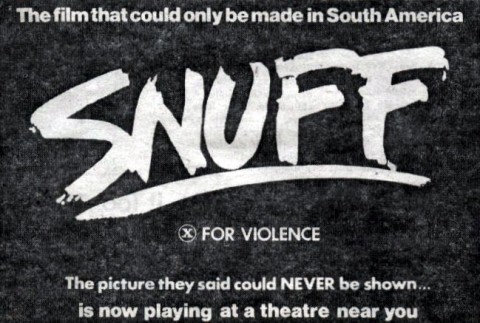
In 1976 producer Allan Shackleton, who held the rights to the Findlays’ film, exploited the wave of wild rumours that South America was the cradle of real filmed murders: he re-edited it with a new ending and released it as “Snuff”.
The film, whose tagline read “The film that could only be made in South America… where life is CHEAP”, became famous for its final scene, in which a woman appears to be really killed by the crew. The sequence was so realistic that, even though it was proven fake, rumours that it was a real murder kept going. Even police investigated, concluding it was fiction.
Shackleton then organised a clever publicity campaign: he is said to have hired people to protest outside cinemas showing the film. Soon, though, the protests became real, especially from feminist groups opposed to violent pornography.
“Snuff” has the dubious “merit” of having rooted the belief that films of killings made purely for sale really exist.
It is important not to confuse this genre with “mondo movies”, films popular between the ’60s and ’80s which, although they showed atrocities and sordid acts of all kinds, presented themselves as documentaries.
The urban legend of snuff
In the 1980s some horror films, deliberately shot to look amateur, made many people believe they were watching real killings. This was the case with the Japanese “Guinea Pig” series, created by manga artist Hideshi Hino, with its grainy footage and extreme special effects.
In 1991 actor Charlie Sheen watched Flower of Flesh and Blood, the second film in the series, directed by Hino himself, and became convinced it showed the real dismemberment of a woman. He reported it to the FBI, which opened an investigation but closed it when the producers released a “making of” showing how the special effects had been done.
Another legend grew up around Hino: it is said that in the mid-1980s he received material from a fan which, he claimed, showed a real murder, and that the film was inspired by it.
Cannibal Holocaust (1980) by Ruggero Deodato was also accused of showing real deaths, so much so that the director ended up on trial in Italy, but that too was fiction.
Snuff films in reality
For decades the existence of a real snuff industry was never proven. In fact, many point out it would make no sense: anyone filming a murder hands the jury perfect evidence of their crime, with too many details about who they are, how they killed and where.
With the arrival of the web, sadly, videos of real murders filmed by the killers themselves have appeared online, such as those of the so-called Dnepropetrovsk maniacs. In these cases, however, the footage was not made to be sold, but for the killers’ own gratification or to shock viewers.
In 2025 Vice magazine published an investigation into what it called the first documented real snuff video, known as “The Vietnamese Butcher”: the killing of a willing participant, whose videos and images have been sold since February 2025 on the dark web and on Telegram channels.
From urban legend, snuff movies are edging into a dangerous grey area, showing us that while many dreams cannot come true, some nightmares can turn into terrible, sad realities.
🦋 Emadion lives through its readers. If this story kept you up at night, buy me a coffee: it helps me bring you the next nightmare.
☕ Support Emadion on Ko-fiSources
Many thanks to Francesco, who helped write this article. I invite you to visit his very interesting website: 24framesite