 Posted by
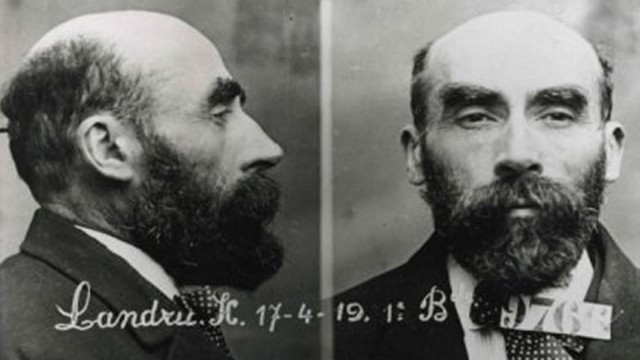
Henri Désiré Landru (1869-1922), the “Bluebeard of Gambais”, used marriage ads between 1914 and 1919 to seduce at least ten lonely women, almost all war widows, robbed them and killed them along with the teenage son of his first victim, burning the bodies in his stove. Without a single corpse, he was convicted of 11 murders thanks to his notebook and guillotined on 25 February 1922.
The fairy tale of Bluebeard was written by Perrault in 1697 and tells of a man who kills his wives and hides their bodies in a secret room. Over time “Bluebeard” became a byword for a violent man, but it was during the First World War that the wicked man with the bluish beard seemed to appear in flesh and blood.
His name was Henri Landru, a Parisian who seduced widows to rob them and then killed them.
Henri Landru
Henri Désiré Landru was born in Paris on 12 April 1869 into a modest but respectable family: his father, Julien, was a stoker who later became a factory manager, while his mother worked from home as a seamstress. They were devout Catholics and Henri went to a religious school, where he was described as a serious student and served as an altar boy.
After school he worked briefly in an architect’s office, then in 1889 he began his military service, which lasted four years. Meanwhile he started a relationship with his cousin, Marie-Catherine Rémy, who gave him a daughter. They married in 1893 and had four children in all.
In the following years Landru could not hold down a job: he worked as an accountant, furniture salesman, mapmaker and assistant toymaker. It is said that what pushed him into crime was an employer who fled to America with the savings of Landru and his colleagues, but some biographers doubt it really happened that way.
What is certain is that Landru dreamed of becoming an inventor. In 1898 he designed a motorcycle, the “Landru”, and swindled investors over a factory that did not exist. From there began a long career of fraud.
The frauds
His first conviction came in 1904: two years in prison. Between 1902 and 1914 Landru was in and out of prison for various frauds, but stayed married to Marie-Catherine.
In 1909, in Lille, he posed as a single businessman and persuaded a wealthy widow to hand over her savings. He was caught trying to cash her securities and sentenced to three years. Perhaps this is where he learned his lesson: no victims, no witnesses.
While he was in prison, in 1909, his mother died. In 1912, shortly after his release, his father took his own life, apparently out of shame and despair at his son’s criminal life.
In summer 1914, after another 35,600-franc fraud over a fake car factory, Landru was sentenced in absentia to four years’ hard labour and lifelong deportation to New Caledonia. But he had already vanished, using false names and constantly moving.
The murders
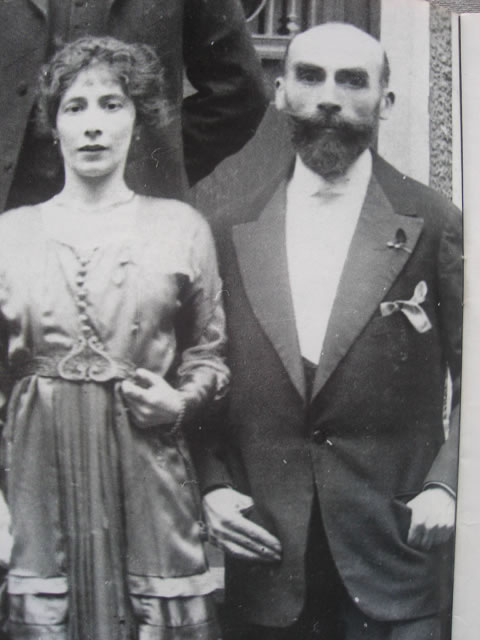
With the outbreak of the First World War, newspapers filled with ads from lonely widows seeking companionship and security. Landru saw the opportunity and began placing his own:
Widower with two children, aged 43, comfortable income, affectionate, serious and moving in good society, desires to meet widow with a view to matrimony
Replies poured in. Landru carefully catalogued them in his notebooks, sorting the women by how wealthy they seemed: “No money”, “No reply”, “Probably has assets”, “Further investigation required”.
The first to fall into his trap was Jeanne Cuchet, a 39-year-old widowed seamstress, to whom he introduced himself as “Raymond Diard”. Her sister and brother-in-law did not trust him and one day, in his empty house near Chantilly, they found papers with his real name and his criminal record. Jeanne, however, would not leave him; she broke with her family and in December 1914 moved with her son André, aged 16 or 17, into the villa Landru had rented in Vernouillet. The two were last seen alive around 26 January 1915. Shortly afterwards neighbours reported thick, acrid smoke coming from the chimney. Landru told police he was burning rubbish, and they believed him.
In June 1915 it was the turn of Thérèse Laborde-Line, a 46-year-old Argentine, and in August of Marie-Angélique Guillin, 51, to whom Landru claimed he was the future consul general in Australia. Once she had disappeared, Landru emptied her account by posing as her brother-in-law.
By late 1915 the neighbours in Vernouillet were getting suspicious, so Landru rented an isolated villa in Gambais, 300 metres from the nearest house. As soon as he moved in he bought a large kitchen stove and a big supply of coal.
In Gambais disappeared Berthe Héon, 55, Anna Collomb, 44, Andrée Babelay, 19, Célestine Buisson, 47, Louise Jaume, 38, Anne-Marie Pascal, 36, and finally, on 13 January 1919, Marie-Thérèse Marchadier, 37, with her two dogs. The pattern was always the same: Landru bought two train tickets to Gambais, a return for himself and a single for her. Then he sold the victims’ furniture and securities and wrote postcards to their friends pretending they were fine.
A few days before she disappeared, Anne-Marie Pascal wrote to her aunt that she was afraid of him: when he looked at her with those eyes she went cold, and there was something demonic about him.
For each victim Landru used a different name, and he noted everything in his notebook so as not to get confused.
The arrest
What brought Landru down was the stubbornness of his victims’ families, especially Marie Lacoste, Célestine Buisson’s sister. Getting no answer to the letters she sent her sister in Gambais about her son, who had gone blind, in January 1919 she wrote to the village mayor. The mayor put her in touch with Victorine Pellat, Anna Collomb’s sister, who had made similar enquiries. The two women compared their stories, realised the man with the false names was the same person, and reported the disappearances.
On 11 April 1919 a friend of Marie Lacoste who had seen Landru before recognised him shopping on the rue de Rivoli with a young woman. Police traced his address and on 12 April 1919, his fiftieth birthday, arrested him in the flat near the Gare du Nord he shared with his 24-year-old mistress, Fernande Segret. As he was led away, he reportedly sang her an aria from Massenet’s Manon.
Landru denied everything. He admitted to being a swindler, but not a murderer:
Just because I am Landru doesn’t prove I am a murderer
And when asked where the women were, he replied that it was his business.
But police found his black notebook: it held his accounts, meetings with 283 women contacted through ads and marriage agencies, and the list of the eleven victims, ten women and André Cuchet. Many of the other women were found alive, but 72 were never traced.
In the Gambais villa, under a shed and in the stove, investigators found more than four kilos of burnt bone fragments, including 295 pieces of human bone and 47 teeth, along with scraps of cloth and buttons. In the garden they found only the skeletons of two dogs, Marie-Thérèse Marchadier’s.
Trial and sentence
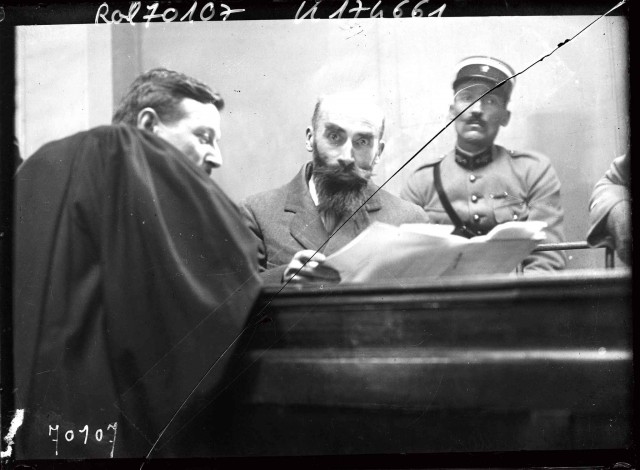
The trial opened in Versailles on 7 November 1921 and turned into a real show. Every day trains full of onlookers arrived from Paris, and celebrities such as the writer Colette, Maurice Chevalier and Rudyard Kipling were seen in court. Landru received fan letters, gifts and even marriage proposals, and in the 1919 elections almost 4,000 voters had written his name on their ballots.
In court he was calm, polite and sarcastic, and kept denying the murders. His famous lawyer, Vincent de Moro-Giafferi, staked everything on the lack of bodies. At one point he announced that the victims had been found and were about to walk into the courtroom: everyone turned towards the door, and he argued that this proved nobody was really sure they were dead. The prosecutor pointed out that the only one who had not turned round was Landru.
On 30 November 1921 the jury found him guilty of all eleven murders, by 9 votes to 3. His plea for clemency was rejected and on 25 February 1922 Landru was guillotined outside the prison in Versailles. He refused a last confession and told the priest to worry about saving his own soul.
In 1963 newspapers published what looked like his confession: a sentence Landru had written on the back of a drawing of his kitchen given to one of his lawyers, found by the lawyer’s daughter. The versions reported differ, but all speak of something being burned inside the house.
In 1958, digging in the grounds of the Gambais villa, partial skeletons of two people were found, perhaps Jeanne and André Cuchet themselves.
Henri Landru and public opinion
At the beginning of the 20th century the concept of a serial killer did not exist. Serial murderers were not at all common, and a case like this shook post-war France terribly. Landru was nicknamed the Bluebeard of Gambais, just like the character in Perrault’s tale who killed his wives.
His story also inspired Charlie Chaplin’s film Monsieur Verdoux. A severed, preserved head said to be his is on display at the Museum of Death in Hollywood, California.
🦋 Emadion lives through its readers. If this story kept you up at night, buy me a coffee: it helps me bring you the next nightmare.
☕ Support Emadion on Ko-fi