 Posted by
Between 1944 and 1947 Ernesto Picchioni, a violent man living in a farmhouse at kilometre 47 of the Via Salaria near Nerola, scattered nails on the road and killed the travellers who came to him for help, to rob them. It was his wife who got him arrested. Sentenced to life in 1949 for two murders, he died in prison in 1967. His victims may have been many more.
It is the evening of 3 May 1947. Alessandro Daddi, a Roman office worker, is riding along the Via Salaria on his Ducati Cucciolo, the motorised bicycle that in those years was almost a luxury. He is on his way to visit his mother in Contigliano, near Rieti. He will never get there.
In an Italy just out of the war, a person going missing doesn’t make the news. The roads are full of drifters, veterans, people looking for work or running from something. But along that stretch of the Salaria, near the village of Nerola, about 40 kilometres from Rome, people disappear a little too often. And there is a house, isolated and crumbling, with a light on at kilometre 47. It is the only place to ask for help if you get a puncture in the dark. It is Ernesto Picchioni’s house.
The man who sold snails
Ernesto Picchioni was born in Ascrea, in the province of Rieti. The date is uncertain: some sources say 1900, others 3 May 1906. In 1944 he settled in Nerola with his wife, Angela Lucarelli, and their four children, in a two-storey farmhouse he occupied illegally. When the Carabinieri asked him how he made a living, he said he sold snails. In the village he was known as a rough, violent man who frequented taverns. In 1946 he served four months in prison for hitting the owner of the land he lived on over the head with a stone.
At home he was an absolute master. He beat his wife, threatened his children and imposed silence through fear. He claimed to be a communist and a former partisan, but the Communist Party had already expelled him in June 1946 for “moral unworthiness”.
The spider’s web
Picchioni’s method was simple and ruthless. He scattered carefully bent nails on the Salaria, which punctured the tyres of bicycles and motorbikes. Anyone left stranded at night could see only one light: that of his farmhouse. Picchioni welcomed the travellers kindly. He offered food, wine, tools for the repair, sometimes a bed for the night, especially if the guest seemed well-off. Then, when the victim let his guard down, he killed him and stripped him of everything: money, clothes, the vehicle he had arrived on.
There are two confirmed victims. Pietro Monni, a lawyer, disappeared on 5 July 1944 while cycling along the Salaria towards Ponterotto. Picchioni killed him with a shotgun blast to the head. He later said he hated him because, over dinner, he “always wanted to be right”. Alessandro Daddi, an office worker, was killed on 3 May 1947, Picchioni’s 41st birthday according to one of the birth dates handed down. While repairing his Cucciolo he was struck from behind with a club and finished off with a kitchen knife, in front of the killer’s wife and one of his sons. Both bodies ended up buried in the vegetable garden. But they were not alone: other human remains, dog carcasses and pieces of dismantled bicycles would be found around the house.
The motorbike and the wife
Picchioni was betrayed by his greed. In the days after Daddi’s disappearance, people in the village saw him riding a motorised bicycle identical to the missing man’s. For some time the Carabinieri had in fact been investigating livestock thefts and night-time robberies right around kilometre 47. Picchioni was stopped but soon released on bail. According to newspapers of the time, a lorry full of party comrades even came from Monterotondo to press for his release. The case seemed destined to fade away.
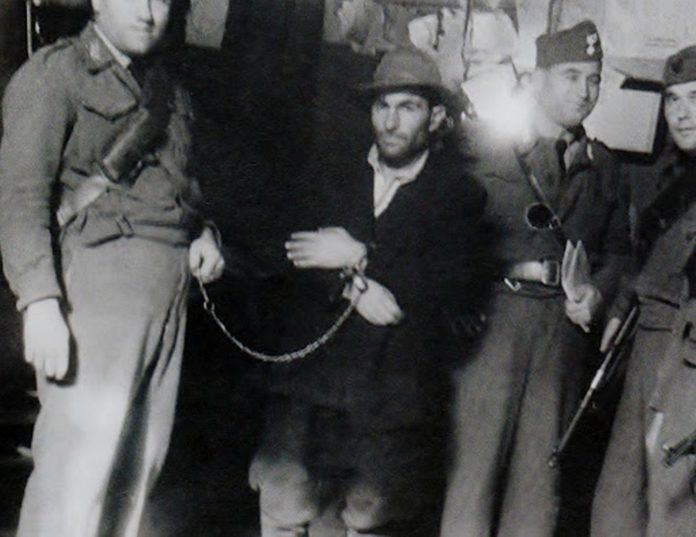
It was Angela Lucarelli, 34, who reopened it. Worn out by years of beatings and threats, the wife told the Carabinieri everything, and the children confirmed it. A chilling detail emerged: Picchioni had made his son Angelo dig a pit, promising to bury the whole family in it if anyone talked. On 28 October 1947 Picchioni was arrested again while coming home drunk. On him was a list of people to kill, including the mayor of Nerola. By then the whole village knew, and the Carabinieri had to protect him from a crowd that wanted to lynch him. They dug in the vegetable garden and found the bodies of Daddi and of Monni, recognised by his family from his bloodstained jacket.
The trial
In prison Picchioni first denied everything, then confessed, but tried to give the murders a political motive. He claimed he had killed two retreating German soldiers “out of patriotism”. The local partisan leaders immediately denied it. During questioning the count of victims rose to eight, including, according to the press, a priest.
The trial opened on 9 March 1949 before the Court of Assizes in Rome. Reporters described a stocky man with very bushy eyebrows and an expressionless face. In court his wife confirmed her husband’s horrors. On 12 March 1949 the verdict came: life imprisonment for the murders of Monni and Daddi. Other sources speak of two life sentences plus 26 years. The Court of Appeal confirmed the sentence on 13 September 1954. In the same year Picchioni was tried for a third murder, that of Mario Lucchesi, found dead in May 1945 at the Collevecchio junction. He was acquitted for lack of evidence. In the meantime he had also spent time in a criminal asylum.
How many were there really?
Ernesto Picchioni died in Porto Azzurro prison, on the island of Elba, on 9 September 1967, of cardiac arrest. He never received visits from his family. His daughters Carolina and Gabriella, according to what has been handed down, were adopted in 1952 by a wealthy foreign industrialist.
The real number of his victims remains a mystery. Estimates range from the 2 identified to the 6 considered certain, up to the 16 hypothesised. The bodies of a thirteen-year-old and an elderly man were also found around the village, but a link to him was never proven.
Legends also grew up around the monster. It is said, for example, that he tried to attack Pope John XXIII during a prison visit, but the dates don’t add up: by 1954 Picchioni was already in Porto Azzurro, while the famous papal visit to Regina Coeli was in 1958.
The case caused an enormous stir. Street singers made rhyming ballads about it, Ennio Flaiano drew on it for a short story, and his nickname even ended up in a Totò joke in the film Totò contro i quattro. Today, though, the monster of the Salaria is almost forgotten. Like his nameless victims.
🦋 Emadion lives through its readers. If this story kept you up at night, buy me a coffee: it helps me bring you the next nightmare.
☕ Support Emadion on Ko-fiSources
- Atlante del crimine, University of Milano-Bicocca (with references to newspapers from 1947-1954, Italian)
- Ernesto Picchioni, Wikipedia (Italian)
- il Giornale, “Nella tela del ragno” (Italian)
- Criminologia e Diritto (Italian)