 Posted by
- Who: Opeyemi Enoch, mathematics lecturer at the Federal University of Oye-Ekiti, Nigeria.
- What he claimed: to have proved the Riemann hypothesis, formulated in 1859, and to have won a million dollars.
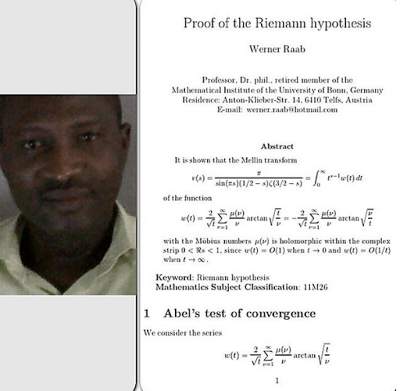
- What really happened: the proof was never recognised and the paper posted online under his name turned out to be copied.
- Today: the Riemann hypothesis is still one of the most famous unsolved problems in mathematics.
Update: when I wrote this article, in November 2015, the news was going around the world, picked up even by the BBC and the Daily Telegraph. A few days later it turned out to be false. I have left the story below as I told it then, followed by what really happened.
The Nigerian professor in question, Opeyemi Enoch, had supposedly solved a problem a good 156 years old.
The prize
The greatest minds in mathematics had already attempted this feat, without success.
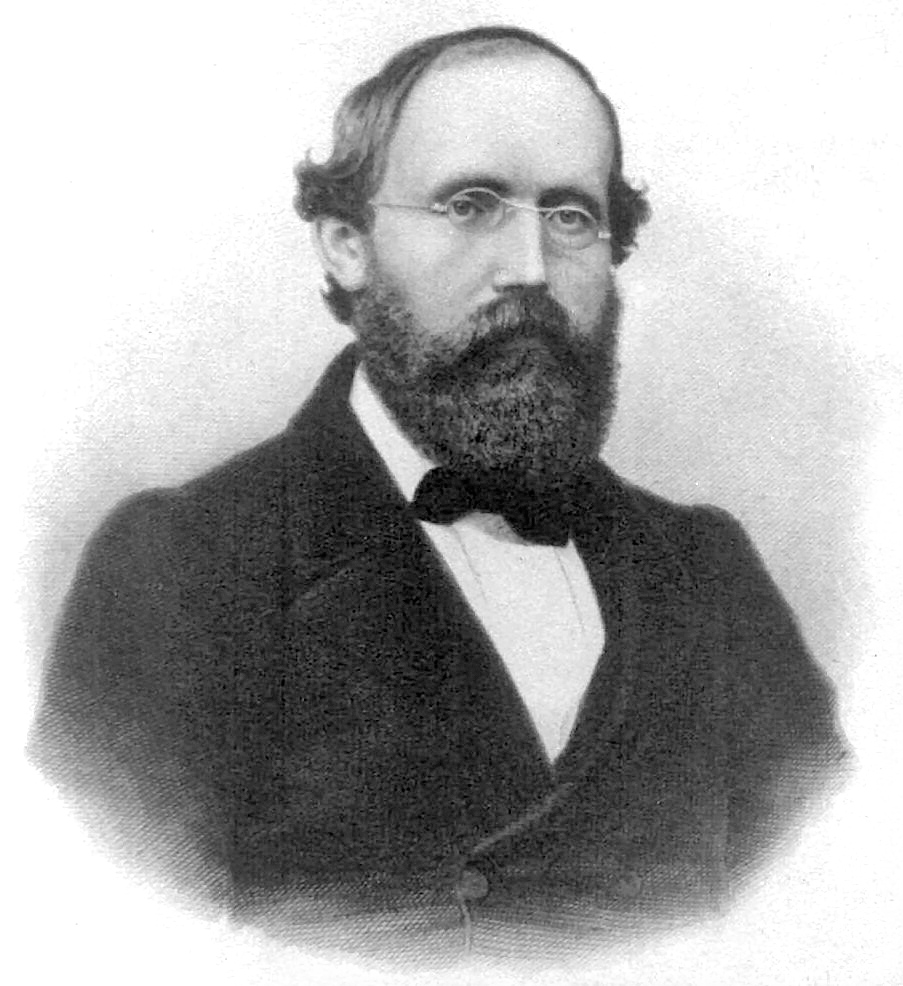
Opeyemi had supposedly won a million dollars this way. The problem had been formulated in 1859 by Bernhard Riemann and was closely tied to prime numbers: the Riemann hypothesis concerns the points where a particular function, the zeta function, equals zero, and proving it would give a much better understanding of how prime numbers are distributed.
The solution to this mathematical problem could be used in cryptography and quantum physics.
But according to the Nigerian professor, the credit went to his students:
They are the ones who told me I could do it, I didn’t do it for the money
he explained.
There was no shortage of envious people and gossips, though, and one of the questions put to him was:
Why don’t you find a solution to Nigeria’s problems too?
In fact Opeyemi said he had already thought of that himself, long before winning the prize.
He had designed a prototype silo for poor farmers and was looking for a better way to protect oil pipelines from vandalism.
He also wanted to use mathematics to look for a solution to climate change.
The news was false
The million-dollar prize really exists, but it is not awarded by the International Conference on Mathematics and Computer Science, as reported at the time. Since 2000 it has been offered by the Clay Mathematics Institute, in the United States, for each of the seven “Millennium Prize Problems”, which include the Riemann hypothesis.
To win it, presenting a solution at a conference is not enough: the proof has to be published in a serious scientific journal and withstand at least two years of scrutiny by other mathematicians. Enoch had only given a talk at a conference in Vienna, and his own abstract did not announce a proof at all.
When journalists asked, the Clay Mathematics Institute confirmed nothing and pointed to its website, where the Riemann hypothesis was, and still is, listed as unsolved. The only one of the seven problems officially solved is the Poincaré conjecture, proved by Grigori Perelman in 2003.
What’s more, the paper with the supposed proof uploaded under Enoch’s name on academia.edu turned out to be copied from a text already circulating online, signed by a certain Werner Raab.
So the 156-year-old problem, now more than 165 years old, is still waiting for someone to solve it. What a pity!
🦋 Emadion lives through its readers. If this story kept you up at night, buy me a coffee: it helps me bring you the next nightmare.
☕ Support Emadion on Ko-fi