 Posted by
- Announcement: 28 September 2015, NASA.
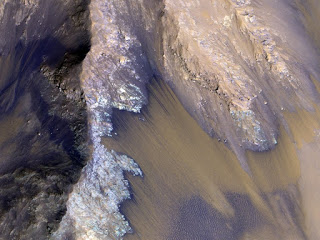
- What: hydrated salts in the dark streaks (RSL) that appear in summer on Martian slopes, photographed by the MRO probe.
- What changed later: since 2017 many studies think those streaks are flows of dry sand, not water.
- The news: in 2018 a radar suggested lakes under the south pole; in 2024 seismic data from the InSight lander pointed to liquid water 10-20 km deep.
Water on Mars
The news of water on Mars has just been made public. Stories suggesting water on the red planet have been circulating for years, but this is the first time there is evidence for it.
The MRO (Mars Reconnaissance Orbiter) spacecraft photographed grooves containing salts that only form in the presence of water. These are certainly not great rivers or streams, but trickles of salty water that form during the Martian summer months.
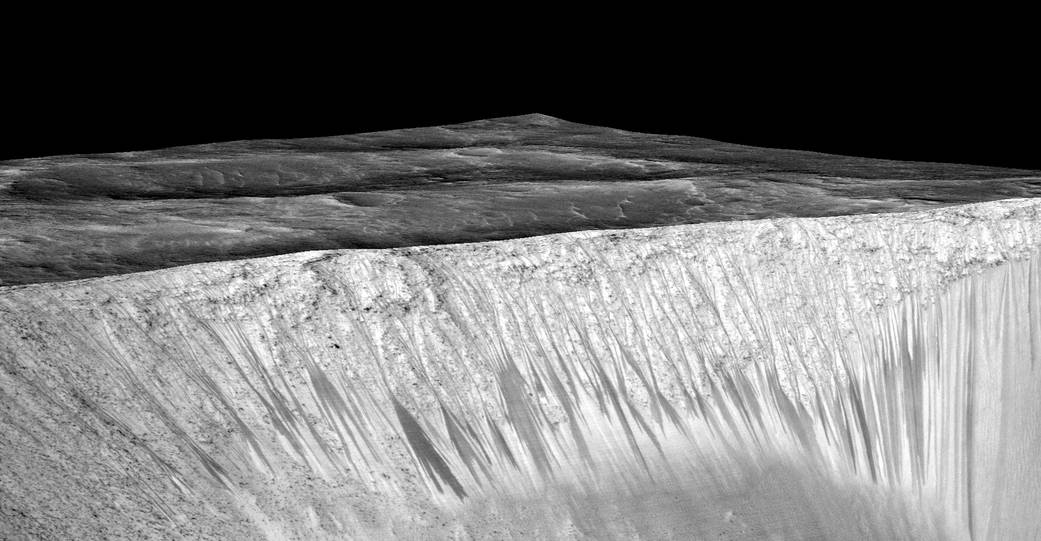
These grooves had already been observed in 2011, but scientists were not sure they really were traces of water. They are called recurring slope lineae, or RSL: dark streaks half a metre to five metres wide, up to hundreds of metres long, that appear on the steepest slopes when it is warmest and fade with the cold.
The origin and chemical composition of the water are still unknown, but its mere presence suggests the possibility of life, at least microbial, in it.
Mars’s thin atmosphere, however, does not allow liquid water to exist for more than a few seconds. So where would the water that left these traces come from?
The most likely hypothesis is that it comes from melting underground ice, whose presence has already been confirmed by special radars.
Update: what we know today
In the following years, unfortunately, the 2015 enthusiasm cooled somewhat. In 2017 several studies showed that the streaks always stop at a slope of about 27-28 degrees, just like avalanches of dry sand. Researchers also pointed out that the water had never been seen directly: only the salts had been found. Today many scientists therefore think RSL are flows of dry grains, although the salty water hypothesis has not been entirely abandoned.
But water on Mars has not disappeared from the news, quite the opposite. In 2018 the Italian MARSIS radar, on board the European Mars Express probe, detected what could be lakes of salty water beneath the ice of the south pole, a finding still hotly debated.
And in August 2024, analysis of seismic data collected by NASA’s InSight lander suggested a huge reservoir of liquid water 10 to 20 kilometres beneath the Martian crust. Too deep to reach, but enough to rekindle the hope that somewhere underground there might be life.
🦋 Emadion lives through its readers. If this story kept you up at night, buy me a coffee: it helps me bring you the next nightmare.
☕ Support Emadion on Ko-fi