 Posted by
Teke Teke is the ghost of a girl cut in half by a train. With no legs, she drags herself along on her elbows, making a sharp clicking sound, “teke teke”, and she’s faster than anyone. If she catches you, she slices you in half like her. The legend spread among Japanese children in the 1980s and 90s and is tied to an older story, that of Kashima Reiko, who asks: “Where are my legs?” Only one answer will save your life: “On the Meishin Expressway.”
Japanese has a word for almost every sound. “Doki doki” is a pounding heart, “goro goro” is thunder, “shin” is the silence of snow. And then there’s “teke teke”: the sound of something hard tapping on concrete, steady, faster and faster.
For generations of Japanese children, that sound has only one meaning. If you hear it behind you, in the evening, near the railway, don’t turn around. And don’t run, because it’s no use.
The girl on the tracks
In its best-known form, the story is set in Hokkaido, Japan’s northernmost island, on a winter night. A girl, sometimes a schoolgirl and sometimes a young office worker, falls onto the tracks at a station or a level crossing. A train comes and cuts her in two at the waist.
The cruellest detail is the one children whisper: the Hokkaido cold was so intense that her blood vessels contracted, and she didn’t die right away. She stayed alive for several minutes, dragging herself across the snow, looking for help.
Ever since, her ghost has roamed near stations and crossings at night, sometimes near schools. Missing the lower half of her body, she moves on her hands or elbows, making the sound that gave her her name. When she meets someone she chases them, and she always catches up: in the stories she’s faster than a car. Often she carries a scythe. Her victims are cut in half, exactly like her.

“Where are my legs?”
Teke Teke has an older sister, and her name is Kashima Reiko. Her story is older, and some scholars think the two legends fed into each other until they blurred together.
Kashima Reiko is also said to have lost her legs under a train. But instead of chasing people down the street, she appears in toilets, often at stations. She knocks on the stall door and asks a question: “Where are my legs?”
Anyone who can’t answer, or answers wrongly, is torn apart. Those who know the legend have the answer ready: “On the Meishin Expressway.” The Meishin is the major motorway linking Nagoya and Kobe, and its name is made from the Japanese initials of the two cities. Why the legs of a girl who died in Hokkaido should be there, nobody knows, and that’s the beauty of it. In versions that travelled abroad, the answer often became “on the Meishin line”, as if it were a railway.

Sometimes there are more questions. Kashima may ask if you need your legs, and you must say you’re using them. She may ask who told you her story, and you must say her name. There’s also a mysterious formula, “kamen shinin ma”, which could be translated as “mask, dead person, demon”. Some say the name Kashima comes from the first syllables of those three words.
And then there was the part that really scared children: the chain. Anyone who hears Kashima Reiko’s story, it was said, will get a visit from her within a month, or within a few days. The only way to avoid it is to tell the story to others. That’s how legends save themselves.
Where it really comes from
The problem is that there’s no evidence the Hokkaido girl ever existed. The towns named as the scene of the tragedy change with the teller: Asahikawa, Muroran, Sapporo. One especially grim version tells of a young office worker in Muroran attacked by soldiers after the war and left on the tracks. But nobody has ever found a railway accident that really matches.

Other theories place the origin elsewhere: in Kakogawa, Hyogo Prefecture, where after the war a woman is said to have thrown herself under a train, or in Okinawa, where a similar story circulated. Japanese scholars of modern folklore tend to think Hokkaido came later: an explanation added to give the story a believable beginning, in a place far enough away and cold enough to make it plausible.
What we know for sure is that Teke Teke took off in the 1980s and 90s, during the great boom of “school ghost stories”. The folklorist Tōru Tsunemitsu collected similar tales in his 1990 book on school ghosts, and children’s magazines ran special issues. In 2009 director Kōji Shiraishi released two films at once, Teketeke and Teketeke 2. In the first, the creature appears after sunset on a footbridge over the tracks, and anyone who turns at the sound is doomed.
A fear built out of trains
Japan is a country of trains. People take them to school, to work, to visit family. Tracks cross cities and countryside, crossings ring at all hours. And, sadly, railway accidents and suicides are a reality children hear about early.
Teke Teke gives all this a shape. It turns the level crossing, a place you pass every day, into a place where death is a few metres away. And like many horror stories for kids, it’s also a very practical warning: don’t play near the tracks, don’t cross when the barriers come down, get home before dark.
Then there’s the body. Kuchisake-onna has a slit mouth, Teke Teke is cut in half, Kashima Reiko is looking for her legs. Modern Japanese legends are full of wounded bodies coming back to ask the living for something. Maybe because what scares us most isn’t the ghost itself, but the idea that the same injury could happen to us.
What to do if you hear her
The legend is quite clear about what doesn’t work. Running is useless, because she’s faster. Hiding doesn’t work either, because she’ll find you. Ignoring her question is the surest way to end up like her.
What you need is memory. Remember the name, remember the answer, remember the story. And then, as the chain demands, tell it to someone else. Consider this article our way of staying safe.
If this gave you chills, read the stories of Kuchisake-onna, the slit-mouthed woman, and of Hitori Kakurenbo, the Japanese game you should never play.
🦋 Emadion lives through its readers. If this story kept you up at night, buy me a coffee: it helps me bring you the next nightmare.
☕ Support Emadion on Ko-fiSources
- Yokai.jp, Teke Teke: uncertain origins and spread in the 1980s
- Wikipedia, Teke Teke
- The Business Standard, The legend of Teke Teke
- Horror Obsessive, Teke Teke and Kashima Reiko
- Jorudan Movie, Teketeke (2009) film page (in Japanese)
- Tōru Tsunemitsu, Gakkō no kaidan, Kōdansha KK Bunko, 1990
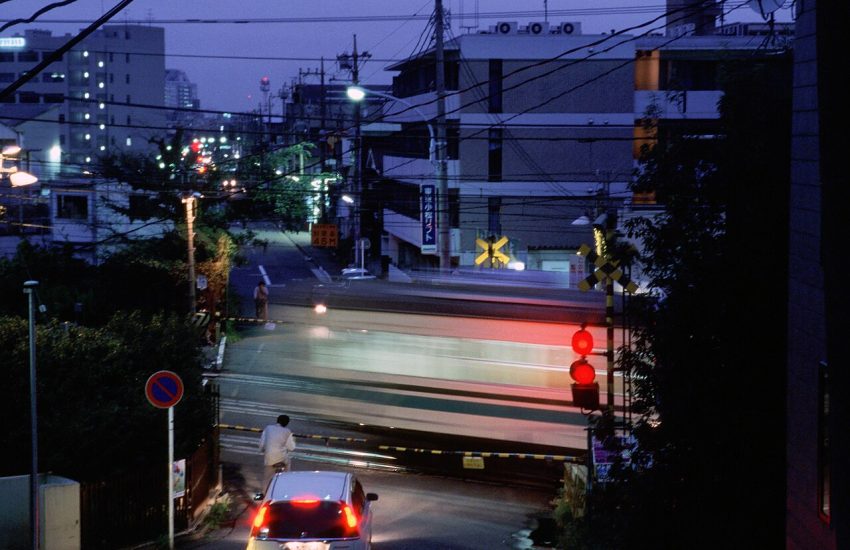
Featured image: a train passes a level crossing at dusk, photo by Shellparakeet, Wikimedia Commons, CC0.