 Posted by
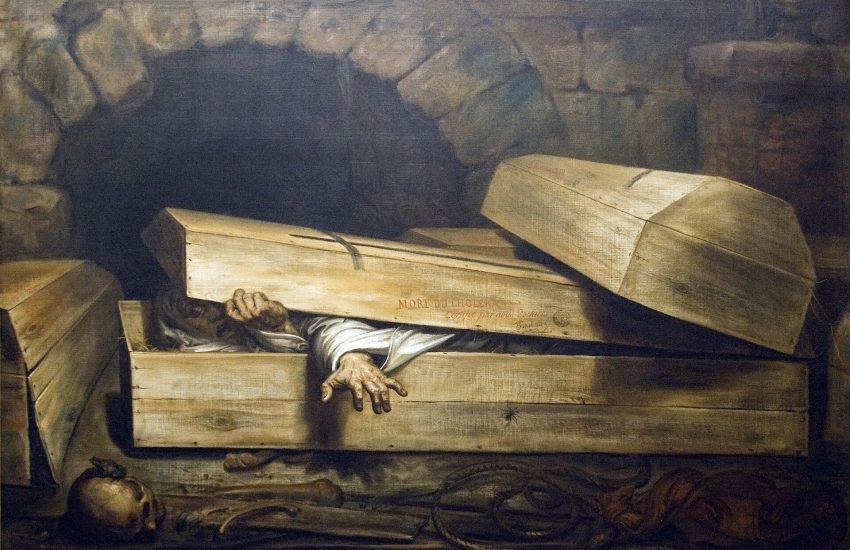
In the nineteenth century people’s greatest fear was not ghosts, but being buried alive.
Doctors who got their diagnosis wrong, illnesses that left patients motionless and cold as corpses, stories of coffins reopened with scratch marks on the lid. It was in this climate that one of America’s saddest legends was born: the story of a boy who, declared dead, refused for five days to behave like a dead body. Many even consider it the only “confirmed” case of a zombie. To be clear: I am not talking about the film genre that has become a cult today, but about a child who, after being declared dead, remained for five days in a state no one could explain, before he really left this world.
The legend
The story, as it is usually told, begins in December 1879 in a small town in Pennsylvania. In the most common version the town was called Pincherville, today’s Orange, and the family was named Bellingan. The son of a well-off family fell ill with tuberculosis. His parents called in the best doctors, but at the time there was no cure: the doctors could only ease the child’s suffering, with medicines that often did more harm than good. According to the story, the boy was treated with preparations containing zinc and lead, which were not only useless but toxic.
 On 11 January his heart stopped beating, and the doctor declared him dead.
His devastated parents decided to wait for all the relatives to arrive before the funeral. The body was laid out at home, as was the custom then. And that is where someone noticed that something was wrong.
The body did not change. Hours went by, then days, and the boy showed no sign of decomposition. After three days his skin was still pink and his tissues soft; someone cried miracle, and his parents began to hope that their son would open his eyes again. He did not stiffen, and his skin stayed warm. The doctor came back and confirmed it: the boy was dead. And yet, according to the story, his pupils reacted slightly to light. The family tried everything to wake him, in vain. The doctor, struck by such a strange case, obtained permission to postpone the burial. It was the town’s mayor, the legend says, who granted it.
On the fifth day the unthinkable happened. In front of the terrified onlookers, the boy’s body was shaken by violent convulsions. Immediately afterwards, within a few minutes, it changed: the skin took on the colour of a corpse and all the signs of death that had been missing until then appeared at once. As if death, after waiting five days, had taken everything in one go. The boy was buried on 18 January 1880 in the town cemetery, while his mother kept repeating that he was still alive.

True story or legend?
Let’s say it straight away: there are no reliable records of this story. There are no contemporary reports confirming it, and the details change from one telling to another, even the names of the family and the town. In all likelihood it is a legend, born or developed long after the events it claims to describe.
But like all legends that survive, it has roots in very real fears.
Tuberculosis, the disease that “consumed”
In the nineteenth century tuberculosis was one of the leading causes of death in Europe and America. It was called consumption, because it seemed to consume the sick from the inside: they grew thin, faded away little by little, coughed up blood. Its cause remained unknown until the end of the century, when it was discovered to be a bacterium.
The disease spread easily within families. When someone died of tuberculosis, other relatives often fell ill soon afterwards. And in the countryside of New England some people found a terrible explanation: the dead person was “feeding” on the living, consuming their life from the grave. Between the late eighteenth and the late nineteenth century dozens of bodies were exhumed to check whether they had stayed “fresh”, and in some cases their hearts were burned. This is the so-called New England vampire panic, and its most famous case is that of Mercy Brown, in 1892.
In that culture, a body that did not decompose was not a medical mystery. It was a danger signal.
The fear of being buried alive
The other great fear of the time was apparent death. Nineteenth-century medicine had no precise way of establishing death: no electrocardiograms, no brain scans. Doctors relied on the pulse, the breath, a mirror held in front of the mouth. And cases of people believed dead and then “woken up” were frequent enough to frighten everyone.
Edgar Allan Poe wrote a famous story about it, The Premature Burial. Safety coffins were patented, with bells attached to a cord that the supposed dead person could pull from inside, or with tubes to let air in. And many families took to watching over the body for days before the funeral, just to be sure.
What might have happened
If a case like this really happened, how could we explain it today? The boy died in January, in the middle of winter: in a cold house, a body keeps much longer than usual. Some diseases and some poisons, such as lead and other metals used in the medicines of the time, can alter the signs of death. And when people recall a tragedy, their memory always tends to add details.
Or, and this is the most disturbing hypothesis, the doctors really were wrong, and for five days the boy was alive, in a state no one knew how to recognise. Over the years, those who have told this story have spoken of apparent death caused by a severe stroke. And even today the news occasionally reports people believed dead who wake up in the morgue. Today we know there are conditions, such as some forms of deep coma, in which a person can look dead. In 1880 no one had the tools to notice.
In any case, the story of the “zombie boy” is not really about zombies. It is about parents who could not let their son go, and about an age when the line between life and death was much thinner than we like to think.
Had you heard of coffins with bells? Do you think this story is just a legend?
🦋 Emadion lives through its readers. If this story kept you up at night, buy me a coffee: it helps me bring you the next nightmare.
☕ Support Emadion on Ko-fiSources
- Wikipedia, “New England vampire panic”.
- Restoration Obscura, The New England Vampire Panic.
- Edgar Allan Poe, The Premature Burial, 1844.