 Posted by
Five stories of people declared dead and buried, or nearly buried, while they were still alive: Octavia Smith Hatcher (Kentucky, 1891), Mina El Houari (Morocco, 2014), Angelo Hays (France, 1937), Essie Dunbar (South Carolina, 1915) and Neysi Pérez (Honduras). Some are well documented, others sit halfway between news and legend.
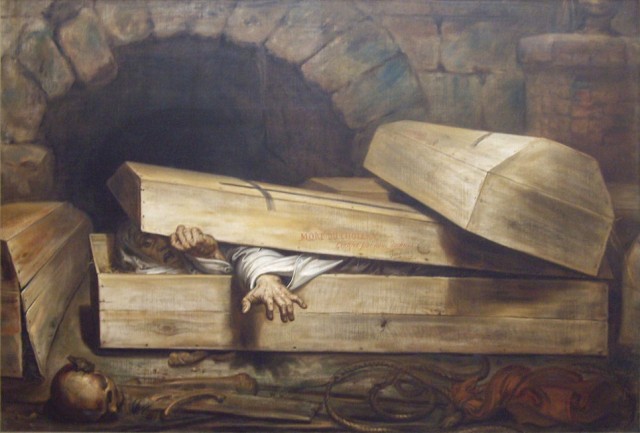
Being buried alive is a fear many people share, so much so that it has a name: taphophobia. For the people in these stories, though, the nightmare came true.
Octavia Smith Hatcher
Octavia Smith was a young woman from Pikeville, Kentucky, the daughter of one of the town’s most prominent families. In 1889 she married James Hatcher, a wealthy businessman. In January 1891, aged twenty, she gave birth to a son, Jacob, who died shortly after birth.
Octavia sank into a deep depression, stayed in bed for months and finally fell into a coma. On 2 May 1891 she was declared dead of unknown causes. It was hot and embalming was not common in the area, so she was buried quickly.
Shortly afterwards, according to the story told in Pikeville, other people in town fell ill in the same way and slipped into a coma-like state, but some of them woke up. Her husband was seized by a terrible doubt: what if his wife had woken up too? So he had the body exhumed, and found that his fear had come true.
The lining of the coffin had been scratched and torn, and Octavia lay dead, her nails bloodied and broken and her face twisted in terror.
James had her reburied and put up a life-size statue on her grave, which still stands in Pikeville cemetery today. It must be said, however, that there are no documents or newspaper articles from the time mentioning the exhumation, and some think it is just a local legend.
Mina El Houari
Mina was a 25-year-old Frenchwoman from Cadenet, in southern France. In 2014 she met a man online and the two chatted for months, until Mina decided to go to Morocco to meet him. On 19 May 2014 she arrived in Fez and checked into a hotel. From that moment all trace of her was lost.
Her worried family travelled to Morocco and alerted the authorities, who managed to track the man down. He confessed that he had invited her to dinner at his house and that during the evening Mina had collapsed. He had seen her lose consciousness, thought she was dead and, in a panic, buried her in the garden.
Police dug where he pointed and found Mina’s body, along with a pair of muddy trousers and a shovel. Sadly the young woman had diabetes without knowing it, and that evening she had not died but fallen into a coma. Without realising it, her suitor had buried her alive, and she had suffocated.
The man was arrested and charged with involuntary manslaughter.
Angelo Hays
It is 1937 and Angelo is a 19-year-old living in Saint-Quentin-de-Chalais, France. One day he is riding his motorcycle when he suddenly loses control and is thrown headfirst into a brick wall. His face is disfigured, the doctor finds no pulse and declares him dead. He is buried three days later.
Shortly before the accident, though, Angelo’s father had taken out a life insurance policy on his son for a considerable sum, 200,000 francs. The suspicious insurer, two days after the funeral, asked for the body to be exhumed to verify the cause of death.
When the coffin was opened, Angelo’s body was still warm and a faint heartbeat could be felt. He was rushed to hospital, where after several operations doctors managed to save him. The severe head injury had put him into a state of unconsciousness so deep that his vital functions slowed to a minimum, allowing him to survive in the grave.
After his ordeal Angelo invented a safety coffin, complete with an air pipe, food supplies and a radio transmitter to call for help, and in the 1970s he toured French fairs with it.
Here too, though, there is a but. Over the years his story changed several times: in 1958 he told newspapers he had spent two days in the coffin and was found alive just before being taken to the cemetery, and some believe he was never actually buried.
Essie Dunbar
In the summer of 1915 Essie Dunbar, a 30-year-old woman from South Carolina, suffered an epileptic fit. Her family called the doctor, Dr D.K. Briggs of Blackville, who found no signs of life and pronounced her dead. The body was placed in a coffin and the funeral set for the following morning.
Essie’s sister did not live in town and had to set off right away to attend. The ceremony began, but she was late. The preacher decided to stretch out the sermon so she could arrive and say goodbye to Essie, but by the end of the ceremony she still had not appeared. So they decided to lower the coffin into the grave.
Moments later the sister arrived and asked for the coffin to be opened so she could see Essie one last time. When it was opened, however, Essie sat up and smiled. After the initial fright came joy.
Essie lived another 47 years and died on 22 May 1962. Newspapers announced it with a headline about her “final funeral”. In this case too, though, there are no articles from the time about the first funeral, and the fact-checking site Snopes rates the story as unproven.
Neysi Pérez
Neysi was a 16-year-old girl from Honduras. She had recently married and was three months pregnant. One night, after getting up to go to the bathroom, she collapsed unconscious.
Her parents, very religious, believed she was possessed and called the priest. Neysi did not recover, so they decided to take her to hospital, where three hours later she was declared dead.
The funeral was held and the next day her husband went to visit her grave. He was shocked to hear screams and banging coming from inside. He immediately raised the alarm and other relatives rushed over, breaking open the tomb with hammers.
Once the coffin was out they opened it and took Neysi to hospital, but by then it was too late: she was dead, probably suffocated.
Later the cemetery caretaker said he too had heard Neysi’s screams, but had never imagined they were coming from a grave. Had he realised, Neysi might still be alive.
🦋 Emadion lives through its readers. If this story kept you up at night, buy me a coffee: it helps me bring you the next nightmare.
☕ Support Emadion on Ko-fi