 Posted by
Bloody Mary is the spirit said to appear in the mirror when you chant her name in the dark, usually three times, by candlelight. The ritual probably grew out of old Halloween divination games, in which young women looked into a mirror hoping to see their future husband. Folklorists have read it as a childhood rite of passage, and an Italian psychologist showed that staring at yourself in dim light really does make strange faces appear.
In 2010, at the University of Urbino in Italy, psychologist Giovanni Caputo sat fifty volunteers in front of a mirror. The room was lit by a single 25-watt bulb. Their only task was to look into their own eyes for ten minutes.
Within about a minute, many of them saw their face begin to warp. Some saw a parent. Some saw a stranger, an old man, an animal, a monster. Two thirds reported huge distortions of their own features, and almost half saw fantastic or monstrous creatures.
Caputo wasn’t looking for ghosts. But he had recreated, in a lab, the most famous sleepover game in the English-speaking world: lock yourself in the bathroom, turn off the light, and call Bloody Mary.
The ritual: darkness, a mirror and a name
Anyone who grew up in the US or the UK knows the instructions. Go into the bathroom. Turn off the light. Light a candle. Stand in front of the mirror and say her name. Three times is the classic version, but some say five, seven or thirteen. Some add a spin, or turn on the tap.
The words change too. Sometimes it’s just “Bloody Mary”. Sometimes it’s “Bloody Mary, I believe in you”, or something crueller: “Bloody Mary, I killed your baby.” In some schools she has another name entirely: Mary Worth, Mary Whales, Mary Jane.
What happens next depends on who’s telling it. She appears in the glass, behind your shoulder, as a bloodied woman, a witch or a corpse. She may just stare. She may scream, scratch your cheeks or your eyes, or drive you mad. In the worst versions she reaches out of the mirror and drags you in, and you are never seen again.
Usually the game ends much sooner. Someone screams, someone flicks on the light, and everyone runs into the hallway laughing. And that, folklorists say, is the point.
Before Bloody Mary, there was a husband
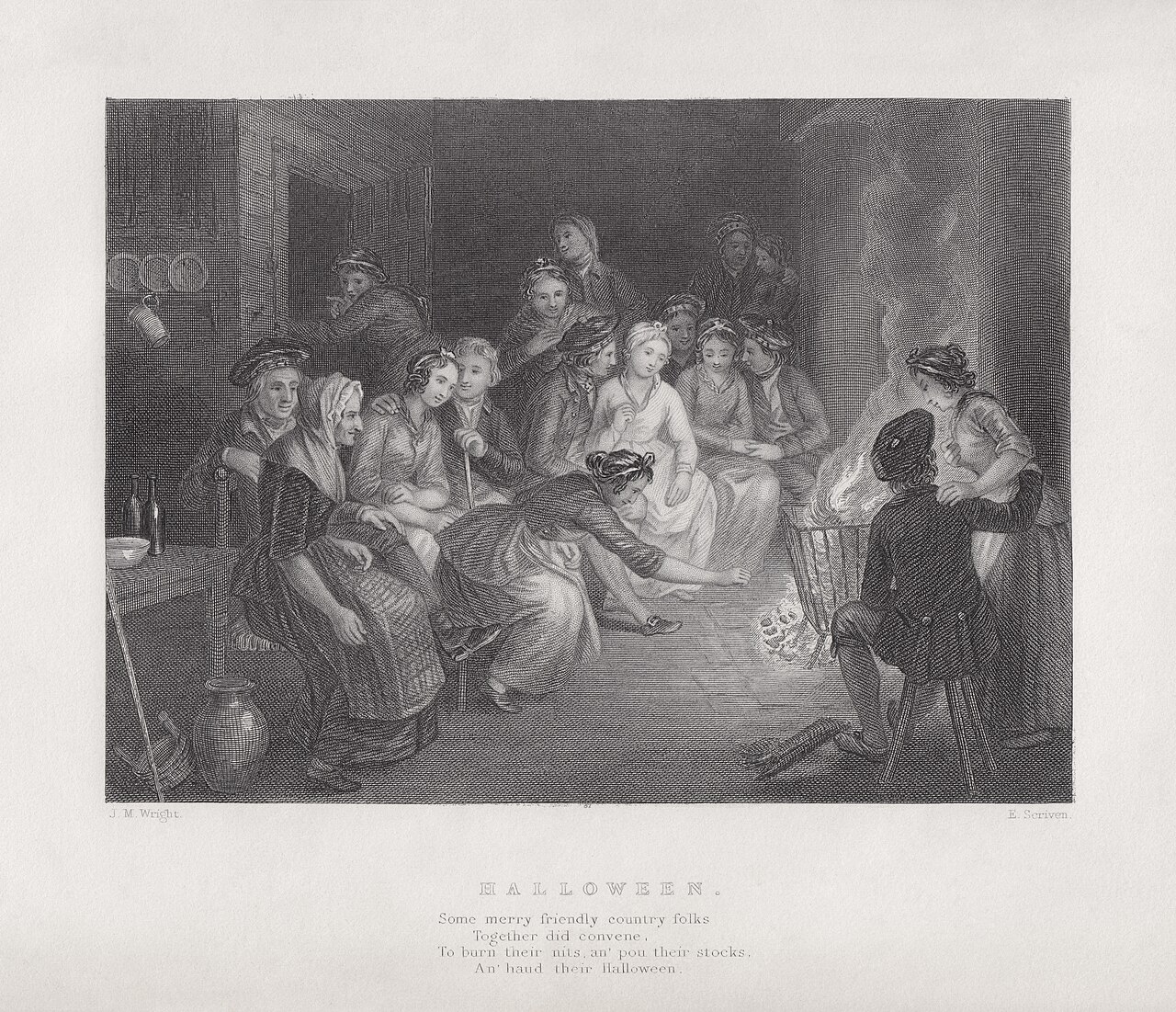
Long before candles in school bathrooms, mirrors were used to see the future. In the British Isles, at least from the 1700s, Halloween was the night for love divination. Girls used nuts, apples, balls of yarn, and mirrors to find out whom they would marry.
In 1786 the Scottish poet Robert Burns described one of these rituals in the notes to his poem Halloween: take a candle, go alone to a looking glass, and eat an apple in front of it while combing your hair. At some point, the face of your future husband will appear over your shoulder.
A more theatrical version had you walk up a staircase backwards, in the dark, with a candle in one hand and a hand mirror in the other. At the top, your groom would appear in the reflection. But there was a catch. If you saw a skull, or the face of Death, you would die before you married.
By the turn of the twentieth century, the custom had even made it onto greeting cards. In one drawn in 1904 by the American illustrator Ellen Clapsaddle, a girl in a nightgown holds up a candle, and in the mirror, instead of her own face, there’s a young man.
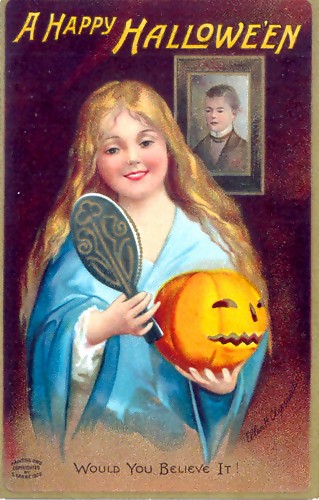
It didn’t take much for a romantic game to turn into a scary one. Instead of the groom, she showed up.
Who was Mary?
Nobody knows, and she may never have existed. Every school has its own story. Mary was a witch burned a hundred years ago in the next town over. She was a bride murdered on her wedding day. She was a girl disfigured in a car crash who now hates anyone who looks in a mirror. Sometimes she’s a mother whose children were killed, and then she looks a lot like La Llorona, the weeping woman of Mexican folklore.
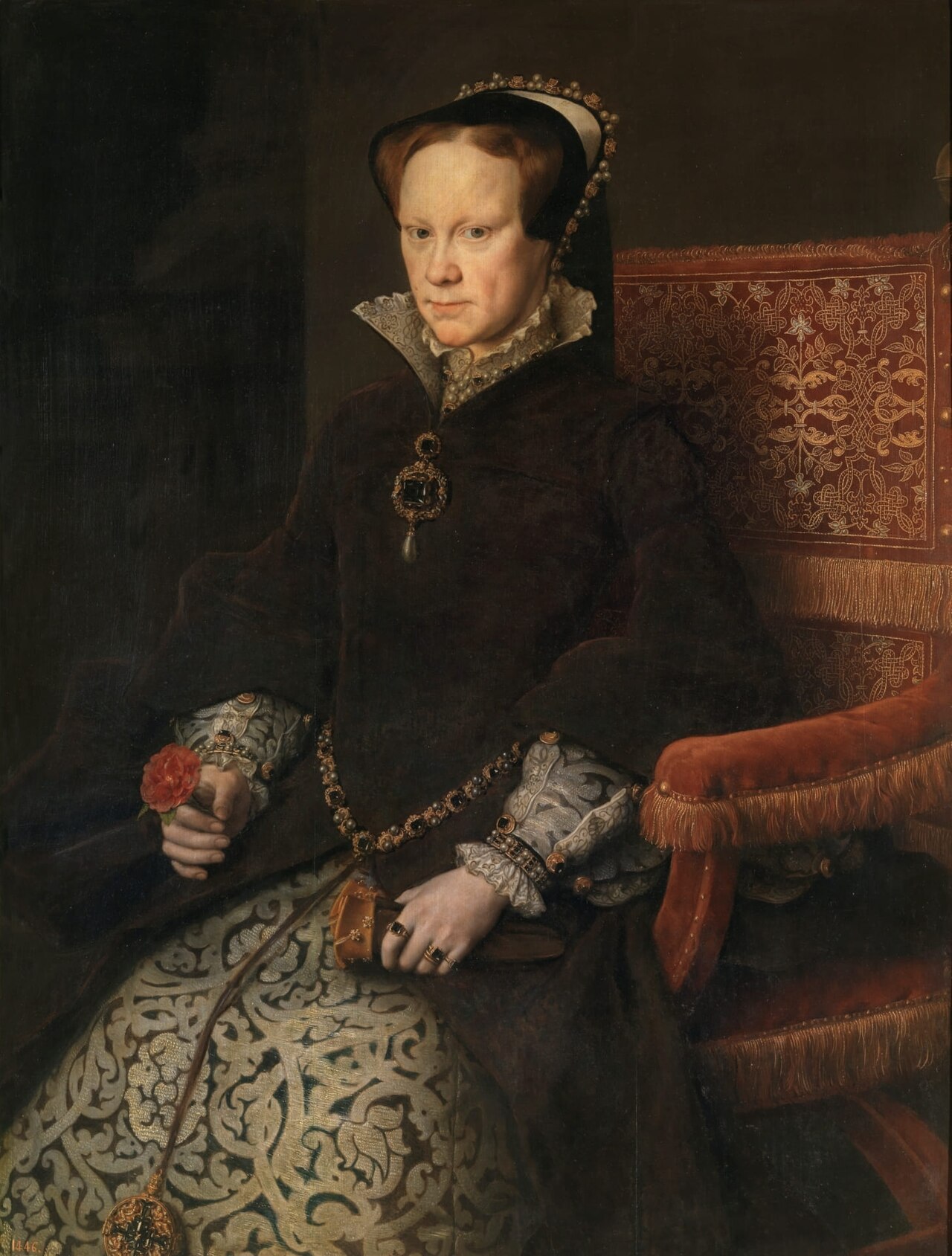
The name does have a famous precedent. “Bloody Mary” was the nickname English Protestants gave to Queen Mary I. During her reign, from 1553 to 1558, hundreds of people accused of heresy were burned at the stake. Some have pointed out another detail: the queen announced pregnancies that never produced a child, which echoes the “I killed your baby” chant. It’s a tempting idea, but most folklorists think the queen lent the legend her nickname, not her story.
Mary isn’t alone. In Sweden, children call the Svarta Madam, the Black Madam, in front of the mirror. Britain has long had its school “toilet ghosts”. And in Japan, in the last stall of the elementary school bathroom, Hanako-san answers when you knock three times.
What the folklorists say
The first scholar to take the game seriously was the American folklorist Janet Langlois, who in 1978 collected dozens of versions of the “Mary Whales” ritual from girls in Indiana. Twenty years later, in 1998, Alan Dundes of UC Berkeley offered a reading that is still debated.
Dundes noted that the players are almost always girls between eight and twelve, that the ritual happens in a bathroom, and that blood is at its centre. For him, Bloody Mary was an unconscious way for girls to face, together and safely, their fear of and curiosity about puberty and their first period. A rite of passage dressed up as a ghost story.
Not everyone agrees, and his Freudian reading has plenty of critics. But almost everyone agrees on one thing: the thrill is in the dare. Whoever stays at the mirror longest is the bravest. And the fear happens somewhere safe, a few steps from bed, with friends on the other side of the door.
The science of faces in the mirror
Which brings us back to Urbino. Caputo called it the “strange-face-in-the-mirror illusion”. The ideal conditions are exactly those of the ritual: very dim light, ideally behind you, and your gaze fixed on your own eyes from a short distance.
Part of the explanation is Troxler fading. When we stare at something that doesn’t change, our visual neurons gradually stop signalling it. The features of the face dissolve, then snap back when we blink. In low light, with little colour and lots of shadow, the brain tries to fill in the gaps. And a brain built to recognise faces ends up seeing them everywhere.
It’s unsettling even if you know what’s going on. Many of Caputo’s volunteers said those faces stirred strong emotions, sometimes fear. Now imagine feeling that at ten years old, in the dark, right after a friend has told you about the witch who was burned alive.
It doesn’t explain everything. It doesn’t explain the stories of scratches found on cheeks the next morning, or of mirrors that crack. But it does explain why, sometimes, something really does appear in the glass.
The mirror as a door
The idea that mirrors are a threshold to another world is much older than Bloody Mary. In many homes, until the last century, when someone died the mirrors were covered with a black cloth and left covered until the body had left the house. People believed the soul of the dead might catch its reflection and be trapped in the glass. Similar customs survive today, for example in Jewish mourning tradition.
Some people cover mirrors at night too, so that a sleeper’s soul won’t get lost in dreams. Others never put a mirror opposite the bed. These habits survive long after anyone remembers why. Of all the mirror legends, Bloody Mary may simply be the one that took off.
How to get out alive
The legend has no rulebook, and every group of friends makes up its own. The most sensible rules come straight from these old traditions. If the mirror is a door, you close it by covering it, as people did in houses of mourning. If she appears behind you in the reflection, don’t turn around to look, because that’s where she lives: inside the glass. And as long as the candle stays lit, at least you can see where her hands are.
If you want to try it, all you need is a dark bathroom, a candle and a few minutes of nerve. If nothing happens, you’ve learned something about your brain. If something does, remember to cover the mirror before you leave.
If you like bathroom ghosts, read the story of Toire no Hanako. And for another legend you should never test, there’s hide and seek by yourself.
🦋 Emadion lives through its readers. If this story kept you up at night, buy me a coffee: it helps me bring you the next nightmare.
☕ Support Emadion on Ko-fiSources
- Medical News Today, Caputo’s experiment explained
- Scientific American, Locking Eyes with a Monster
- Alan Dundes, “Bloody Mary in the Mirror: A Ritual Reflection of Pre-Pubescent Anxiety”, Western Folklore, 1998
- Snopes, Bloody Mary
- Folklore Thursday, Faces in the Mirror
- EBSCO Research Starters, Bloody Mary (folklore)
- Wikipedia, Bloody Mary (folklore)
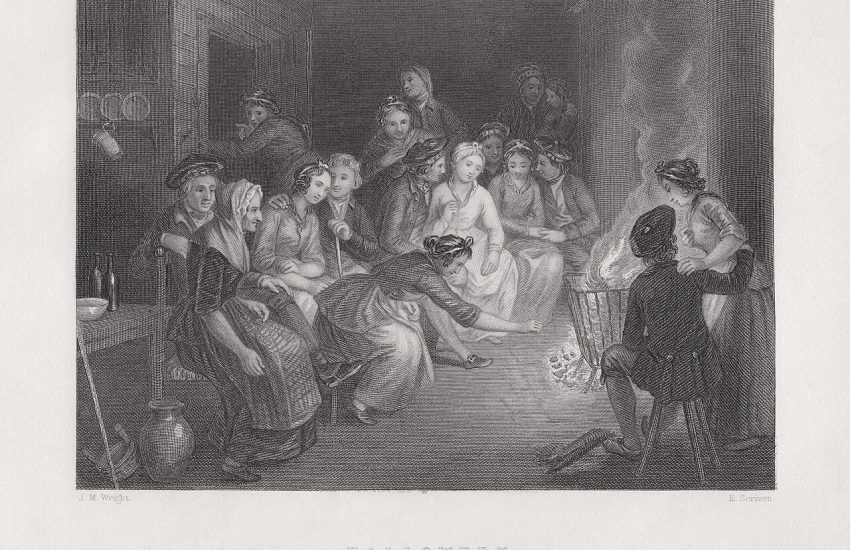
Featured image: Halloween night, engraving by J. M. Wright and Edward Scriven for Robert Burns’s poem (c. 1841), Wikimedia Commons, public domain.