 Posted by
- Where: the Penitentiary of New Mexico, south of Santa Fe.
- When: from 1:40 a.m. on 2 February 1980 to the afternoon of 3 February, for 36 hours.
- Toll: at least 33 inmates dead and more than 200 injured; 12 officers taken hostage, none killed.
- Why it is remembered: it is considered the most violent prison riot in US history for the kind of violence, with torture, mutilation and dismemberment.
What I’m going to tell you about today is not, sadly, the plot of a film or an urban legend, but something that really happened at the New Mexico penitentiary on 2 and 3 February 1980. Over those two days at least 33 inmates were killed and more than 200 injured.
The story
This was a classic tragedy waiting to happen: the prison was overcrowded, with 1,156 inmates that night in a facility with fewer than 1,000 beds. First-time non-violent offenders were not separated from violent repeat offenders, and many slept in crowded, filthy dormitories. Guards were few and poorly trained, and since 1975 educational and recreational activities had been suspended, forcing inmates to stay locked up for long periods.
Inmates had repeatedly raised these problems with the guards, along with the terrible hygiene and the food, infested with cockroaches and mice, but their requests were never heard. A visiting warden called it the filthiest institution he had ever seen.
In 1976, during an inmate strike, guards drove them out with tear gas and then made them run naked down a corridor while beating them with axe handles, in what became known as “the night of the axe handles”. One inmate, Dwight Duran, handwrote a 99-page complaint to the federal court, but nothing changed.
Moreover, in recent years the prison had encouraged a system of informers, the so-called “snitch game”: some inmates were coerced into informing for the guards, which had increased violence among prisoners. Informers were then moved to a special area, Cell Block 4, for their protection.
The start of the riot
In the early hours of Saturday 2 February 1980 many inmates in dormitory E2 were drunk on homemade liquor. At 1:40 a.m., during the night count, a guard left the dormitory door open and two inmates overpowered him.
Given the staff’s poor training, it didn’t take long for the rioters to take the dormitory guards hostage, and then the others who were locking up the south side blocks: in all, over the course of the riot, there were 12 hostages.
At that point the riot could have been contained, had the grille to the south wing been closed. Instead it was open, as was the one by the control centre, left open most nights.
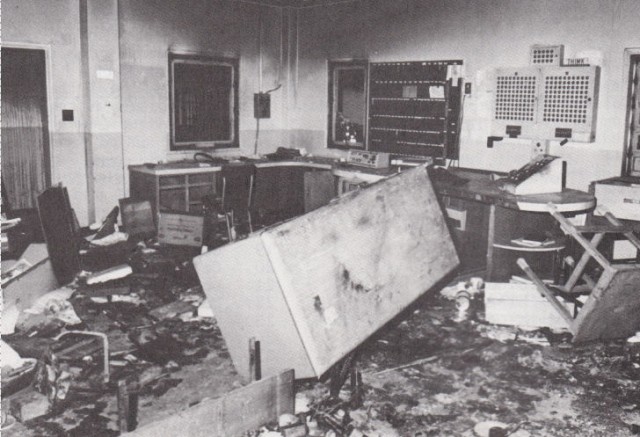
By 2:05 a.m. the inmates had full control of the prison: they smashed the supposedly bulletproof glass of the control centre with a brass fire extinguisher and seized the keys and door controls, freeing their companions too.
The violence begins
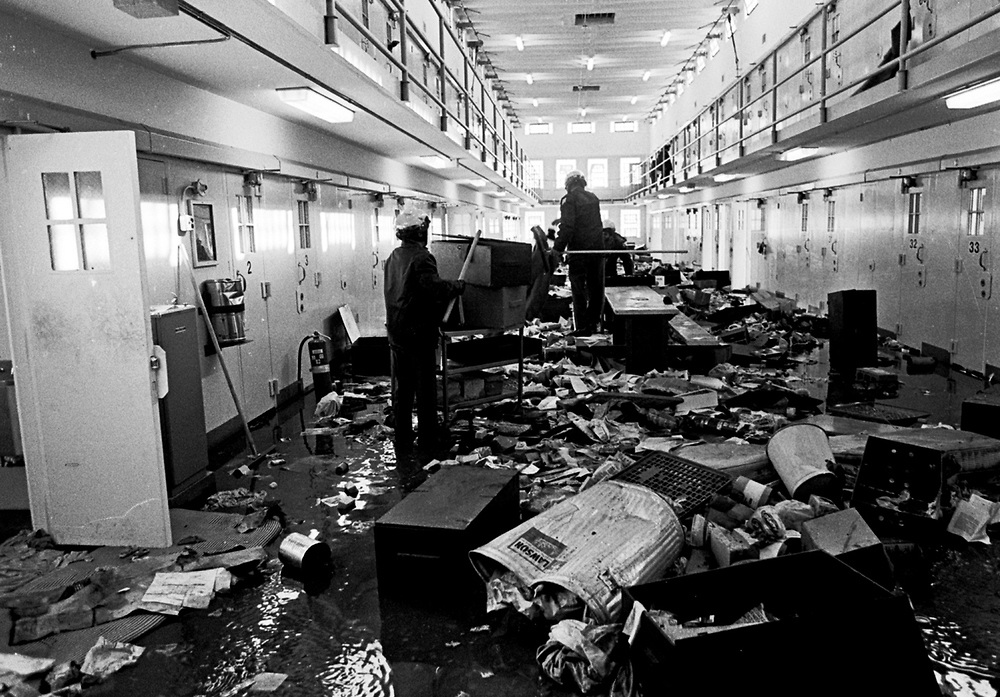
The situation soon spiralled: rival gangs began fighting and the first murders took place. Rioters looted the prison pharmacy, consuming and handing out large amounts of drugs, and set fire to offices, including the one holding the psychological records used to deny parole.
Some of the most dangerous criminals, just released from segregation, decided to go to Cell Block 4, the special area used not only for informers but also for mentally ill inmates, sex offenders and other vulnerable prisoners, seeking revenge. There were 96 prisoners in all.
The cells in this area could not be opened with normal keys or from the control centre. As luck would have it, though, construction work was under way in nearby Cell Block 5, and the inmates found blowtorches with which they began cutting through the grilles. It took about five hours.
By then the news of the riot was public and many prisoners in Cell Block 4 begged the State Police, waiting just outside the fence, to help them out. Cell Block 4 even had a back door that would have allowed them to escape, but being for emergencies only it was never opened and nobody had the keys to hand. The police, moreover, had agreed with the negotiators: as long as the hostage officers stayed alive, nobody would go in.
The riot leaders then began describing over the radio, with the guards’ walkie-talkies, what they would do to the prisoners in Cell Block 4, but still nobody intervened. One official, hearing about those inmates, reportedly said: “It’s their ass.”
Torture and murder

At dawn the so-called “execution squad” got into Cell Block 4. The panel controlling the cell doors had been burned, so every cell had to be opened with the blowtorch, one at a time. Victims were dragged out, tortured, dismembered, hanged or burned alive. By 10 a.m. 12 of the 96 prisoners had been identified as informers and killed; in all, 16 died in Cell Block 4.
Some eyewitnesses described what they saw: some prisoners were hanged; one of them, Mario Urioste, jailed for shoplifting and moved to Cell Block 4 for his protection, was found hanged, his throat cut and his genitals cut off and stuffed into his mouth.
Another man was thrown from the second-tier balcony with a noose around his neck and partially decapitated, then the body was dragged down and hacked up with an axe. Some were burned alive, and in the gymnasium a fire was lit to burn a pile of corpses, which got out of control and burned through the roof. For decades the burn marks remained visible on the floor.
Another inmate, finally, was held in front of a window while a blowtorch was run over his face. According to a witness interviewed by the BBC programme Timewatch, the flame was turned on his eyes until his head exploded.
As for the guards, some were protected and fed by certain inmates, and two managed to get out disguised as prisoners, escorted by sympathetic inmates. Others were beaten, tortured and raped: seven were seriously injured, but none died. The inmates themselves carried out the two most badly hurt guards on blankets, because they did not want an officer to die in their custody.
Negotiations
Negotiations began in the first hours, over the radio, but were chaotic because the inmates had no real spokesman: different voices contradicted each other and argued on the airwaves. On the authorities’ side, negotiations were led first by Deputy Warden Robert Montoya, the same man behind “the night of the axe handles”, and then by Deputy Secretary of Corrections Felix Rodriguez. Governor Bruce King chose to negotiate rather than attack.
The prisoners’ demands were better food, better hygiene, a solution to overcrowding and the violence it caused, restoration of educational and recreational programmes, and talks with independent federal officials and journalists.
The next day, Sunday, none of the conditions had been accepted: the authorities’ strategy was to stall. At this point some inmates no longer wanted any part in the riot and fled into the yard and beyond the fence, terrified by the chaos inside. According to a later inquiry, the riot was started and run by a small group of inmates, while most were just trying to escape.
The end of the riot
On Sunday afternoon, 36 hours after the riot began, heavily armed State Police, accompanied by Santa Fe officers, entered the charred remains of the penitentiary, finding at least 33 dead and more than 200 injured. Some had died of overdoses after the pharmacy was looted, the others had been murdered. According to writer Roger Morris the death toll may have been higher, since several bodies had been burned or dismembered.
After the rioters surrendered, it took days to restore order. Only a few inmates were prosecuted, and the longest additional sentence was nine years: according to Morris, most crimes went unpunished. Much of the evidence was lost or destroyed, partly because the rioters had burned the records office.
This ended one of the largest and worst riots in US history. Only years later, thanks to the case brought by Dwight Duran, was the New Mexico prison system reformed. The old building, long closed, has been open for guided tours since 2013.
🦋 Emadion lives through its readers. If this story kept you up at night, buy me a coffee: it helps me bring you the next nightmare.
☕ Support Emadion on Ko-fi