
 Posted by
In May 1933 about 6,000 deportees, mostly city dwellers from Moscow and Leningrad arrested for lacking internal passports, were abandoned on Nazino Island, on the Ob River in Siberia, with little flour and no tools or shelter. Within 13 weeks over 4,000 died or disappeared amid hunger, disease, violence and cannibalism. The affair was kept secret until 1988, when the Memorial society made it public.
In 1933 about 6,000 people were deported by the Soviet government to Nazino, a remote island in Siberia. There, left without shelter or enough food, cases of cannibalism began to occur. After a few weeks around 2,000 survivors remained, almost all in desperate condition. The island is now known as “cannibal island” or “death island”.
The story
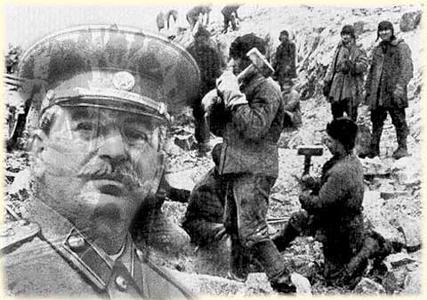
In the 1930s Stalin wanted a rapid industrialization of the country, and to fund it all the wealth produced by agriculture had to go to industry. Peasants’ land was collectivized and their harvests seized, without leaving them even the bare minimum to survive.
This, together with “dekulakization”, which in three years deported about two million peasants considered well-off, caused a terrible famine that killed millions, especially in Ukraine.
Many peasants, stripped of their land and starving, began moving to the cities. On December 27, 1932 the Politburo then introduced compulsory internal passports for residents of major cities: the stated aim was to “cleanse” Moscow, Leningrad and other urban centers of “superfluous elements”, kulaks, criminals and “socially dangerous elements”.
Anyone without a passport could be arrested and deported through a simple administrative procedure, usually within two days. Between March and July 1933, 85,937 people were arrested and deported for this reason in Moscow alone. They included former traders, peasants fleeing the famine, petty criminals and anyone who did not fit the ideal of the working class.
The report of a local official, Vasily Velichko, cites many cases of people arrested by mistake: a Moscow driver awarded bonuses three times at work, who stepped out for a cigarette while his wife got ready for the cinema; an old woman who had come to town to buy a suit for her husband; a worker stopped on his way to a football match, who had left his passport at home.
The Nazino affair
In February 1933 secret police chief Genrikh Yagoda and Gulag head Matvei Berman presented Stalin with a “grandiose plan”: to move up to two million people to “special settlements” in Siberia and Kazakhstan, to cultivate a million hectares of virgin land and become self-sufficient within two years. The plan was approved on March 11, 1933, although shortly after the number of planned deportees was cut to one million.
The deportees were to pass through transit camps in Tomsk, Omsk and Achinsk. The Tomsk camp could hold 15,000, but over 25,000 arrived in April, before it was even finished. The convoys that left Moscow and Leningrad on April 29 and 30 reached Tomsk on May 10. The daily ration during the trip was 300 grams of bread per person.
The criminals among the deportees beat the others and stole their food and clothing.
On May 14 about 5,000 deportees were loaded onto four timber barges and sent to Nazino Island, a small swampy island on the Ob River, 800 kilometers north of Tomsk, in an area inhabited only by a few indigenous Ostyaks. About a third were criminals, sent there to “decongest the prisons”. The barges carried twenty tons of flour, about 4 kilos per person, but no other food, no cooking utensils and no tools. Even the guards had just been recruited and had neither shoes nor uniforms.
Arrival on the island
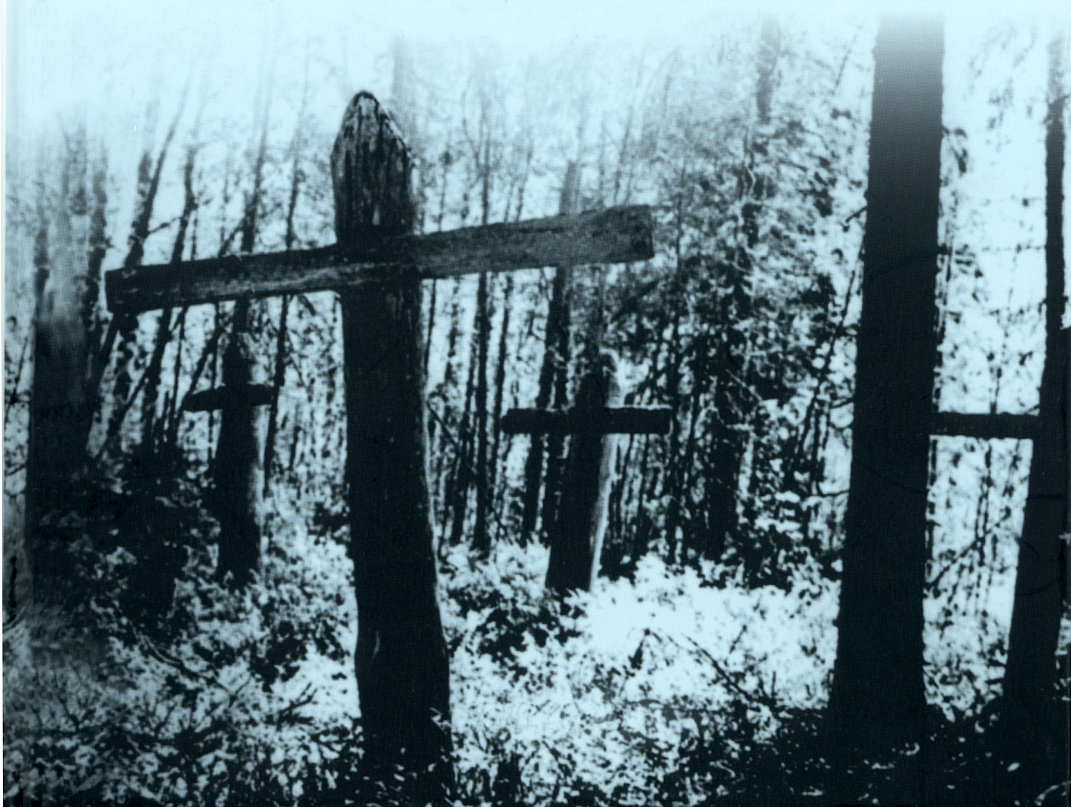
On the afternoon of May 18, 1933 the deportees landed on the island, 3 kilometers long and 600 meters wide. 322 women and 4,556 men were counted, plus 27 bodies of people who had died during the journey. Over a third were too weak to stand. There was no shelter, it snowed on the first night and no food was handed out for four days. On the first day 295 people were buried.
When the flour was unloaded a fight broke out and the guards fired into the crowd. From then on the flour was distributed through “brigadiers”, each in charge of a brigade of about 150 people. They were often criminals, who abused their role and kept everything for themselves.
There were no ovens to bake bread, so many mixed the flour with river water and ate it like that. This caused a dysentery epidemic.
Some built makeshift rafts to escape, but most fell apart and hundreds of corpses washed up on the banks downstream. Guards hunted down the escapees and killed them as if they were animals. Those who managed to cross the river found themselves in the taiga, with no way home, and were presumed dead. On May 27 another 1,200 deportees arrived.
Cannibalism
Order on the island collapsed within days. Most of the deportees came from cities and knew nothing about farming. Gangs formed and terrorized the weakest: people were killed for a bit of food or money, and gold teeth were pulled from corpses and traded for food and cigarettes. The guards, in turn, extorted the deportees and executed them for minor offenses.
On May 21 the three health officers on the island counted seventy new deaths and, in five cases, signs of cannibalism. In the following weeks cannibalism spread to the point that people began to be killed just to be eaten. Within a month the guards arrested about fifty people for cannibalism.
In 1989 an Ostyak eyewitness told the Memorial society what they had seen. The fleeing deportees asked where the railway was, where Moscow and Leningrad were, places the Ostyaks had never heard of. The witness also told the story of a girl protected by a young guard, Kostia Venikov, who had fallen in love with her. One day he had to go away and left her in the care of a comrade, who could not protect her.
Some deportees caught her, tied her to a poplar tree and cut off her breasts, her muscles and everything that could be eaten. When Kostia returned she was still alive. He tried to save her, but she had lost too much blood.
The end of the project
Shortly after the deportees arrived at Nazino, Stalin himself had rejected Yagoda and Berman’s plan. In early June the island settlement was dissolved and the 2,856 survivors were moved to smaller settlements along the Nazina River, leaving 157 people on the island who were too sick to be moved. Several hundred died during the transfer, and those who arrived faced a typhus epidemic.
In 13 weeks, of the roughly 6,000 deportees intended for Nazino, between 1,500 and 2,000 died of starvation, exposure, disease, murder or accidents. Another 2,000 vanished and were presumed dead. According to Velichko’s report, sent to Stalin and circulated by Kaganovich to Politburo members, out of about 6,700 deportees only 2,200 survived. In October a Party commission estimated that of the roughly 2,000 survivors half were sick and bedridden and only 200-300 were fit to work.
Some local officials and guards tried to dispute the report, but were sentenced to between one and three years in prison. The Nazino case led to the end of large-scale colonization plans using deportees and to the abandonment of the idea of using “declassed elements” and criminals for new settlements.
Rediscovery
For decades the tragedy was hidden and only a few survivors, officials and witnesses knew about it. In 1988, during glasnost, its details became public thanks to the human rights society Memorial, which in 2002 also published the documents of the 1933 special commission.
In 2006 French historian Nicolas Werth, one of the authors of The Black Book of Communism, devoted the book Cannibal Island to the affair, which in 2009 became a documentary.
🦋 Emadion lives through its readers. If this story kept you up at night, buy me a coffee: it helps me bring you the next nightmare.
☕ Support Emadion on Ko-fi

Socialism at work.
Socialism at work.