 Posted by
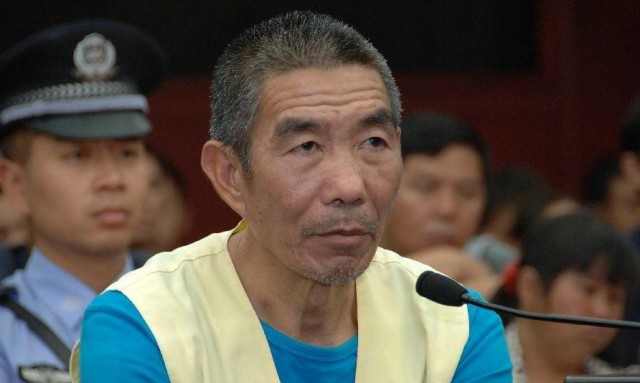
Zhang Yongming (1956-2013), the “Jinning monster”, killed at least 11 people, almost all boys and young men, between 2007 and 2012 in the village of Nanmen, near Kunming. He had already been convicted of a murder in 1979. Families reported him for years, but police did not investigate. Arrested in May 2012 thanks to the searching of a victim’s mother, he was executed on 10 January 2013.
Zhang Yongming was a Chinese serial killer and cannibal who killed at least 11 people, boys and men, between 2007 and 2012. Zhang strangled his victims, then dismembered the bodies and, according to reports, sold their flesh at the market, passing it off as ostrich meat.
Zhang Yongming
Zhang was born in 1956 in Nanmen, a village in the Jinning district of Kunming, in Yunnan province.
His violence showed early. In 1974, aged 18, he stabbed a cousin who was sleeping over at his house. The boy survived with eight wounds to the neck, and Zhang got away with six months in prison because it was claimed he had been sleepwalking.
In 1978 he killed a 16-year-old boy he worked with, strangling him in his home. He fled but was arrested two weeks later. In 1979 he was sentenced to death with a two-year reprieve, a formula in Chinese law that often turns into imprisonment, and indeed the sentence was commuted. He was released in September 1997, after 19 years.
Back in the village he found his parents dead, his siblings gone and the family home collapsed. The authorities gave him a plot of land and a small allowance, but he soon abandoned the fields and lived on odd jobs. Neighbours avoided him because of the old murder; he never married and left home almost only to play go in the park.
The murders
From 2007 boys and young men began to disappear from the village, always in the morning and always near the Nanmen ditch, a stone’s throw from Zhang’s house and fields. Zhang lured them, sometimes asking for help carrying wood, and then strangled them with a rope or a belt.
Families reported him several times. Some villagers had seen him lurking near the spot where a boy had vanished, and another youngster said he had managed to break free while Zhang was trying to strangle him. In December 2011 a 17-year-old even managed to have him pinned down by a neighbour after an attempted attack. But the police did not investigate: once they let him go after he paid 30 yuan in medical costs, another time they decided to drop it because they considered him mentally ill. Many parents came to believe their sons had been kidnapped to work in brick kilns.
The arrest
The last victim was Han Yao, a 20-year-old university student who was working on a building site in Nanmen and disappeared on the morning of 25 April 2012.
His mother, Cheng Lianyan, went to the police twice but was sent away. So she investigated on her own: she met the parents of other missing young men and within two days found that all the disappearances had happened between 9 and 11 in the morning, in the same place, near Zhang’s house. She took everything to the Kunming newspapers, which ran the story on 3 May, and that same day a special task force was set up.
On 7 May 2012 Zhang was arrested at home. There officers found Han Yao’s dismembered body, along with his phone and cards. What emerged from the search was chilling.
As in the case of Ed Gein, human remains were found in the Chinese serial killer’s house. Neighbours said they had seen plastic bags hanging from the house with broken bones sticking out, and police reported eyeballs preserved in bottles and what looked like human flesh hung to dry. The remains of about ten people were dug up from the house and the fields.
According to the charges, Zhang fed some of the flesh to his dogs and sold some at the market as ostrich meat.
The victims and the sentence
Police confirmed 11 murders between 2007 and 2012, all the victims male. Apart from two older men, they were between 12 and 22 years old. Zhang, however, was accused of up to 17 murders, the number of people who had disappeared from Nanmen since his release from prison.
He was sentenced to death again, and this time he did not escape it: he was executed on 10 January 2013. During the trial he never apologised for the murders and never showed any remorse.
After the case, twelve police officers were disciplined for dereliction of duty, including the Jinning police chief, who was removed from office. The police defended themselves by saying that at the time their priority was fighting drugs.
🦋 Emadion lives through its readers. If this story kept you up at night, buy me a coffee: it helps me bring you the next nightmare.
☕ Support Emadion on Ko-fi