 Posted by
On 17 August 1997 the great British cave diver Rob Parker entered the Four Sharks Blue Hole, off South Andros in the Bahamas, with his partner Dan Malone. He wanted to explore a rift no one had ever mapped. Malone made it back to the surface. Parker did not.
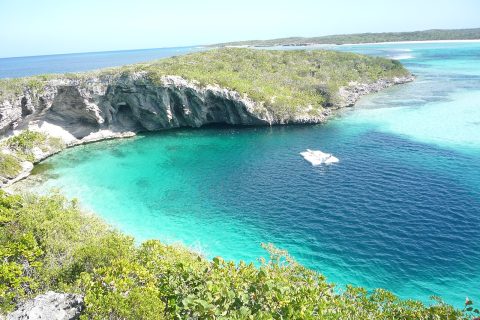
From the boat, it looks like nothing more than a stain. The turquoise of the reef suddenly turns deep blue, almost black, as if someone had spilled ink into the sea. The people of Andros, the largest island in the Bahamas, know these openings well. They call them blue holes, and for generations they have said that the Lusca lives down there: a creature half shark, half octopus, that drags anyone who gets too close to the bottom.
The legend has a very real explanation. Many of Andros’s blue holes “breathe” with the tide. For hours they suck water in, creating whirlpools on the surface, then they blow it back out with force. Anyone in the wrong place at the wrong time really can be pulled under.
One of these holes lies about five kilometres northwest of Dolly Cays, off South Andros. It is called the Four Sharks Blue Hole, and in August 1997 it took the life of one of the best cave divers in the world.
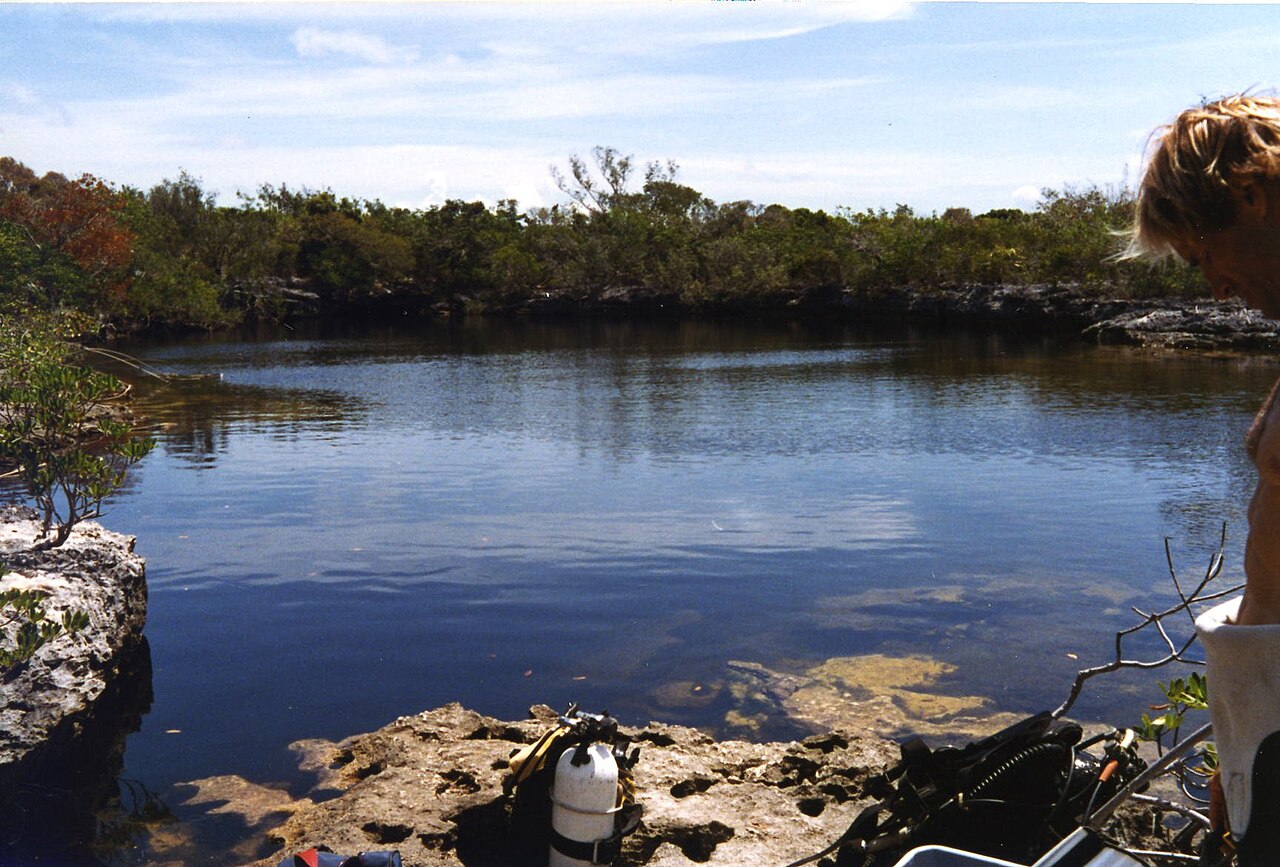
What lies beneath the Four Sharks Blue Hole
The entrance is a basin about ten metres deep. Below it opens a large cavern, roughly 70 metres long, 20 wide and up to 60 deep. At the far end, at 40 metres, a narrow crack in the rock leads into a rift that drops even deeper. In 1997 that section had never been mapped.
For a cave diver, a place like this is both an invitation and a threat: total darkness, passages barely wider than your shoulders, tidal currents, and depths where the air you breathe starts to play tricks on you.
Rob Parker, the man on the edge
Rob Parker was 35, came from Bristol, and was considered one of the best cave divers in the world. He was also a skilled climber: in 1992 a photographer caught him scaling the walls of a former Bristol church turned into a climbing centre.
In England his name was tied above all to Wookey Hole in Somerset, one of the most famous flooded caves in Britain. In the mid-1980s Parker pushed to almost 70 metres, setting a British record, and stopped only at a pile of boulders blocking the way. It would take nearly twenty years for other divers to get past that point.
He had explored caves in Mexico and knew the Bahamian blue holes well. Those who dived with him described him as an athlete, competitive, a true pioneer. The obituary published by the British magazine Descent was titled “The Man with the Edge”.
A trip to remember a friend
1997 had already been a dark year. In May, Rob Palmer, Parker’s friend and a great explorer of Andros’s blue holes, had died in the Red Sea. In August a group of divers returned to the Bahamas to film a documentary about the blue holes in his honour. Palmer’s widow, Stephanie Schwabe, was with them.
Parker wasn’t there only to remember his friend. He wanted to explore the unknown part of the Four Sharks Blue Hole, beyond the crack. According to the reconstruction of the accident, he feared the film crew would not allow such a risky dive, so he decided to do it before they arrived.
17 August 1997
On 17 August Parker descended into the Four Sharks Blue Hole with his dive partner Dan Malone. Two support divers, Tom Iliffe and Gene Flipse, waited for them in the main cavern.
Each carried two tanks: one of trimix, a helium blend that reduces the “drunken” effect of nitrogen at depth, and one of ordinary air. The plan was to switch to air at 67 metres and go down to about 76. Along the way was a squeeze at 50 metres, only 60 centimetres wide.
Switching to air at those depths is a choice that would make many instructors shudder today. The deeper you go, the more nitrogen affects the brain like alcohol. It’s called nitrogen narcosis, the “rapture of the deep”: it slows reflexes, confuses, and makes even simple tasks go wrong.
The two reached the end of the permanent guideline and, after about twenty minutes, began their way out. That’s when Malone realised something was wrong. At around 55 metres, Parker had lost consciousness and was sinking into the dark.
A race in the dark
Malone went after him. He grabbed him by the ankle, then by his buoyancy compensator, and started towing him back toward the line, kicking as hard as he could. In the struggle he lost both fins. He had reached about 70 metres.
As if that weren’t enough, one of his trimix regulators failed. He carried on with the other without telling Parker, and when the trimix ran out he had to switch to air at 76 metres, deeper than planned.
Then, almost unbelievably, Parker came round. He opened his eyes near the guideline and started swimming on his own. For a moment it seemed the worst was over.
At the squeeze the two took different routes: Parker went above the line, Malone below it. The last time Malone saw his partner, Parker was inside the passage and seemed to be struggling to get through.
There was nothing else Malone could do. He was almost out of gas, about 300 psi, a bare minimum. He waited about five minutes, then alerted the support divers and began his ascent, using a decompression tank staged at 37 metres. To reach the surface safely he had to stay in the water for more than three hours.
Rob Parker never surfaced.
The recovery
The next day, 18 August, Dan Malone went back down with Stephanie Schwabe and Brian Kakuk, an American diver experienced in cave body recoveries. They found Rob at 45 metres, head down, wedged in a vertical slot 60 to 75 centimetres wide, facing back into the cave.
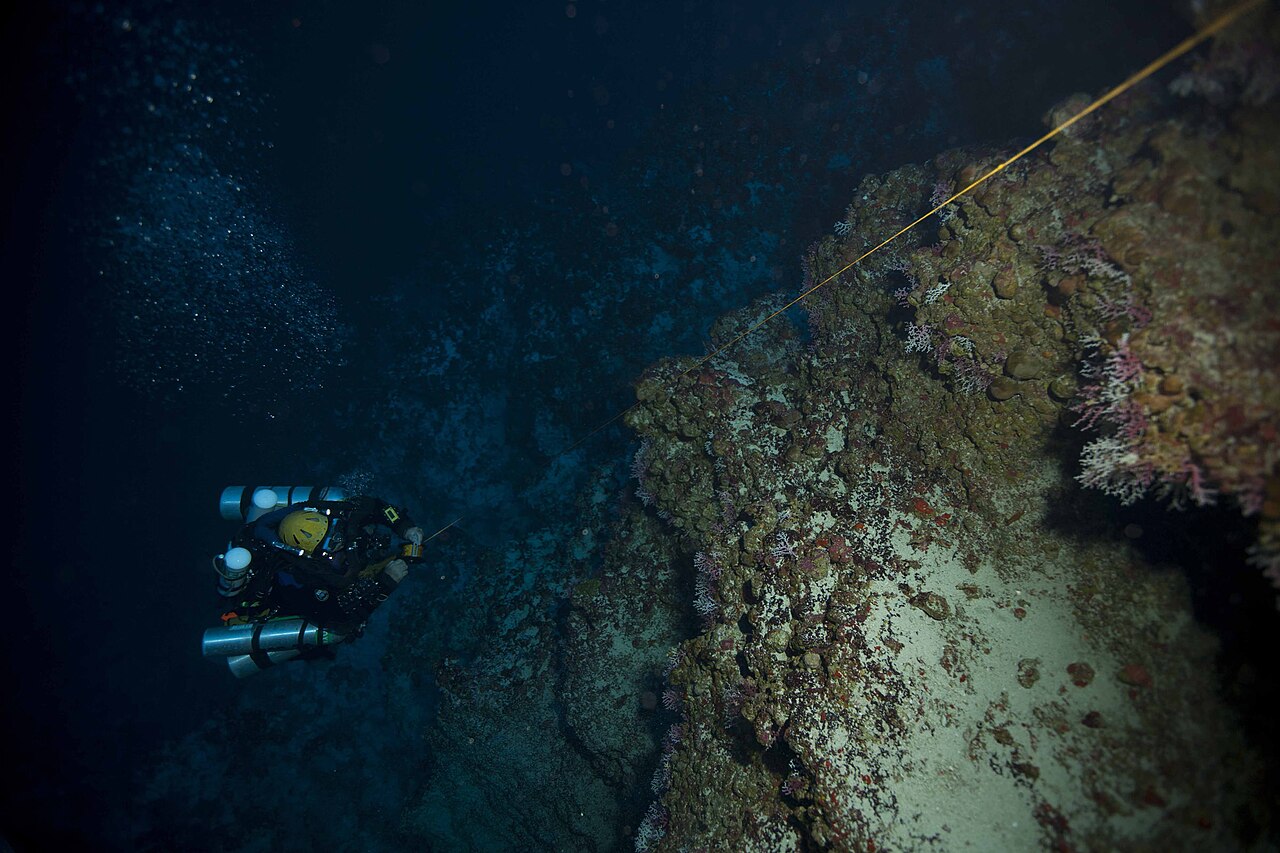
They couldn’t bring him out right away. The blue hole “breathes”, and the recovery had to be timed with the tides. On 19 August Kakuk, Malone, Schwabe and Iliffe returned and freed him, removing his equipment to get him through the slot, and carried him about fifty metres to the main cavern. His gear slipped into the rift and was never found.
Within a few months, Stephanie Schwabe had lost her husband and had to bring one of her closest friends back to the surface.
Why did Rob Parker die?
There is no certain answer. No autopsy was performed, and Parker’s equipment was never recovered. A medical problem, a failure, a mistake: every hypothesis remains open.
US Coast Guard investigator Mike Popovich and the divers involved, however, became convinced of one thing: Parker was suffering from nitrogen narcosis. Confused and disoriented, instead of following the way out he would have slipped into the wrong part of the rift, and never made it back.
Brian Kakuk described him as a highly skilled diver with more than a thousand dives behind him, specialising in deep blue holes. And that may be the most unsettling part of the story: the Four Sharks Blue Hole didn’t take a careless beginner, but one of the very best.
The legend lives on
Today Rob Parker’s story is everywhere on YouTube and TikTok, with 3D reconstructions and ever more dramatic titles. It was the subject of an episode of the documentary series Scary Interesting, titled “Four Sharks Hole”, and an ebook summed it up in a line that sounds like a horror film: two went in, only one came back.
The people of Andros would probably say it was the Lusca. The truth is simpler, and perhaps more frightening: down there you don’t need a monster. Darkness, rock, the tide and a few metres too many are enough.
🦋 Emadion lives through its readers. If this story kept you up at night, buy me a coffee: it helps me bring you the next nightmare.
☕ Support Emadion on Ko-fiSources
- Cave Diving Accident – Tragic Underwater Fatality: Four Shark Blue Hole
- Descent no. 139 (December 1997) – The Man with the Edge, Rob Parker obituary
- Mendip Cave Registry – Wookey Hole bibliography, 1985
- DeeperBlue – British Divers Set New Cave Diving Record
- Scary Interesting, season 2, episode 5 – Four Sharks Hole
- Daniel Turmoil – The Blue Hole (ebook)
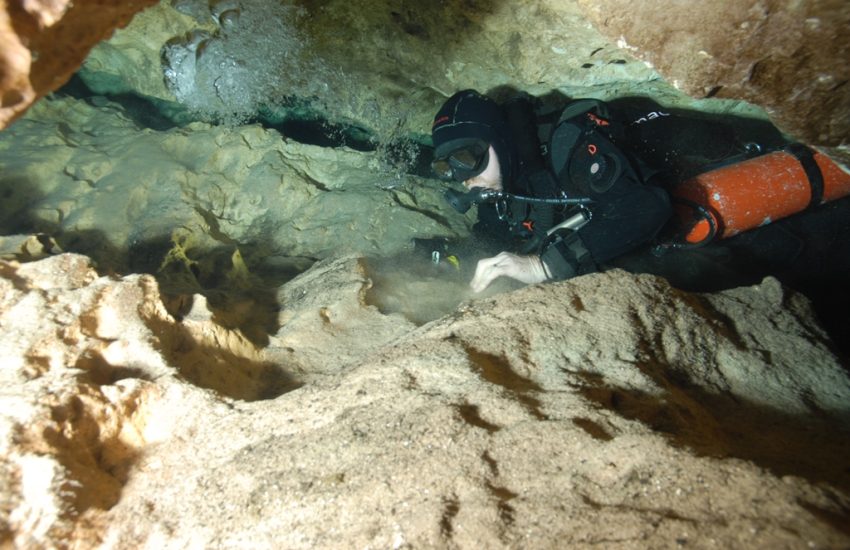
Featured image: a sidemount cave diver in a tight passage, photo by Pete Nawrocky, CC BY-SA 3.0, via Wikimedia Commons.