
 Posted by
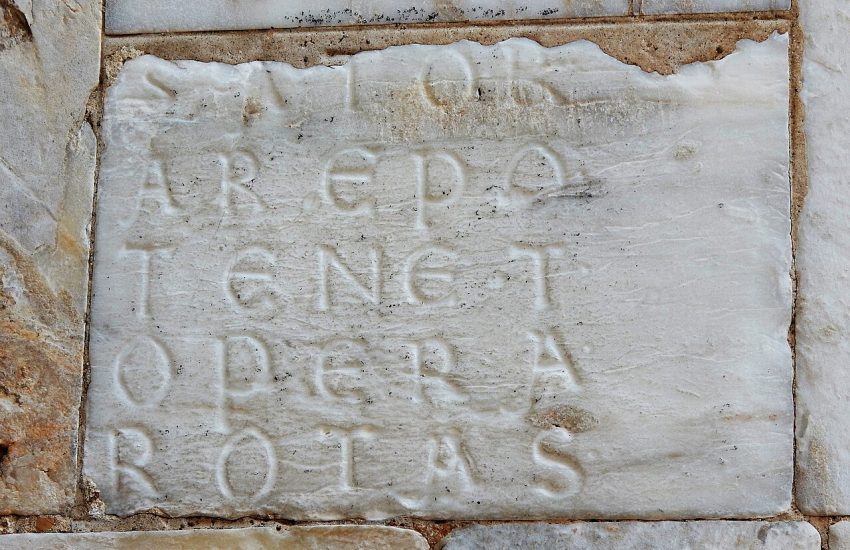
Five Latin words, each of five letters, arranged in a square that can be read in every direction: left to right, right to left, top to bottom and bottom to top. The Sator Square appears on the walls of Pompeii, in medieval churches, in medical books and in amulets against fire. Nobody knows for sure who invented it or what it really means.
S A T O R
A R E P O
T E N E T
O P E R A
R O T A S
Look at it closely and you’ll see it’s a small marvel. The five words form a perfect palindrome: SATOR AREPO TENET OPERA ROTAS read backwards gives the same phrase. And if you read the columns, top to bottom, you find the same five words again. In the middle, the word TENET forms a cross.
What does it mean?
Four of the five words are ordinary Latin. Sator is the sower, but also the creator, the father. Tenet means holds, sustains. Opera means with care, with effort. Rotas are wheels. The problem is Arepo: it’s a word that appears in no other known Latin text.
The simplest translation is roughly: “The sower Arepo holds the wheels with care”. Perhaps Arepo is a proper name, invented to make the puzzle work. Perhaps it comes from another language, Celtic or Egyptian, as some have suggested. Perhaps it means plough. There are dozens of hypotheses, and none convinces everyone.
The hidden Lord’s Prayer
In 1926 something surprising was noticed. If you take all the letters of the square and rearrange them, you can write PATER NOSTER twice, the opening words of the Lord’s Prayer in Latin, crossing in the shape of a cross on the central N. And you’re left with two As and two Os, which can be placed at the ends of the cross: alpha and omega, the beginning and the end, a Christian symbol of Christ.
It seemed to be the answer: the square would have been a secret sign of recognition among the early Christians, at the time of the persecutions. For a few years almost all scholars agreed. Then came Pompeii.
The Pompeii square
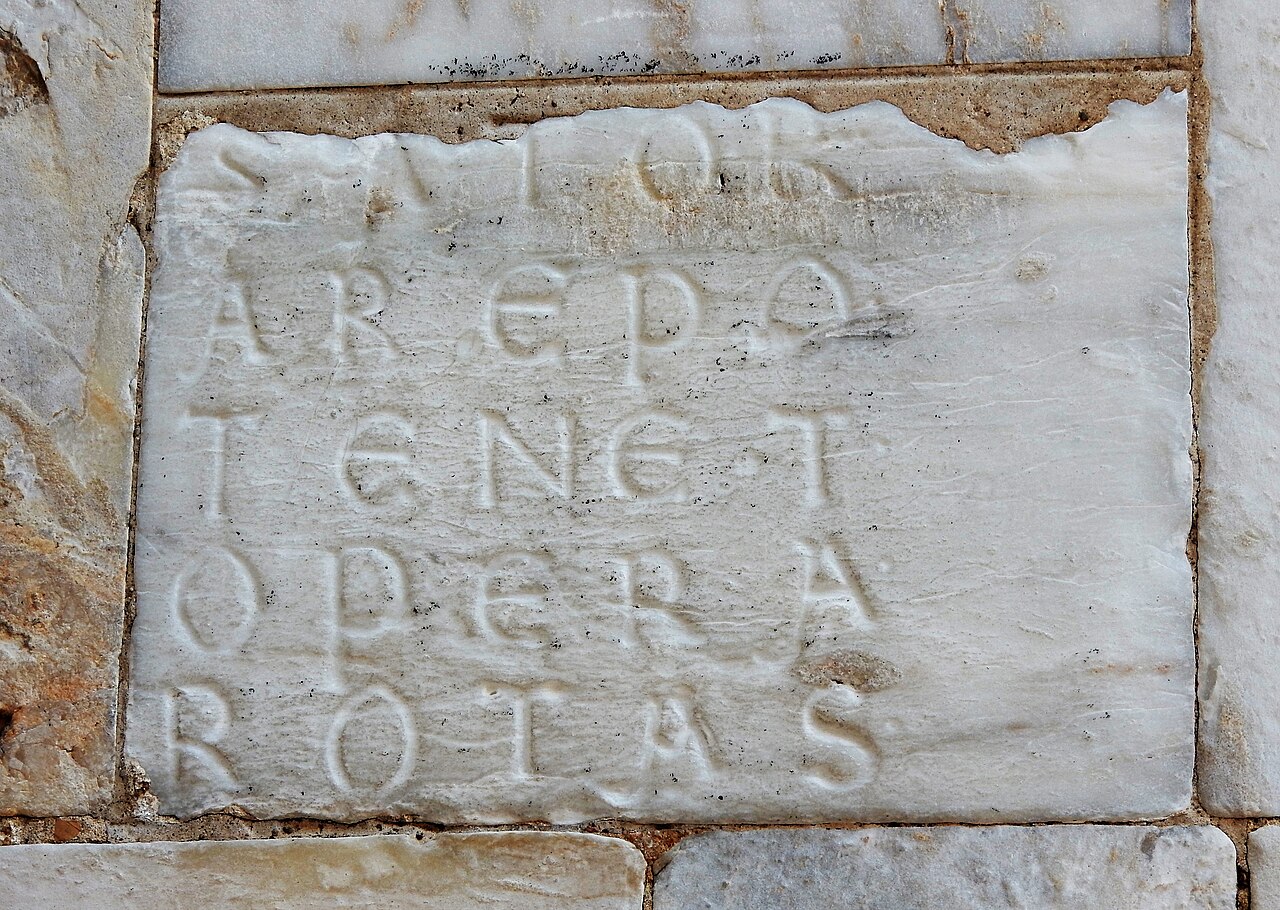
In 1925 the archaeologist Matteo Della Corte had found a fragment of the square, written in the version beginning with ROTAS, in the House of Paquius Proculus in Pompeii. In 1936 he found another, complete, carved on a column of the Great Palaestra, near the amphitheatre. This one dates from before the earthquake of AD 62. It is the oldest known Sator Square.
And that’s a problem for the Christian theory. In AD 62 Christians were very few, and it’s far from certain there were any in Pompeii. The alpha and omega symbol, moreover, spread later. That’s why many scholars now think the square began as a Roman word game, a puzzle, and was only later adopted by Christians, who saw a religious meaning in it.
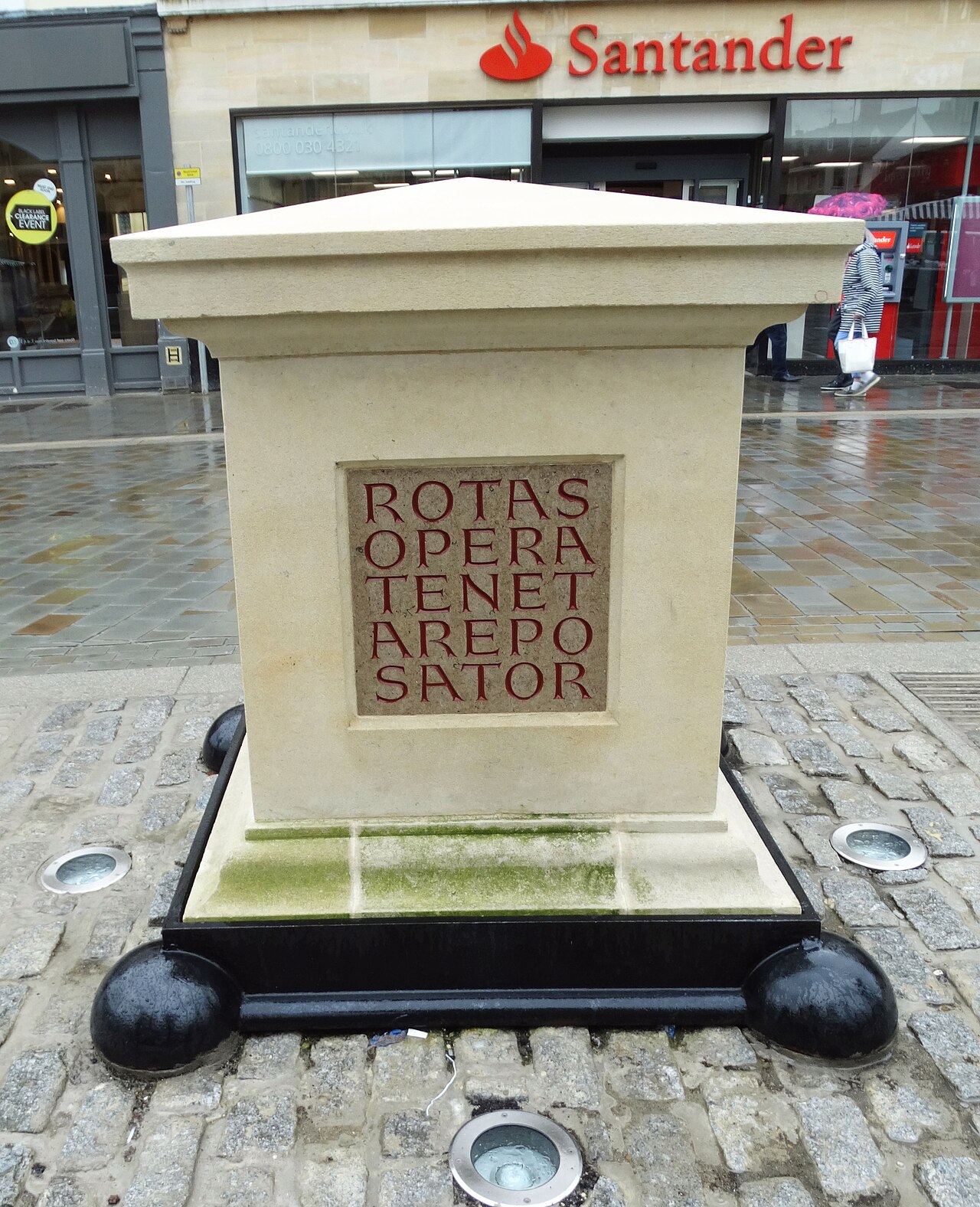
Similar squares have also been found in Cirencester, in England, scratched on the plaster of a Roman house, and at Dura-Europos, in Syria, on the walls of a 3rd-century Roman military office.
An amulet
In the Middle Ages the Sator Square spread throughout Europe and changed its purpose. It became a magic formula. It appears in medical handbooks as a remedy against dog bites and rabies, against madness, and to help women in childbirth. In Germany it was believed to put out fires. As late as the 19th century, in America, it was still used as a lucky charm.
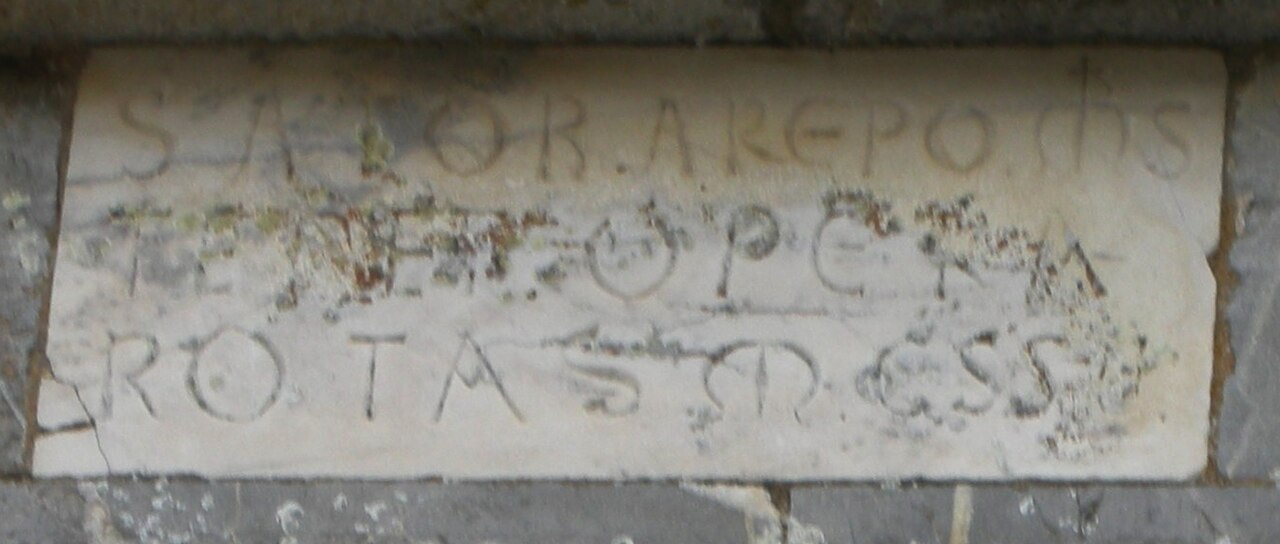
In Italy it can be found in many churches: on Siena Cathedral, in the parish church of San Giovanni in Campiglia Marittima, in abbeys and country churches, sometimes arranged in a circle instead of a square.
In recent years it has become famous again thanks to Christopher Nolan, who named one of his films Tenet and used the other words of the square for the names of characters and places.
I love the Sator Square because it’s an object that has changed meaning several times without changing a single letter. A Roman word game, a Christian symbol, an amulet against fire, a film puzzle. Two thousand years later we’re still wondering who Arepo was.
On Emadion you can also read about the Devil’s Door of Turin and the Voynich manuscript.
🦋 Emadion lives through its readers. If this story kept you up at night, buy me a coffee: it helps me bring you the next nightmare.
☕ Support Emadion on Ko-fiSources
Featured image: Photo G.steph.rocket, CC BY-SA 4.0, via Wikimedia Commons