
 Posted by
- What it is: the binding of girls’ feet, practised in China for about a thousand years.
- Origin: probably among 10th-century court dancers; it spread under the Song dynasty.
- How widespread: in the 19th century it affected 40-50% of Chinese women, almost 100% in the upper classes.
- End: banned by the Republic of China in 1912; the last known case dates to 1957.
The evocative, poetic name Golden Lotus actually refers to the painful practice of foot binding, common in China until a few decades ago.
History
This practice of binding and deforming women’s feet probably began in the 10th century among court dancers, and spread among elite women during the Song dynasty. Over the centuries it reached the poorer classes too. The oldest archaeological evidence comes from the tombs of two 13th-century women, Huang Sheng and Madame Zhou, whose feet were wrapped in gauze strips 1.8 metres long.
Various stories and legends try to explain the practice. The most famous says that Emperor Li Yu, of the Southern Tang kingdom, had a golden lotus almost two metres tall built, decorated with precious stones, and asked his concubine Yao Niang to bind her feet with white silk in the shape of a crescent moon, to dance on her toes inside it. Her dance was so graceful that other women tried to imitate her. Another legend says a concubine had a deformed foot and persuaded the emperor to have all the other women’s feet bound, so that hers would become the standard of beauty.
In reality the practice probably did arise among dancers who bound their feet to dance better. Female spectators began binding their feet in imitation, and so the practice spread and the bound foot became a real status symbol.
Under the Qing dynasty the rulers were not Chinese but Manchu, and they tried several times to abolish the custom with edicts, in 1636, 1638 and 1664, but few obeyed, and in 1668 the Kangxi Emperor gave up. In the 19th century an estimated 40-50% of Chinese women had bound feet, and among upper-class Han women almost 100%.
In the late 19th century the first anti-footbinding societies appeared, whose members pledged not to bind their daughters’ feet and not to let their sons marry women with bound feet. In 1902 Empress Dowager Cixi issued an edict against the practice, soon rescinded, and in 1912 the new Republic of China officially banned it, although for years the ban was not enforced.
The procedure
Foot binding took place at a young age, usually around 5. The mother took a bandage about 5 cm wide and about 3 metres long and wrapped it around her daughter’s foot, folding all the toes except the big toe under the sole.
The binding was very tight, also to bring the sole as close as possible to the heel. Then the little girl was told to walk. The pain was atrocious, but it was unthinkable for a woman not to have bound feet; this was essential in order to marry. Nobody would want a woman with normal feet.
This practice often led to infections and ulcers, which caused bad smells and discharges of blood and pus. The nails had to be cut often so they would not grow into the skin, but sometimes that was not enough.
Dead skin and flesh were removed periodically and the wounds cleaned, and within about 5 years or a little more the foot was permanently deformed. The position of the toes and the tight binding meant there was almost no circulation in the foot, and any cut or graze could lead to infection, gangrene and the loss of toes. The latter was seen as an advantage, though, because a foot without toes was smaller.
Characteristics
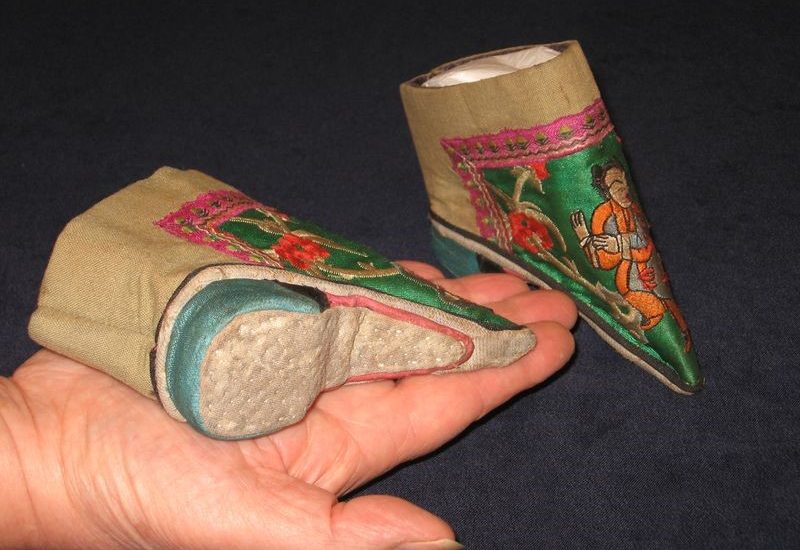
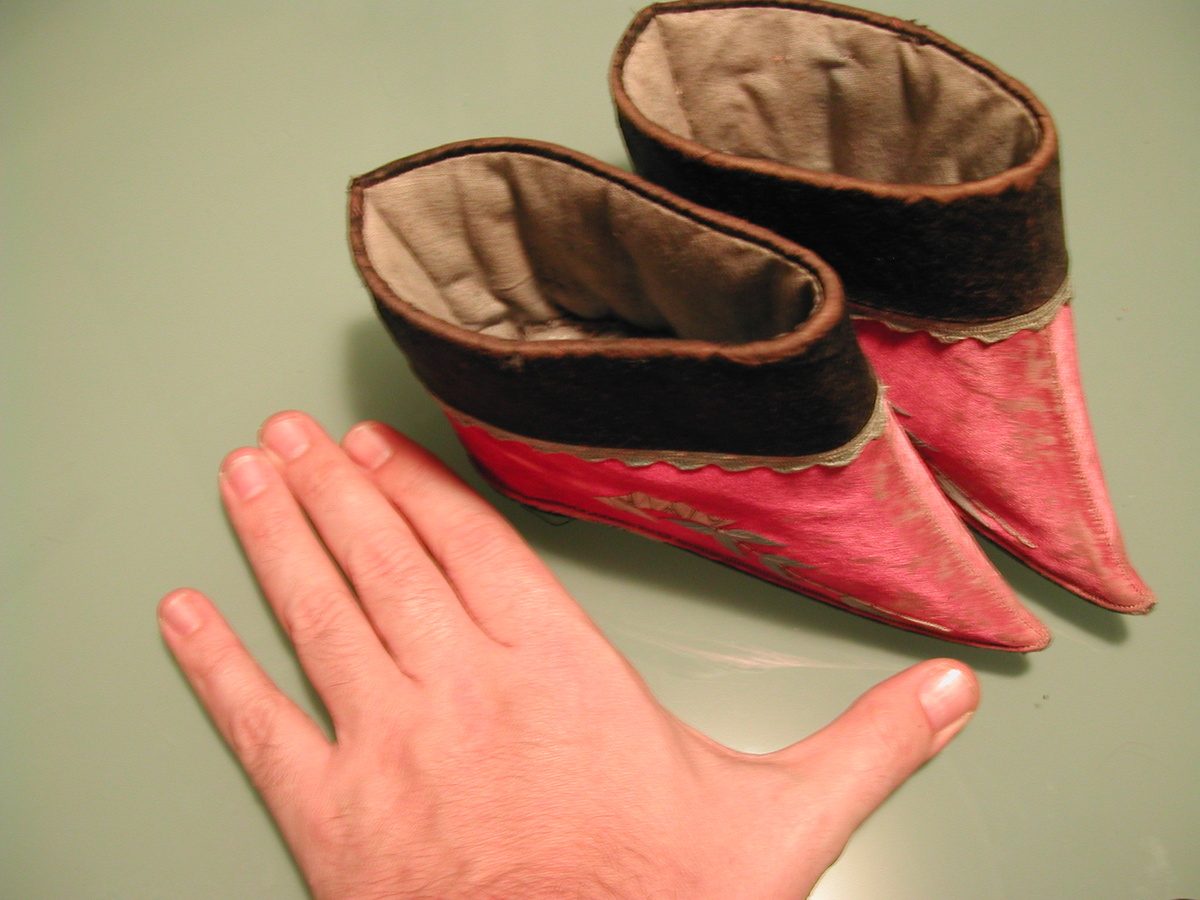
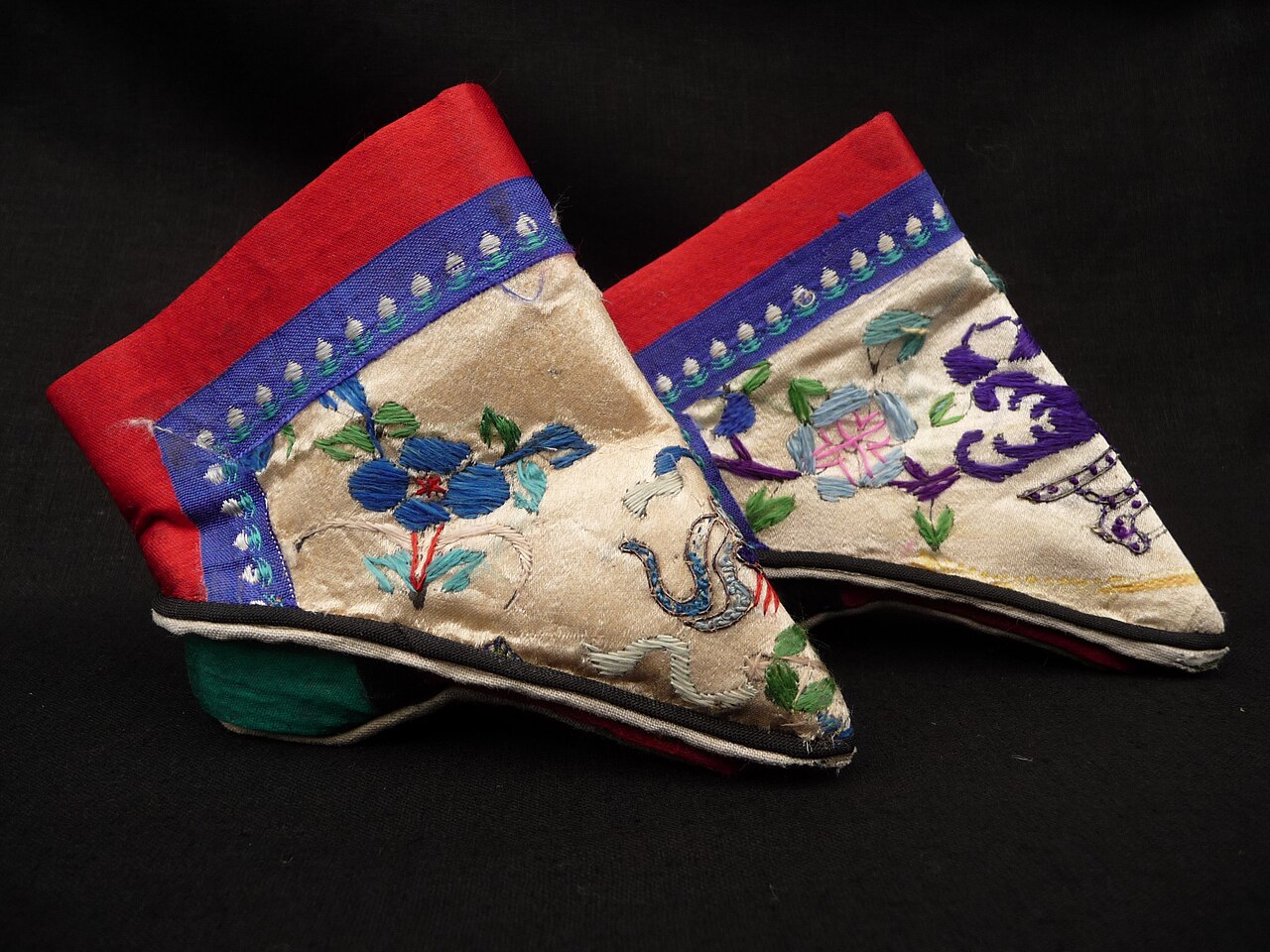
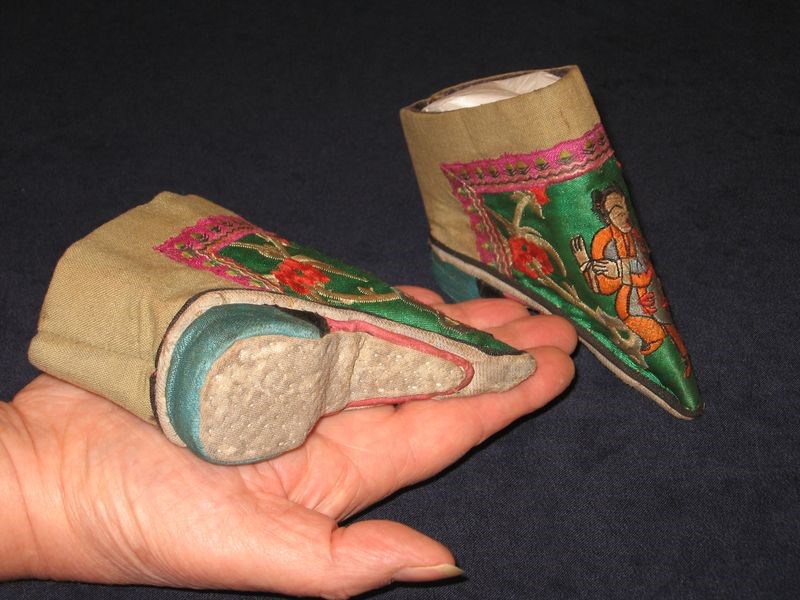
Feet deformed in this way had to reach a length of about 10 cm, the so-called “three-inch golden lotuses”, and were hidden by little shoes decorated by the girls themselves. The shoes’ decorations also mattered for marriage, as a sign of the young brides’ domestic skills.
The bound foot became a symbol of wealth, since a woman with bound feet walked with difficulty and therefore could not work in the fields. Westerners see the practice as female subjugation, since with bound feet women not only could not work, but could not even go far from home, becoming totally dependent on their husbands.
We should remember, however, that women controlled the household and the children, and had an important role in the family. Moreover, this practice was carried on above all by women themselves, mothers and grandmothers, who defended it and kept practising it for decades after it was officially abolished, because bound feet offered the chance to marry a wealthy man and so improve the fortunes of whole families.
Peasant families usually bound their daughters’ feet later than the rich, because they needed the girls to work as much as possible before marriage, but it was not unusual for the eldest daughter’s feet to be bound and for her younger sisters to serve her once she married.
Erotic value
Men saw the bound foot as erotic, and some Chinese sex manuals list up to 48 different ways of touching bound feet. The foot was seen as very erotic and played the same role as the breast in the West. At the end of the Song dynasty some even drank from a special shoe with a small cup in the heel, a custom called the “toast to the golden lotus”.
Feet deformed this way also gave women a swaying gait, considered sensual (a bit like the one caused by high heels).
However the foot always had to stay well bound and covered, because the sight of it unwrapped could cause disgust, not to mention the terrible smell it inevitably gave off. Only the husband could touch a woman’s foot or remove her shoe: otherwise she suffered a very serious humiliation.
Criticism
The custom was strongly criticised, above all by Westerners, who considered it barbaric and cruel, and later by Chinese intellectuals of the May Fourth Movement, who saw it as the symbol of the country’s backwardness. Sometimes, however, it is compared to the corset, very fashionable in the West, which deformed the ribcage, sometimes with serious consequences.
In some remote rural areas, such as Yunnan, foot binding continued until the 1950s; the last known case dates to 1957. In 1999 the last factory making shoes for bound feet, in Harbin, closed.
Several museums display the little shoes worn by women with golden lotus feet and, at barely ten centimetres or less, it is really hard to imagine them fitting an adult woman’s foot. Since the practice was so hard to eradicate, there are still recent photos of elderly women with bound feet.
🦋 Emadion lives through its readers. If this story kept you up at night, buy me a coffee: it helps me bring you the next nightmare.
☕ Support Emadion on Ko-fi


The smallest adult feet I’ve ever seen were on a woman who’d always used a wheelchair and had never stood on them, and the same goes for the smallest pair of hands. I’ve never quite understood the fascination with something that does not appear functional. The best dollhouse things are those that work or look as if they could.
The smallest adult feet I’ve ever seen were on a woman who’d always used a wheelchair and had never stood on them, and the same goes for the smallest pair of hands. I’ve never quite understood the fascination with something that does not appear functional. The best dollhouse things are those that work or look as if they could.
ft ft