 Posted by
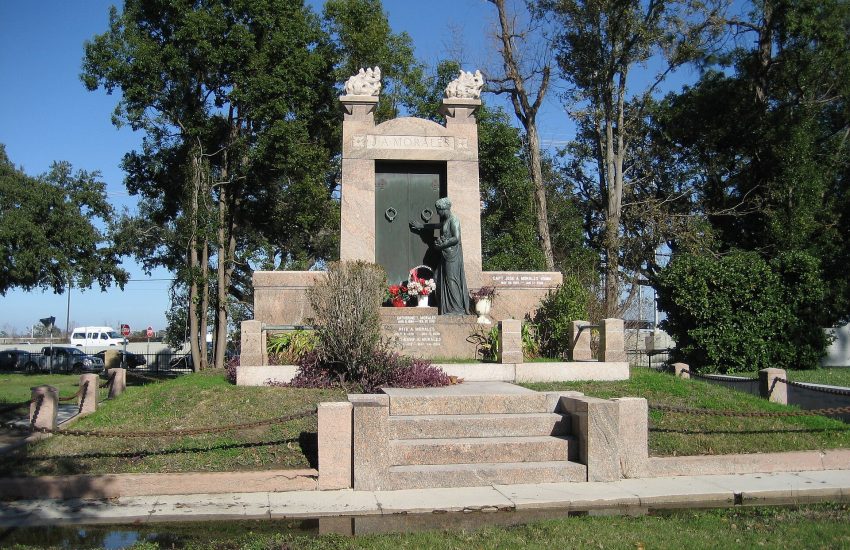
The bronze girl has been there for more than a century. She is climbing the steps of a red granite tomb, and with one hand she seems about to knock on the great metal door. It is impossible to tell whether she wants to go in or whether someone is stopping her.
We are in Metairie Cemetery, in New Orleans, among the mausoleums of the city’s richest families. Today the tomb bears the name of another family, the Moraleses. But everyone in New Orleans still calls it by the name of the woman who had it built: Josie Arlington. Whose real name was Mary Deubler.
📍 This story is on the Mystery Map: see where it happened →
From Mary to Josie
Mary Anna Deubler was born in New Orleans in 1864 to German parents. The family was poor, and she began very early to earn a living in the only way open to a girl with no money and no education in that city: prostitution. According to the stories she was about 17, and for a while she used the name Josie Alton.
She was intelligent, ambitious and determined not to stay poor. With her partner of those years, Philip Lobrano, in 1890 she opened a brothel of her own. But her private life was anything but calm: during a family quarrel, Lobrano shot and killed Mary’s brother, Peter. It was more or less then that Mary ceased to exist, and Josie Arlington was born.
The queen of Storyville
In 1897 New Orleans made an unusual decision. Instead of fighting prostitution, it decided to confine it to a specific district near the centre, where it would be tolerated. The district took its name from the alderman who had proposed the ordinance, Sidney Story: Storyville.
Josie moved there and opened, on Basin Street, one of the most luxurious houses in the district: a four-storey building simply called The Arlington. It catered to rich and important clients, and Josie became one of the most famous, and richest, women in New Orleans. It is said that she demanded elegant and discreet girls, threw out anyone who turned violent and charged very high prices for the time. It is also said that when desperately poor young girls knocked on her door looking for work, she preferred to give them some money rather than let them into that world: a detail that, true or not, many have linked to the statue on her tomb.

In 1905 a fire devastated the building. According to some accounts Josie barely escaped, and the experience marked her deeply, making her fear a sudden death. She moved the business to a nearby building, but by then she was tired. In 1909 she retired, sold the business and went to live in a large house on Esplanade Avenue, far from Storyville.
A tomb among the rich
Josie had money, but not what she wanted most: the respect of New Orleans high society. So she decided to get it, at least in death. Around 1910 she paid 2,000 dollars for a plot in Metairie Cemetery, where the city’s most prominent families were buried. The scandal was enormous: a former Storyville madam among the elite.
She did not care. In 1911 she signed a contract with the sculptor Albert Weiblen and personally supervised every detail of the tomb. Red granite, two large braziers on either side of the entrance, a bronze door. And in front of the door the statue of the girl, which Josie had brought over from Germany.
People immediately began to interpret it. The red granite? A reference to the red-light district. The burning braziers? The fire of passion. And the girl? For some she represented an innocent girl turned away at the door of Josie’s house. For others she was Josie herself as a young woman, knocking at the door of the family home she had been thrown out of. What Josie really saw in her, we will never know.
The tomb that burns
Josie Arlington died on 14 February 1914, Valentine’s Day, and was buried in her tomb. That was when the stories began.
At night, passers-by said, the granite tomb lit up with a red glow, as if the braziers were really burning. Word spread fast, and every evening a small crowd gathered outside the cemetery to see the “flaming tomb” of the queen of Storyville. It was also said that the bronze girl sometimes came down the steps and walked along the cemetery paths. Or that knocks could be heard on the door at night, as if someone wanted to get in.
There was a rational explanation: near the cemetery there was a red signal light, and its reflection on the polished granite could look like fire. But that was not enough to stop the legend.
So far I have told you the historical facts, those reported in documents and in New Orleans newspapers of the time. But there is another side, much less rational. According to the most famous account, about a year after the burial some visitors fled in terror, saying the statue had come down the steps of the mausoleum. The caretakers went to check and found it, so they say, with its arms at its sides instead of a hand raised towards the door; the cemetery was closed until the police arrived, and when they checked again the statue was back in its usual pose. In the following years the gravediggers said several times that they had seen a woman resembling the statue wandering among the tombs, and some girls said they had felt “something” touch their hair or shoulder. The curious became so numerous that the police were often needed to send them away.

Where does Josie rest?
The saddest part of the story comes later. Josie had left everything to a niece, Anna, and to her long-time partner, Tom Brady. The two married shortly after her death, and within a few years they had squandered the fortune. To pay their debts they even sold the tomb, which passed to the Morales family.
Josie’s remains were removed and moved to a receiving vault in the cemetery, in a place that has never been made public. Even today there are people working to give her a grave with her own name.
And perhaps this is what feeds the ghost stories. Josie Arlington had built that tomb for herself, stubbornly, against the judgement of an entire city. Then it was taken from her. The bronze girl is still there, her hand reaching towards the door. Some say she is Josie, who has been trying to come home for a hundred years.
Do you believe there is something true about the flaming tomb of Metairie? Would you like to see it in person?
🦋 Emadion lives through its readers. If this story kept you up at night, buy me a coffee: it helps me bring you the next nightmare.
☕ Support Emadion on Ko-fiSources
- New Orleans Historical, The Morales-Arlington Tomb: A Fiery Legacy.
- Gambit / The Advocate, What happened to the remains of Josie Arlington, the Storyville madam?
- Wikipedia, “Josie Arlington”.
- Atlas Obscura, Metairie Cemetery.