 Posted by
On 13 August 2007 Chiara Poggi, 26, was killed in her family’s house on Via Pascoli in Garlasco, in the province of Pavia, northern Italy. Her boyfriend, Alberto Stasi, found her body. After two acquittals he was definitively sentenced to 16 years in 2015. But the case never really closed: in 2025 Pavia prosecutors reopened the investigation into Andrea Sempio, a friend of Chiara’s brother, and on 3 November 2026 they asked for him to stand trial. He has always said he is innocent.
How many times can the same murder be solved? In Garlasco, a town of just under ten thousand people in the Lomellina area, about thirty kilometres from Pavia, they have been asking that for almost twenty years. The Garlasco murder has had a culprit convicted by a final ruling, then a second suspect, two prosecutors’ offices at work, expert reports that contradict each other and a whole country split in two, as if it were a football match.
In the middle of all this noise, people sometimes forget that at the centre of it there is a 26-year-old woman. This article starts with her.
Who Chiara was
Chiara Poggi lived with her parents, Giuseppe and Rita, and her younger brother Marco in a two-storey house on Via Giovanni Pascoli, in a quiet part of town. She had graduated in Economics from the University of Pavia in 2005 and was already working. Those who knew her describe her as reserved, precise and very close to her family.
For a few years she had been dating Alberto Stasi, 24, also from Garlasco, a student at Bocconi University in Milan. In August 2007 he was writing his thesis, and they spent a lot of time together.
In mid-August her parents and Marco left for a holiday in the mountains. Chiara stayed at home because of work, and on the evening of 12 August she had dinner with Alberto, who stayed with her until late.
13 August 2007
The next morning, at 9:12, someone switches off the house alarm. Most likely it is Chiara, opening the door to someone she knows: there is no sign of forced entry. A neighbour later says she saw a black women’s bicycle leaning against the Poggis’ gate.
Alberto, meanwhile, is at home. He will say he tried to call Chiara several times, on the landline and on her mobile, without an answer. Forensic analysis of his computer will show that he worked on his thesis that morning from 9:35 to 12:20.
In the early afternoon he goes to the Poggi house. He goes in and, according to his account, finds Chiara at the bottom of the stairs leading to the cellar. Shortly before two in the afternoon he calls the emergency number while already driving to the Carabinieri station: “I think someone has been killed”.
Chiara had been struck several times on the head with a blunt object, and her body had been left on the cellar stairs. The weapon has never been found.
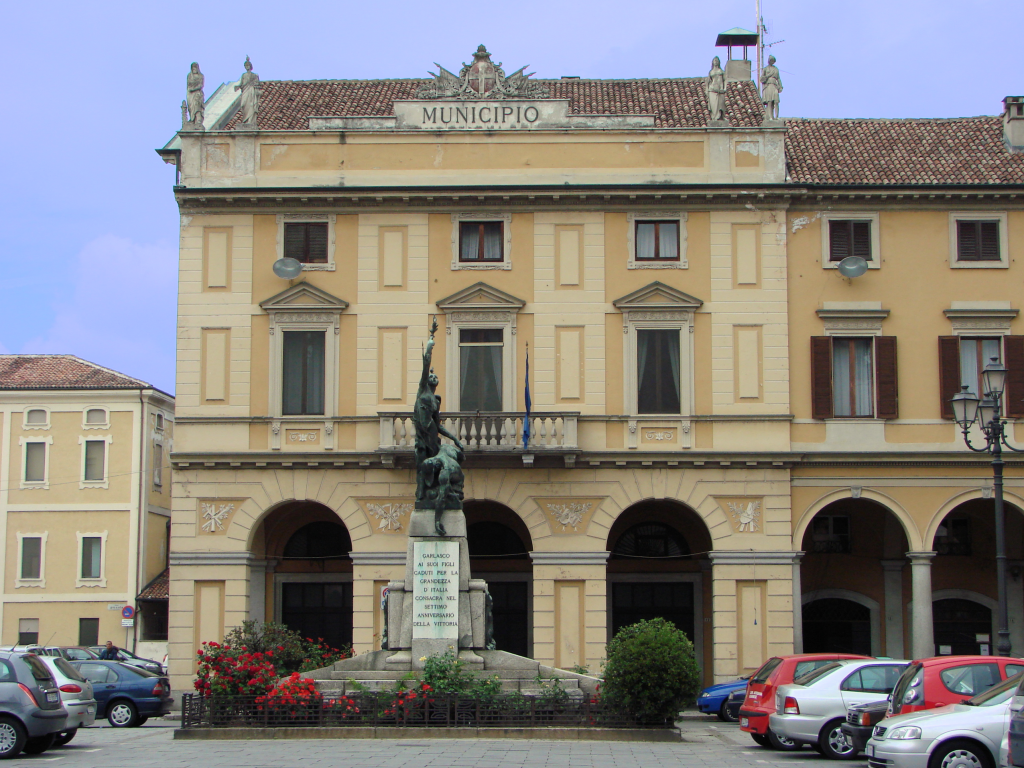
Photo: Samuele – Wikimedia Commons – public domain
An investigation that started on the wrong foot
What happened in the following hours has become a textbook example of how not to handle a crime scene. Dozens of people went into the house, not all of them wearing protective gear. The family cat wandered freely among the bloodstains. The body was moved before anyone noticed the print of a bloody hand on her pyjamas, which remained visible only in the photos. Chiara’s fingerprints were not taken straight away, and years later her body had to be exhumed. At the morgue she was not weighed, because there were no scales, and this made the estimate of the time of death less precise. The autopsy, on 16 August, placed it between 10:30 and 13:00, but later trials moved it forward to the window between 9:12 and 9:35.
Investigators focused on Alberto almost immediately. Above all, one detail made them suspicious: his shoes. The floor was covered in bloodstains, yet the soles of his shoes were clean. They were seized only the next day. The Carabinieri also noticed two fresh scratches on his arm, but nobody photographed them.
On 24 September 2007 Alberto Stasi was detained. Four days later a judge released him: the evidence was not enough.
A closed case that won’t close
That was the start of a very long legal saga, which I tell in detail in an article on Alberto Stasi’s trials. In short: acquitted at first instance in 2009 and on appeal in 2011, in 2013 the Court of Cassation overturned everything and ordered a new trial. In December 2014 Stasi was sentenced to 16 years, and on 12 December 2015 the Cassation upheld the sentence. He went to Bollate prison. A motive, however, was never established with certainty.
In 2016 Stasi’s defence presented an expert report on the DNA found under Chiara’s fingernails: according to its experts it belonged to Andrea Sempio, a friend of Marco Poggi who was 19 at the time. Pavia prosecutors investigated, but dropped the case in 2017. A second inquiry was dropped in 2020.
Then, on 11 March 2025, came the turning point: Sempio received a notice that he was under investigation again. From then on the Garlasco case was back on the front pages, on TV almost every evening and among the most searched topics on Google. The developments, from the DNA to “fingerprint 33” and the Vigevano parking ticket, are in the article on the new investigation into Andrea Sempio.
Where things stand today
On 3 November 2026 Pavia prosecutors asked for Andrea Sempio, now 38, to stand trial, considering him the sole perpetrator of the murder. A preliminary hearing judge will decide whether he must face trial; the hearing could be set as early as January. Sempio has always said he is innocent, and his lawyers dispute the charges point by point.
Alberto Stasi, meanwhile, is serving the last part of his sentence outside prison. His lawyers have announced that in mid-November they will ask the Brescia Court of Appeal to review his case.
It is an almost unprecedented situation: one man convicted by a final ruling for a murder, and another who may be tried for the same crime, accused of committing it alone. Two truths that cannot both stand.
Chiara, first of all
Over the years the Garlasco murder has become many things: a courtroom reality show, a war between rival camps on social media, a talk-show topic. The Poggi family has gone through all of this trying to stay silent and asking only for the truth.
Whatever the judges decide in the coming months, one thing will not change: a 26-year-old woman opened the door of her home to someone she trusted, one summer morning, and was never able to tell anyone what happened next.
🦋 Emadion lives through its readers. If this story kept you up at night, buy me a coffee: it helps me bring you the next nightmare.
☕ Support Emadion on Ko-fiSources
- Wikipedia – Murder of Chiara Poggi
- Il Post – La storia del delitto di Garlasco, dall’inizio (Italian)
- Il Giorno – Garlasco, quanti colpi di scena in quasi 20 anni (Italian)
- MilanoToday – Chiesto il rinvio a giudizio per Sempio (Italian)