 Posted by
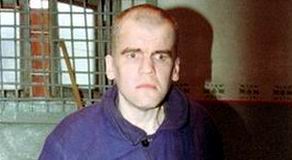
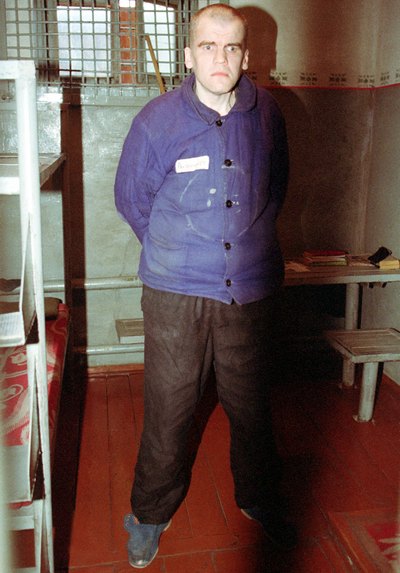
Sergei Ryakhovsky (1962-2007), known as the Balashikha Ripper or “the Hippopotamus” because of his size, killed at least 18 people between 1988 and 1993 in the Moscow area, mostly elderly women, but also men and two teenagers. He stabbed or strangled his victims and then mutilated and violated their bodies. He was arrested on April 13, 1993 in a shack where he had prepared a noose, sentenced to death in 1995 and then to life. He died in prison of tuberculosis in 2007.
Sergei Vasilyevich Ryakhovsky was a Russian serial killer and necrophile, known as the Balashikha Ripper or the Hippopotamus because of his size. He was convicted of 18 murders.
Who was Sergei Ryakhovsky
Sergei was born on December 29, 1962 in Saltykovka, a district of Balashikha, a town on the outskirts of Moscow. As an adult he was a giant: almost two meters tall and weighing 130 kilos.
In 1982, at twenty, he repeatedly tried to rape elderly women in Moscow’s Golyanovo district. He was convicted of hooliganism and sentenced to four years in prison.
In Soviet prisons rape was considered a disgraceful crime, and Sergei was in turn raped by other inmates. From that experience came his hatred of homosexuals and his belief that victims should not be left alive.
Modus operandi
Sergei began killing in June 1988. His victims ranged from 16 to 78 years old, and although he claimed he wanted to “cleanse” society of homosexuals and prostitutes, most of his victims were elderly women. He also killed five men and two teenagers.
His modus operandi was to stab his victims or strangle them with his bare hands or a rope. After death he mutilated their bodies, especially the genital area, and often abused them, even when they were men.
Not everyone he attacked died: at least six people survived.
Sergei Ryakhovsky’s murders
His first murder was that of a homosexual man, killed in June 1988 in Bitsa, on the outskirts of Moscow. That same year he killed three more homosexual men in Izmaylovsky Park. It was one of the few crimes he carefully planned.
According to some reconstructions, in July 1988 he attacked a 70-year-old woman, Klavdiya Khokhlova, who died the next day in hospital without having seen her killer’s face. In January 1989 he killed a 16-year-old boy, leaving his fingerprints at the crime scene.
In January 1993 he surprised a 73-year-old man collecting firewood in a forest, killed him and cut off his head with a hunting knife. The next day he returned to the scene to cut off one of his legs as well.
His next victim was a 65-year-old woman, whose abdomen he blew open after death with a small firecracker. Another woman, aged 62, tried to defend herself with a spray and an awl, but he disarmed her and killed her with the very awl she had desperately tried to defend herself with.
His penultimate victim was a 16-year-old boy, whom he hanged and then mutilated and beheaded with a knife.
Arrest and trial
Sergei was arrested thanks to a routine search of the area around one of the crime scenes. In a shack police found a noose fixed to the ceiling and thought it had been prepared for the next murder. So they decided to set an ambush.
On April 13, 1993 Sergei returned to the shack and was arrested. Despite his strength and violent temper he put up no resistance at all: he later admitted that at the sight of the officers’ weapons he froze with fear.
After his arrest the Russian press nicknamed him “the Balashikha Ripper” and “the Hippopotamus”, because of his thick neck and hulking build. At first he cooperated with investigators, showing them the crime scenes and explaining how he killed. He confessed that most of the murders were not premeditated, but the result of a sudden impulse.
Psychiatrists at Moscow’s Serbsky Institute found that his necrophilia stemmed from a malfunction of the central nervous system, but declared him sane. When he found out, Sergei completely changed: he stopped cooperating, demanded that the experts be punished and retracted all his confessions.
In prison he kept a diary counting his murders and also wrote a science fiction novel, “Starfall”, never finished, in which the hero, the “Commodore”, “cleansed” planets of pirates with the help of an army of robots.
In July 1995 he was sentenced to death by firing squad. On hearing the verdict he simply said: “I will be back”. In 1996, however, Russia introduced a moratorium on the death penalty and his sentence was commuted to life imprisonment, to be served in a maximum-security penal colony in Mordovia. He died on November 12, 2007 of tuberculosis that had never been treated.
🦋 Emadion lives through its readers. If this story kept you up at night, buy me a coffee: it helps me bring you the next nightmare.
☕ Support Emadion on Ko-fi