 Posted by
On 1 December 1948 the body of a man with no identification, possibly poisoned, was found on the beach at Somerton Park, Adelaide. In his pocket was a scrap of paper with the Persian words “Tamam Shud”, torn from a copy of the Rubaiyat containing a code that has never been deciphered. In 2021 the body was exhumed and in 2022 researchers identified him as Carl Webb, but police have not yet confirmed it.
The Tamam Shud case is an unsolved Australian mystery that has fascinated the curious for decades. Also known as “the mystery of the Somerton Man”, it concerns the discovery of a man’s body on Somerton beach in 1948. Who this man was and how he died remains a mystery to this day.
The mystery of the Somerton Man
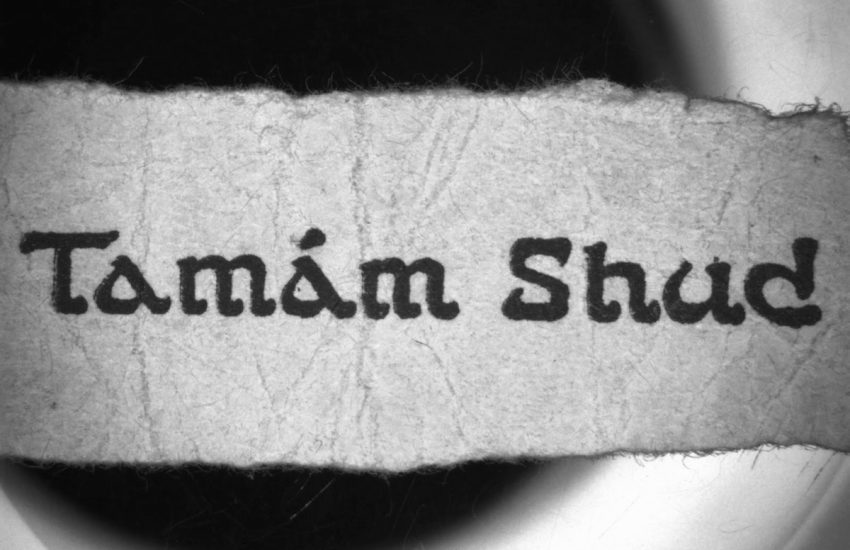
Although it is sometimes reported as “Taman Shud”, the correct spelling ends with an “m”. These two words are Persian and mean “it is over” or “it is finished”. They matter so much because they were found printed on a scrap of paper hidden in the man’s trousers. But let’s take it step by step.
On 1 December 1948 a man’s body was found on the beach at Somerton Park, a suburb of Adelaide, South Australia. He was lying with his head resting against the seawall, legs stretched out and feet crossed. Some witnesses remembered seeing a man resembling the dead man in the same spot the evening before. The first hypothesis was that he had died in his sleep.
In the man’s clothes, almost all of them without labels, various personal items were found, including a train ticket to Henley Beach, but no documents.
The autopsy revealed congestion of several internal organs, suggesting poisoning. However, no trace of poison was found. Later it was suggested that the poison used might have been a particular, very powerful substance that could kill in small doses without leaving traces in the blood. It is not clear, though, whether it was suicide (as in the case of Peter Bergmann) or murder.
On 14 January a suitcase without a label was found in the left-luggage office of Adelaide station. Inside were some clothes, a screwdriver, a knife, a pair of scissors, a brush and a type of thread not available in Australia. The same thread had been used to repair the unknown man’s trousers: the suitcase must have been his.
The Tamam Shud case

Some time after the body was found, a scrap of paper was discovered in one of the trouser pockets, with the words “Tamam Shud” printed on it. These Persian words appear at the end of the poetry book Rubaiyat by Omar Khayyam and would give this unsolved mystery its name.
Police managed to find the book the scrap had been torn from, thanks to a member of the public. On the inside of the back cover they found a phone number and some notes made up of a series of capital letters.
WRGOABABD MLIAOI WTBIMPANETP MLIABOAIAQC ITTMTSAMSTGAB
Despite countless attempts, these notes have still not been deciphered.
The number, on the other hand, belonged to Jessica Ellen “Jo” Thomson, a nurse who lived a few hundred metres from where the body was found. Questioned by police, she denied knowing the man or why he had her number.
She did tell police, however, that during the Second World War, while working in a hospital, she had owned a copy of the Rubaiyat, which she gave in 1945 to a lieutenant named Alf Boxall. She said that after the war Boxall had written to her and she had replied that she was married, and the correspondence ended.
Police then suspected the man might be Boxall. However, Boxall was traced in 1949, and his copy of the book was intact.
The shadow of espionage and other theories

One theory is that the Somerton Man was a spy. Boxall himself is said to have worked in intelligence just after the Second World War. In a 1978 interview, however, the lieutenant gave no information about it.
In 1949 the mysterious man was buried by members of the Salvation Army. A few years after the funeral, flowers began to appear on the grave, but police never found out who left them.
In the following years many people came forward convinced they had identified the Somerton Man, but all the leads proved empty. The man remained nameless.
In 2011 a woman from Adelaide contacted anthropologist Maciej Henneberg and handed him a document found among her father’s belongings. It turned out to be the identity card of an H.C. Reynolds, a type of document issued by the United States to foreign seamen. Henneberg compared the photo with the Somerton Man and found striking similarities, especially in the ear (one of the man’s most peculiar features) and a mole on the face. All this led the anthropologist to think the mysterious man’s identity had finally been found.
A mystery lasting decades

Another researcher, Derek Abbott, continued studying the Somerton Man’s ears, finding features present in only 1-2% of Caucasians. Dental records also showed the man had hypodontia, meaning some teeth had never developed.
In 2010 Abbott obtained a photograph of Robin, the son of Jessica, the nurse questioned by police years earlier, and found that he too had the same rare features. Considering that Robin was 18 months old in 1948, many believe he was not the son of Jessica’s husband but of the mysterious man.
One theory is that both the Somerton Man and the nurse were spies. Supporting it is an interview given by Kate Thomson, the nurse’s daughter, to the programme “60 Minutes”, in which she said her mother had once told her she had lied to the police and knew the Somerton Man very well.
It was Kate herself who suggested her mother might have been a spy. She remembers that she taught English to migrants, was interested in communism and spoke Russian, although she never wanted to say where or why she had learned it.
The DNA analysis
Abbott argued that DNA analysis might clear up many doubts about the Tamam Shud case. However, in 2011 the South Australian Attorney-General, John Rau, refused permission to exhume the mysterious man’s body.
Did they refuse because the Australian government knows the man’s real identity and does not want it made public?
Update: the exhumation and the name Carl Webb
Things changed in 2019, when the new Attorney-General, Vickie Chapman, finally gave permission to exhume the body to extract DNA. The exhumation took place on 19 May 2021, and police said the remains were in “reasonable” condition.
On 26 July 2022 Derek Abbott, together with forensic genealogist Colleen Fitzpatrick, announced they had put a name to the Somerton Man through genetic genealogy, starting from DNA in his hair: he would be Carl “Charles” Webb, an electrical engineer and instrument maker born in 1905.
Be careful, though: South Australia Police and the state’s forensic laboratories have not yet officially confirmed the result. And even if the name is right, the most unsettling questions remain unanswered: how he died, why he had that scrap of paper in his pocket and what the code in the book means.
For now the Tamam Shud case remains one of the greatest mysteries of the 20th century.
🦋 Emadion lives through its readers. If this story kept you up at night, buy me a coffee: it helps me bring you the next nightmare.
☕ Support Emadion on Ko-fi