
 Posted by
I decided to start this blog with one of the stories that fascinated me as a child: the green children of Woolpit.
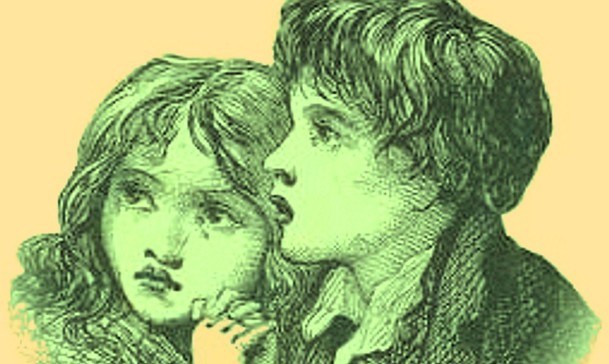
East Anglia, the middle of the twelfth century. It is harvest time. Reapers are working the fields around a small Suffolk village when they notice two children standing by some ancient pits, dug long ago to trap wolves. A boy and a girl, brother and sister. They are crying. They are terrified. Their clothes are made of a cloth nobody recognizes, and they speak a language nobody understands. None of that is what stops the reapers in their tracks, though. The children’s skin is green. All of it, from head to toe.
This is not a tavern tale written down centuries later. Two medieval chroniclers, writing within living memory of the events, recorded it and swore they had it from reliable witnesses. Here is everything we know: what the chronicles say, what became of the girl, the explanations offered over eight centuries, and the real origin of the “green children of Banjos”.
Woolpit, the village of the wolf pit
Woolpit is still there. It is a village of about two thousand people in Suffolk, some eight miles southeast of Bury St Edmunds. The name comes from the Old English wulf-pytt, “a pit for trapping wolves”. These were deep holes, sometimes covered with branches and baited, that an animal could fall into but not climb out of. There were still wolves in twelfth-century England, and the village’s old pits were well known enough to give it its name.
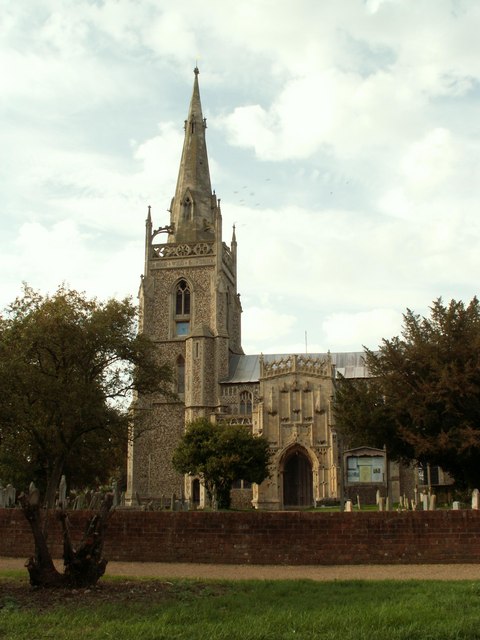
In the Middle Ages Woolpit was tied to the great abbey of Bury St Edmunds, home to the relics of St Edmund, the martyred king of East Anglia. The sound of its bells plays a part in this story. The village also had a church dedicated to the Virgin, which is why one of the chroniclers calls the place “St Mary of the Wolf Pits”.
The two chronicles
Everything we know comes from two Latin texts. Their authors were two churchmen who, in all likelihood, never read each other’s work.
- William of Newburgh (c. 1136 – c. 1198), an Augustinian canon in Yorkshire, tells the story in a chapter of his Historia rerum Anglicarum titled “Of the green children”. The work is often dated to 1189, but scholars place its writing between 1196 and 1198.
- Ralph of Coggeshall (died after 1227), Cistercian abbot of Coggeshall in Essex, about 25 miles from Woolpit, includes it in his Chronicon Anglicanum, written in the 1220s. Unlike William, he names his source: the knight who took the children in.
The discovery and the beans
William places the events in the reign of King Stephen (1135–1154). At harvest time, he writes, a boy and a girl came out of the old wolf pits, “green all over their bodies”, wearing clothes of an odd color and an unknown material. The reapers took them to the village, where a crowd gathered to stare. Ralph says instead that they were taken to the house of a local knight, Sir Richard de Calne, at Wykes, a few miles to the north. There they wept and could not be comforted.
For days they refused all food and came close to starving. Then someone brought in bean plants fresh from the fields. The children grabbed them and split the stalks, not the pods, looking for beans. When they found nothing, they burst into tears. A bystander opened the pods and showed them the beans inside, and they ate hungrily. For months they would eat nothing else.

Little by little they learned to eat bread and other food, and the green faded. They were baptized. The boy, the younger of the two, stayed weak and listless and died soon after. His sister survived, lost all trace of green and learned English. Ralph adds that she spent many years in the knight’s service, and describes her as “rather loose and wanton” in her conduct. William writes that she married a man at Lynn (today’s King’s Lynn, in Norfolk) and was said to have been alive only a few years before he wrote.
The girl’s story: St Martin’s Land
Once she could speak the language, the girl explained where they came from. In William’s version, she and her brother were people of “St Martin’s Land”, so called because the saint was especially honored there. It was a Christian land with churches. But the sun never rose there. There was only a dim light, like twilight. In the distance they could see a bright country, separated from theirs by a very wide river. One day, while tending their father’s flocks, they heard a great noise, like the bells of Bury St Edmunds. Suddenly they found themselves among the reapers at Woolpit.
In Ralph’s version, the girl said that everyone in her homeland, and everything, was green. One day, following their flocks, she and her brother walked into a cave. They heard the sweet sound of bells and followed it for a long time, until they came out into the open by the pits. The sunlight, which they had never seen, and the warm air stunned them. When the reapers appeared, the children panicked and tried to run, but they could no longer find the way back into the cave.
William admits he doubted the story for a long time. In the end, he says, he was “overwhelmed” by so many reliable witnesses that he felt forced to believe it. Ralph, for his part, says he heard the story many times from Richard de Calne himself and his household.
Two versions side by side
The chronicles agree on the essentials: the place, the harvest, the green skin, the unknown language, the beans, the boy’s death, the sunless land. But they differ on a few key points:
- The name of their homeland: only William mentions “St Martin’s Land”, churches and a river. For Ralph, everything there was simply green.
- How they arrived: William has a sound of bells and a sudden arrival among the reapers. Ralph has a cave whose exit they can never find again.
- What became of the girl: William says she married at Lynn. Ralph says she stayed in the knight’s service for years.
- The witnesses: William cites many people but names none. Ralph names one: Richard de Calne.
The date is uncertain too. William says Stephen’s reign; Ralph gives no date. Richard de Calne died around 1188, and the girl lived “many years” in his household, so an arrival a few decades earlier is plausible and fits William’s account. Those who move the story to 1173, under Henry II, do so to support the Flemish orphans theory, which I come to below.
Was her name Agnes?
The chronicles never name the girl. The Scottish writer and astronomer Duncan Lunan says his research into the de Calne family records points to a name: Agnes. According to Lunan, Agnes married one Richard Barre, an official at the court of Henry II.
A Richard Barre did exist. He was a cleric and lawyer, sent by the king to the pope during the Becket crisis, and later a royal justice and archdeacon of Ely. The fact that he was a churchman makes the identification awkward, and no independent source backs it up. It is Lunan’s thesis and his alone, even though the name “Agnes Barre” has spread all over the internet.
The explanations
Over eight centuries the green children have attracted every kind of interpretation. Four stand out.
Anemia and chlorosis: why green?
The most popular medical explanation is chlorosis, an old name for hypochromic anemia. It was once known as “green sickness” because it could give the skin a greenish pallor. It is linked to iron deficiency and a poor diet. With normal food the color returns to normal, exactly as it does for the girl in the chronicles.
Not everyone is convinced. The historian Michał Madej points out that plenty of people in the Middle Ages were malnourished, yet no one described them as green. The children’s color must have been truly out of the ordinary. The historian John Clark, who in 2024 published the first scholarly book devoted entirely to the case, also considers other options, such as favism, the genetic condition that makes broad beans dangerous to eat. A later folk version ties the children to the “Babes in the Wood”, poisoned with arsenic by a cruel uncle, but it has no basis in the chronicles.
Paul Harris’s Flemish orphans
This is the best-known theory, set out by Paul Harris in 1998 in Fortean Studies, a companion to Fortean Times. Harris moves the events to 1173. That year the Earl of Leicester, in revolt against Henry II, landed in Suffolk with an army of Flemish mercenaries. On 17 October they were defeated at the Battle of Fornham, and many were slaughtered.
Flemish weavers and merchants had lived in the region for generations. Harris suggests the children’s parents, immigrants living at Fornham St Martin, a few miles from Woolpit, were killed in the violence. The children fled into Thetford Forest and, with nothing to eat, developed chlorosis. Everything would fit. “St Martin’s Land” would be Fornham St Martin, the wide river the Lark, the bells those of Bury St Edmunds, the unknown language Flemish. The underground passage would be one of the tunnels of Grime’s Graves, the ancient Neolithic flint mines near Thetford.
The theory is clever, but it has many weak spots. The 1173 date contradicts William, who says Stephen’s reign. The chronicles talk about the harvest, in summer, while the battle was fought in autumn. An educated man like Richard de Calne would probably have recognized Flemish, hardly a rare language in eastern England. And Grime’s Graves lies dozens of miles from Woolpit.
Fairies, beans and the world below
To folklorists, the story is full of familiar symbols. Green is the fairy color in British tradition, and caves and pits are doorways to another world. Other medieval tales tell of children or herdsmen who end up in sunless underground lands, led there by sounds or animals. Beans have been tied to the dead since antiquity: the Pythagoreans refused to eat them, the Romans offered them to the spirits of the dead, and the folklorist Katharine Briggs called them “the food of the dead”. In this reading, St Martin’s Land, green and twilit, is a realm of the dead or of fairies. The children are creatures of that world who become human by eating human food and receiving baptism.
It was the folklorist Thomas Keightley who put the story into his Fairy Mythology in the nineteenth century. That collection made it famous in the English-speaking world and handed it over to fairy-tale tradition.
Aliens and parallel worlds
The idea that the children came from another world is much older than UFOs. In 1621 Robert Burton, in The Anatomy of Melancholy, cited the green children as beings who “fell from Heaven”. In the twentieth century Duncan Lunan revived the extraterrestrial idea. He argues the children arrived by accident from a planet with one side always in shadow and a habitable twilight zone, through a malfunctioning “matter transmitter”. Others talk of a portal to a parallel universe, or a hidden world inside the Earth.
John Clark devoted an essay to these theories with a telling title, “Small, Vulnerable ETs” (2006). He shows how each era has retold the medieval story in the science-fiction language of its day. In his recent book, Clark offers no final answer. He prefers to focus on the children as people: two small strangers, lost and frightened, questioned for months by adults who were probably feeding them the answers. The tale of the sunless land, he suggests, may partly be the product of that relentless questioning, and of trauma.
The green children of Banjos
I’m sure you have also heard of the green children of Banjos, a village in Spain. The story is supposed to have taken place at the end of the nineteenth century, and it is almost identical to the Woolpit tale.
In August 1887, near the village of Banjos in Catalonia, farm workers supposedly found two green-skinned children by a cave. They wore clothes of a strange metallic fabric, spoke an unknown language and would eat only beans. The boy died soon after. The girl learned Spanish and spoke of a sunless land, then died herself a few years later. The man who took them in was said to be the local landowner, one Ricardo da Calno.
So were there four green children, in two different countries? Or is one of the stories false? Today we can answer with some confidence. The Banjos story first appears in 1965, in Strange Destinies, a collection of “incredible true facts” by John Macklin. There is no trace of it before then. Researchers such as Garth Haslam and Jason Colavito have shown that Macklin’s text follows Keightley’s nineteenth-century translation of Ralph of Coggeshall almost word for word. The giveaway is the name: Ricardo da Calno is simply Richard de Calne in Spanish dress. On top of that, there is no village called Banjos in Spain, and no record from the time mentions green children in Catalonia. The Banjos children are a modern legend, inspired by the Woolpit story.
Woolpit today
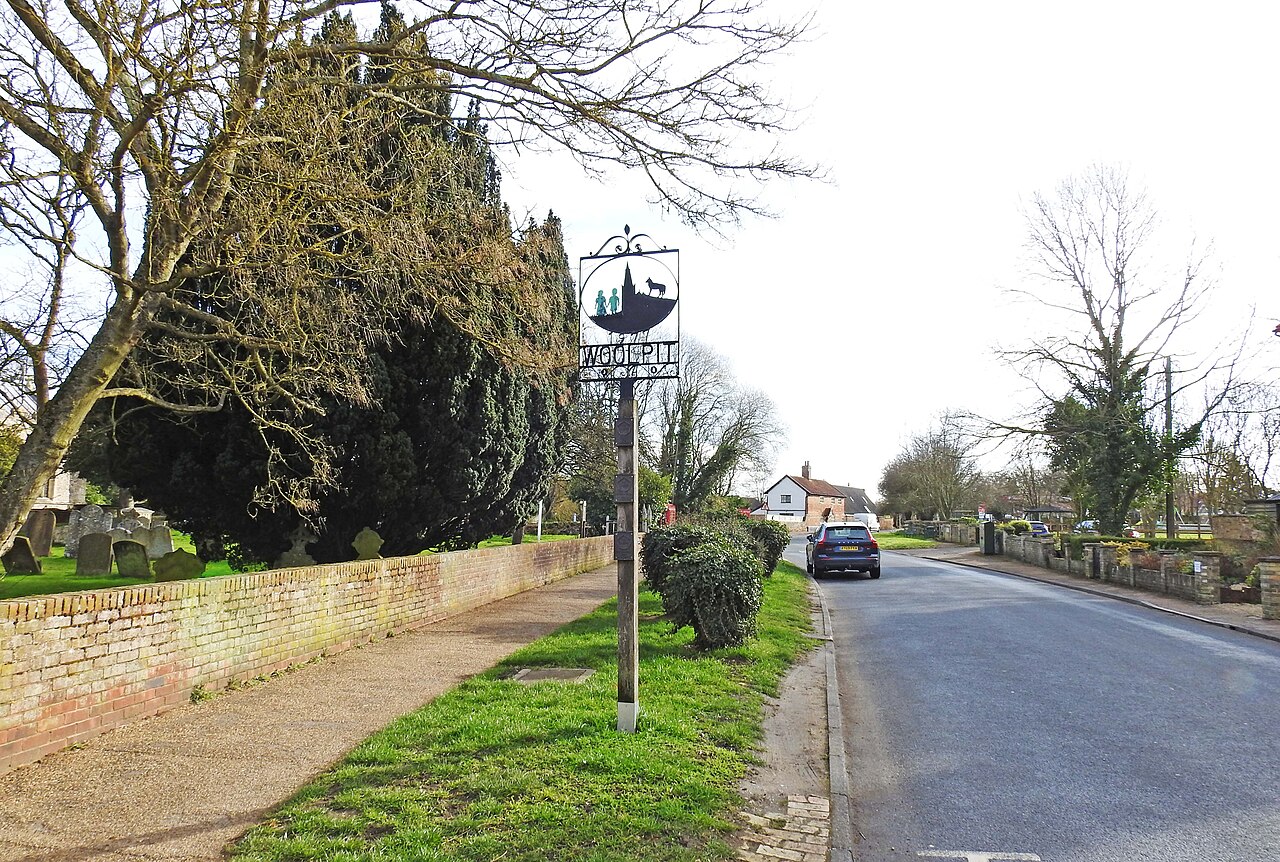
Visitors to Woolpit are greeted by the green children themselves. In the middle of the village stands a wrought-iron sign, put up in 1977 for Queen Elizabeth II’s Silver Jubilee. It sums up the village in three pictures: a wolf, for the origin of the name; St Mary’s church; and the two green children.
St Mary’s, built mostly in the fourteenth and fifteenth centuries, is one of the finest churches in Suffolk, with a grand Gothic porch and a magnificent carved angel roof. Its spire, destroyed by lightning, was rebuilt in the mid-nineteenth century. The story of the green children has also inspired novels, poems and even a children’s opera, starting with the poet Herbert Read’s The Green Child (1935).
Fact or legend?
More than eight centuries later, the wolf pits of Woolpit are gone. St Martin’s Land is on no map, and we do not even know the green girl’s name for certain. What remains are two chronicles written by careful men who, despite their doubts, chose to write it down. Perhaps they were two foreign orphans, starving and terrified, asked once too often where they came from. Perhaps a fairy legend that attached itself to a place. Perhaps something we still cannot explain. Every time I reread this story, I think of that girl who learned to eat bread and speak English, and who perhaps, on summer evenings, watched the twilight and remembered a land where the sun never rose.
Fact or legend? The Green Children remain one of the great unsolved mysteries. Were they victims of a strange illness, travelers from another dimension, or simply the seed of a fascinating myth? Their story, halfway between historical chronicle and folklore, still captures our imagination centuries later.
If you like stories of people who appeared out of nowhere, read about the mystery of Kaspar Hauser and the mysterious man from Taured, who came from a country that does not exist.
🦋 Emadion lives through its readers. If this story kept you up at night, buy me a coffee: it helps me bring you the next nightmare.
☕ Support Emadion on Ko-fiSources
- William of Newburgh, Historia rerum Anglicarum I, 27 “De viridibus pueris” (English translation) – In the Middle
- Ralph of Coggeshall and William of Newburgh, The Green Children (Keightley’s translation) – Sacred Texts
- Garth Haslam, The Green Children of Woolpit (with Ralph’s Latin text and Macklin’s text) – Anomalies (EN/LA)
- James Plumtree, Placing the Green Children of Woolpit – Brill, 2022 (EN/LA)
- Michał Madej, The Story about the Green Children of Woolpit – Res Historica 49, 2020
- Adriana Guillén Ortiz, review of John Clark, The Green Children of Woolpit (2024) – Boletín de Literatura Oral, 2025 (Spanish)
- Green children of Woolpit – Wikipedia
- Bambini verdi di Woolpit – Wikipedia (Italian)
- Duncan Lunan, The Green Children of Woolpit, part 1 – The Orkney News, 2022
- Richard Barre – Wikipedia
- Brian Haughton, Mystery of the Green Children of Woolpit
- Brian Dunning, The Green Children of Woolpit – Skeptoid
- Jason Colavito, The Green Children of Banjos: another case of false evidence – 2012
- Le mystère de deux enfants verts – Futura Sciences, 2026 (French)
- Woolpit – Suffolk Village Signs
- Saint Mary’s Church, Woolpit – Wikipedia


