 Posted by
On Christmas night 1945 a fire destroyed the home of the Sodders, a family of Sardinian origin, in Fayetteville, West Virginia. The parents and four children escaped, but the bodies of the other five children were never found. For the rest of their lives the Sodders believed they had been kidnapped and were still alive. The case has never been solved.
Fayetteville, West Virginia, the night of 24-25 December 1945. This story is not as “American” as it seems: it is Italian at heart, and it stays that way in how the family lives with its loss, with a stubbornness that never fades.
George Sodder was born in Italy as Giorgio Soddu, in Tula, Sardinia, and emigrated to the United States as a boy. Jennie, née Cipriani, had also come from Italy as a child. They married, built a huge family and a stable life in an area where many Italian immigrants lived.
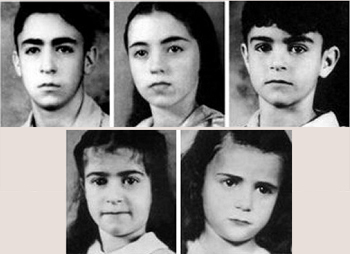
Christmas Eve at the Sodder house was noisy and full of children, but shortly after one in the morning a fire broke out. George and Jennie got out with four of their children, but five children were never seen again: Maurice, Martha, Louis, Jennie Irene and Betty. The state issued death certificates a few days later, but the family always disputed that there was enough evidence.
The fire and the sequence that does not add up
If it had been “just” a fire, the case would have ended in 1945. Instead, in the very first hours anomalies emerged which, placed side by side, raised the suspicion that someone might have been involved that night.
In the best-known accounts, George tried to reach the upstairs windows but could not find the ladder where it was usually kept; he then tried to use his work trucks to get close to the upper windows, but says they would not start, although they had worked the day before. Calling for help was complicated, and many versions of the case also mention cut telephone lines. The fire brigade arrived late, in a setting where the service was voluntary and the chain of calls could slow everything down.
The result is that while the fire took the house, time took away the chance to save those still inside. The fire department concluded the fire was electrical, but George disputed it: he had recently had the house rewired and inspected.
“They died in there”, but no remains are found
After the fire no remains emerged that the Sodders considered consistent with five bodies consumed in that way. The official explanations pointed to the heat and the collapse of the structure, which supposedly erased every trace, but the family kept saying this was impossible, that at least something should have been found. This is the point that turned a bereavement into a case.
The 1949 excavation
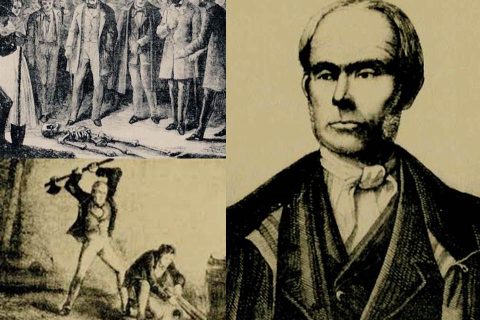
In August 1949 George persuaded a Washington pathologist, Oscar Hunter, to supervise a new dig through the debris. A dictionary belonging to the children, some coins and a few small fragments of human bone were found: lumbar vertebrae, all from the same person.
The bones were sent to Marshall T. Newman, a specialist at the Smithsonian Institution, who determined they belonged to someone aged between 16 and 22, so older than Maurice, the eldest missing child, who was 14. The bones also showed no sign of exposure to fire. Newman found it “very strange” that they were the only bones found, since such a short fire should have left the complete skeletons of the five children, and concluded they probably came from the soil George had used to level the site.
In those same years George even wrote to the FBI. Director J. Edgar Hoover himself replied that the case was a local matter and that the FBI would only step in if local authorities asked, which they never did.
The Italian context and the threats before that night
This is where the Italian origin comes in, not as “folklore” but as social context. George was known for his opposition to Benito Mussolini, and in a community with many Italian immigrants and differing views, this caused friction. Some accounts also mention threats received before the fire. It is not proof, but it is one of the elements that led the Sodders to believe from the start that it was arson.
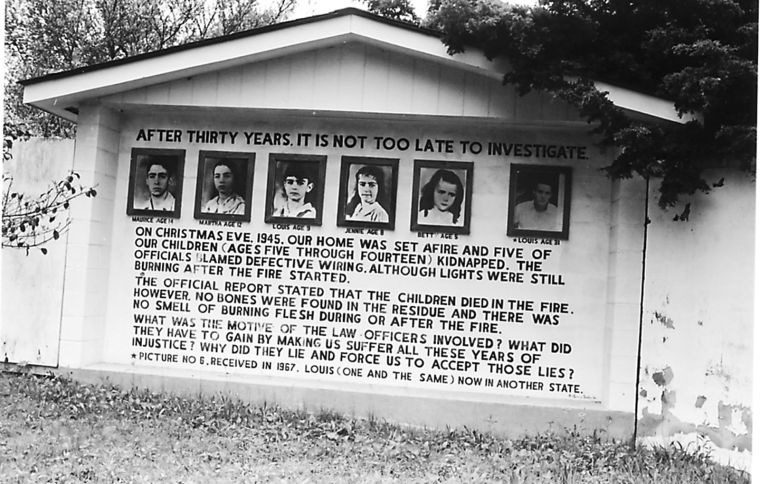
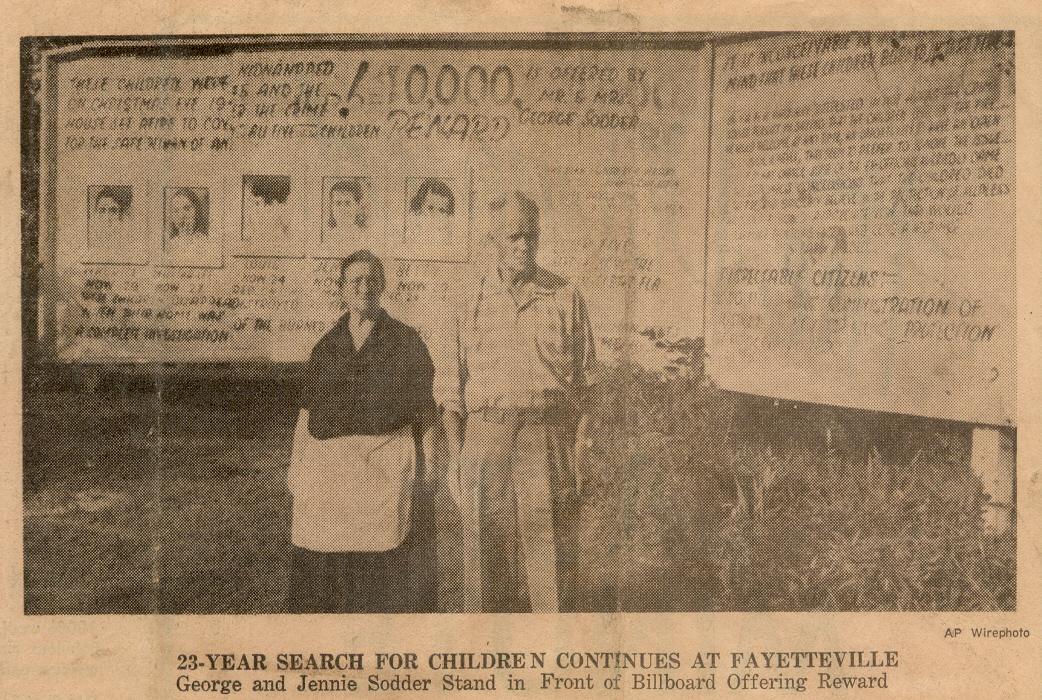
The Sodders turned the search into a constant presence. Its symbol was the billboard with photos of the five children and a reward: not a publicity stunt, but a deliberate choice. It meant “for us this case is not closed”.
The billboard, put up in the 1950s along Route 16 on the land where the house had stood, which the Sodders never rebuilt and turned into a memorial garden for their children, stayed there until shortly after Jennie’s death in 1989. For all those years it reminded people that, for them, the fire had never had an ending.
The 1967 photo that reopened everything
In 1967 an anonymous envelope arrived from Kentucky with a photo of a man and a message on the back mentioning Louis. Jennie and George believed it might be their missing son. The photo is real, documented and kept in public archives too; what never came, however, was definitive confirmation of the man’s identity. It is one of those “proofs” that are enough to rekindle hope and keep suspicion alive.
The theories
There is no certain solution. The most likely theory is that the children died in the fire and that the search for remains was insufficient or hampered by the chaos and the delay of the rescuers. This explanation fits a context of limited resources, but it does not erase the sense of doubt that fuelled everything else.
The alternative theory is kidnapping, with the fire used as cover. It is the theory that best explains a series of anomalies, but it requires a very high level of planning and silence and, above all, it has never found definitive material support.
Then there is the revenge theory, linked to personal or political grudges, supported by the accounts of threats and the climate of the time. As a motive for arson it may seem plausible, but on its own it does not explain the total disappearance of five children without any certain trace.
What remains of the Sodder case today?
What remains is a fire in 1945 and five children never seen again. A family that did not accept a verdict without evidence. Anomalies and testimonies that, decades later, can no longer be verified, and the doubt about what really happened to those children.
The last surviving daughter, Sylvia Sodder Paxton, who was the youngest and was in the house that night, kept talking about the case until her death in 2021, and the Sodders’ grandchildren still keep its memory alive today.
🦋 Emadion lives through its readers. If this story kept you up at night, buy me a coffee: it helps me bring you the next nightmare.
☕ Support Emadion on Ko-fi