 Posted by
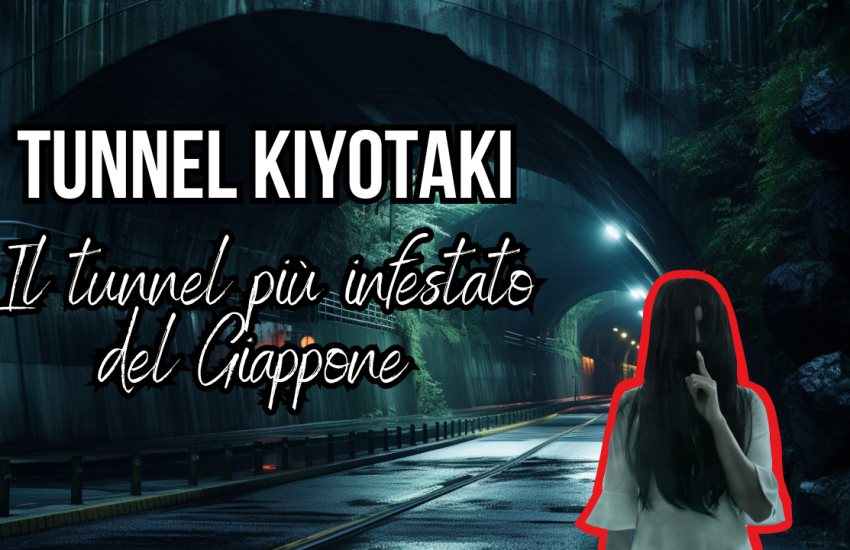
Kiyotaki Tunnel, on the outskirts of Arashiyama in Kyoto, was built between 1927 and 1929 for the Atagoyama Railway and is now a narrow single-lane road tunnel with alternating traffic. Considered one of the most haunted places in Japan, it is tied to the legend of its 444 metres, to alleged apparitions in mirrors and to a traffic light that seems to go haywire.
Hidden among the quiet hills of the Kansai region, in Japan, Kiyotaki Tunnel is a place that draws attention not just for its practical function but for the many legends, superstitions and mysterious stories surrounding it. This seemingly insignificant tunnel has become famous over the years as one of the most disturbing and fascinating places in the country. But what lies behind the dark charm of Kiyotaki Tunnel?
A long history, origins and tragedies of Kiyotaki Tunnel
Kiyotaki Tunnel is on the outskirts of Arashiyama, in Kyoto’s Ukyō ward, north-west of the city. It was dug from 1927 for the Atagoyama Railway, the line that carried pilgrims from Arashiyama to Kiyotaki, at the foot of Mount Atago, home to the Atago-jinja shrine. Trains ran through the tunnel from 12 April 1929 until 1944, when the line was closed. Today the railway is gone and the tunnel is part of a prefectural road, so narrow that cars can only pass in one direction at a time, controlled by a traffic light.
Although its physical structure may look ordinary, its history is steeped in tragedy and superstition that have shaped its reputation. According to the stories, in the Nanboku-chō period (1336-1392) the hill above the tunnel became a place of execution for prisoners of war. Over time the hill became a burial ground for victims with no name or family, creating an air of mystery from the very beginning. It is also said that during construction, in very harsh working conditions, the tunnel suffered several fatal accidents due to sudden roof collapses, costing the lives of several workers. These tragic events provided fertile ground for the first stories of supernatural phenomena inside the tunnel.
The power of the number 4
The superstition surrounding the number 4 is common in many parts of Asia, including Japan. The number 4 is considered unlucky because its pronunciation “shi / 死” sounds like the Japanese word for “death”, and in the case of Kiyotaki Tunnel this superstition shows up in the length of the tunnel, which legend says is exactly 444 metres. In reality estimates put it at around 500 metres, but it hardly matters: for many that figure carries death with it, and the fear associated with the number 4 has remained rooted in the collective consciousness. It is also said that seeing a spirit reflected in the road mirrors at the tunnel entrances brings bad luck.
One of the best-known phenomena linked to Kiyotaki Tunnel is the presence of ghosts. People who have driven through report seeing faint figures, men and women of all ages, appearing suddenly while driving or in their rear-view mirrors. Those who have ventured inside on foot claim to hear faint voices, moaning and crying that seem to come straight from the walls. This fuels theories that the souls of the dead still wander the dark tunnel, unable to find peace.
An even stranger phenomenon seems to involve motorcyclists. Many say they experience an odd effect at the tunnel entrance: ethereal figures passing through the walls a few metres away. Time also seems to warp, with some riders saying it takes them several minutes to get through the tunnel when it should only take a few seconds.
The nameless body
The tunnel’s sinister reputation is also linked to deaths in the area, from road accidents to suicides. Among the stories going around is that of a young woman’s nameless body found near the entrance in 1998, but I have not found official sources confirming it. Stories like this have further fuelled the legends of the “cursed tunnel”, adding to the climate of fear and superstition surrounding it.
The riddle of the traffic light and the spirits’ trick
One of the most intriguing curiosities about Kiyotaki Tunnel concerns the traffic light at the entrance. It is there to manage the alternating one-way traffic inside, but it is said to change colour unpredictably, from green to red and back to green. Some believe this is a trick played by the spirits, an attempt to lure drivers into the tunnel while the light is green, only to suddenly turn it red and put them in danger.
Beyond the legends and superstitions, Kiyotaki Tunnel is an interesting example of how the human mind tends to look for meaning and explanations in dark, inexplicable places. What might seem a simple physical structure becomes a stage for supernatural stories, reflecting our desire to make sense of the world around us.
Kiyotaki Tunnel is much more than a road tunnel. It is a place full of history, legends and superstitions that have given it an aura of mystery. Whether the events are real or the product of human imagination, the tunnel remains fascinating for those willing to step into the intricate world between the real and the imaginary, where past and present intertwine, the mystery seems to linger and the truth remains in the shadows. And you, would you drive through the most haunted tunnel in Japan?
🦋 Emadion lives through its readers. If this story kept you up at night, buy me a coffee: it helps me bring you the next nightmare.
☕ Support Emadion on Ko-fiSources
- Atagoyama Railway, Japanese Wiki Corpus
- The Ghost In My Machine, the many spirits of Kiyotaki Tunnel
- Tokyo Weekender, Kyoto’s eeriest spots